Searching Case Laws & Precedent on Legal Query.....!
Analysing the retrieved Case Laws
Scanned Judgements…!



Searching Case Laws & Precedent on Legal Query.....!
Analysing the retrieved Case Laws
Scanned Judgements…!
The jurisdiction is meant for administrative and judicial supervision, not for substituting the High Court's own judgment on factual or legal issues within the subordinate court's jurisdiction ["2025 Supreme(Online)(Gau) 8265"], ["1952 0 Supreme(Mad) 244"].
Analysis and Conclusion:
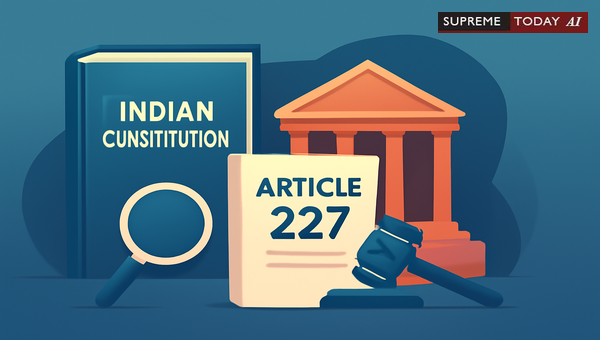
In the intricate web of India's judicial system, play a pivotal role in maintaining the . But what exactly is the scope of Article 227 by the High Court? This question often arises when parties seek intervention against decisions of or . grants the power of , but this is not a blank cheque for . Instead, it is a targeted supervisory mechanism designed to ensure and stay within their bounds. This blog post breaks down the nuances, drawing from precedents and related cases, to clarify when and how can exercise this power.
Note: This article provides general information based on judicial interpretations and is not a substitute for professional legal advice. Consult a qualified lawyer for specific cases.
Article 227 vests with over all courts and within their . As established in key judgments, this is fundamentally a , not an appellate one. The has consistently held that Article 227 confers a supervisory, not appellate, jurisdiction on the High Court 2001 8 Supreme 262 2010 2 Supreme 457 2003 3 Supreme 189.
The primary aim is to keep and within their lawful authority and ensure adherence to proper procedures. It prevents excesses like or but does not allow routine correction of errors. The power must be exercised sparingly, only in cases of grave dereliction of duty, , or or justice 2001 8 Supreme 262 2010 2 Supreme 457 2003 3 Supreme 189.
A cornerstone principle is that cannot act as courts of appeal under Article 227. They may not reappreciate evidence, reweigh facts, or substitute their own findings for those of lower forums unless the errors are . The High Court cannot correct errors of fact or law that are not patent or apparent on the face of the record; it cannot act as a court of appeal 2001 8 Supreme 262 2010 2 Supreme 457 2003 3 Supreme 189.
Reappreciation is impermissible except where findings are so perverse that no reasonable person could have arrived at them 2001 8 Supreme 262 2010 2 Supreme 457. This restraint preserves the hierarchy of courts and avoids overburdening with factual disputes.
Interference is justified only in exceptional scenarios, such as:- or illegal assumption of power.- or serious injustice apparent on the record.- Widespread .- or grave dereliction of duty 2001 8 Supreme 262 2010 2 Supreme 457 2003 3 Supreme 189.
The exercise is discretionary and must be cautious, focusing on preventing rather than nitpicking errors. As noted in precedents, the Court must exercise this jurisdiction with caution, and only in cases of serious misconduct, gross abuse, or fundamental injustice 2001 8 Supreme 262 2010 2 Supreme 457 2003 3 Supreme 189.
Judicial applications reinforce these limits. In a case under the , the High Court clarified: The High Court's power to interfere with a Tribunal order under Art. 227 of the Constitution cannot be converted into an appellate power, and an by way of appeal under a relevant section is wider 1996 0 Supreme(Cal) 52. Here, petitioners bypassed the statutory appeal under for Article 227, but the court dismissed it, emphasizing alternative remedies.
Similarly, in a dispute under , the court stressed: The scope of interference by the High Court under Article 227 is restricted... Judged by these pronounced principles, the High Court... 2022 0 Supreme(Del) 2059. The petition was dismissed, protecting factual findings.
In eviction matters, interference was denied for : The court's jurisdiction under Art.227... is limited to excess or want of jurisdiction in the tribunal and violation of procedure or principles of natural justice 1994 0 Supreme(Ker) 399. Subsequent events could not justify quashing orders.
Another ruling affirmed: This Court has repeatedly held that 'the power of conferred by Article 227 is to be exercised most sparingly and only in appropriate cases in order to keep the within the bounds of their authority' 2021 0 Supreme(All) 1270. Even amid CrPC restrictions, Article 227 applies narrowly.
In revenue disputes under land laws, the High Court quashed orders exceeding jurisdiction: Authorities under the do not have the jurisdiction to decide questions of title to property or to evict persons in occupation of the land 2020 0 Supreme(Telangana) 756. Violation of interim orders led to contempt penalties, underscoring supervisory enforcement.
These examples illustrate Article 227's role in correcting jurisdictional excesses without delving into merits.
While broad, exceptions are narrow:- Patent errors on the record.- No interference with factual findings unless perverse 2001 8 Supreme 262.- Preference for statutory appeals where available, as Article 227 is not a substitute 1996 0 Supreme(Cal) 52.- Sparing use to avoid appellate conversion 2022 0 Supreme(Del) 2059.
must frame issues or protect interests without premature returns if facts are disputed 2022 0 Supreme(Del) 2059.
The scope of Article 227 empowers with vital oversight but demands restraint. It ensures function lawfully without transforming into an appeal forum. rulings like those in 2001 8 Supreme 262, 2010 2 Supreme 457, and 2003 3 Supreme 189 provide clear guardrails: supervisory, sparing, and exceptional.
Key Takeaways:- Supervisory, not appellate jurisdiction.- No unless perverse.- Interfere only for grave injustice or abuse.- Exercise sparingly to uphold judicial hierarchy.
Understanding these boundaries helps litigants navigate effectively and respects constitutional design. For tailored guidance, seek expert counsel.
References:1. 2001 8 Supreme 262: Sethi, J., on limited scope and restraint.2. 2010 2 Supreme 457: Supervisory principles, non-appellate nature.3. 2003 3 Supreme 189: Recent cautions against overreach.
(Word count: approx. 1050)
#Article227, #HighCourtJurisdiction, #ConstitutionalLaw


Mustaqim reported in AIR 1984 SC 38 while speaking about scope and extent of Art. 227 the Supreme Court observed thus : ... "A mere wrong decision without anything more is not enough to attract the jurisdiction of the High Court under Art. 227. ... Then it has been observed in this decision while speaking about the scope of Art.227 that mere wrong decision is not a ground for exercise of jurisdict....

Explaining the scope of jurisdiction under Art.227, this Court in Estralla Rubber v. Dass Estate (P) Ltd. has observed: "6. The scope and ambit of exercise of power and jurisdiction by a High Court under Art.227 of the Constitution of India .

In exercising the supervisory power under Art.227 of the Constitution, the High Court does not act as an appellate court or the tribunal. ... It is pertinent to note that under Art.227, the High Court does not interfere for correcting mere error of facts or, with a finding of the subordinate court which is within the jurisdiction of such court. ... Therefore, the High C....

On an analysis of the aforesaid decisions of this Court, the following principles on the exercise of High Court's jurisdiction under Art.227 of the Constitution may be formulated: (a) A petition under Art.226 of the Constitution is different from a petition under Art.227. ... The mode of exercise of power by the High Court under these two articles is also different. (b) In any event, a petition under Art.#HL_STAR....

The scope of power under Article 227 of the Constitution is no longer res integra. ... Otherwise, there is a danger that someone may challenge in a revision under Art.227, even a decree passed in a suit, on the same grounds on which the respondents 1 and 2 invoked the jurisdiction of the High court. ... that though petitions can be filed under Art.227 against judgments allowing or dismissing first appeals under S.37 of the Act, yet the High....

No doubt, Section 18 of the Act provides the power of the High Court or for that the Apex Court regarding exercise of jurisdiction under Art. 227 of the Constitution of India. ... Section 20 of the Act contemplates an appeal and the scope of the appeal is much more wider than the scope under Art. 227 of the Constitution of India. ... The scope of Section 20 of the Act, that is, the appeal is much more wider than th....

High Court under Art.227 is part of the basic structure of the Constitution. ... The last question to be considered is the scope of restriction contained under Art.227 ... (4) of the Constitution. For easy reference Art.227 is extracted hereunder: ... “227. ... Considering the scope of powers of the High Court explained by the Supreme Court i....

The scope and ambit of exercise of power and jurisdiction by a High Court under Article 227 of the Constitution of India is examined and explained in a number of decisions of this Court. ... We are in agreement with the High Court's enunciation of the principles of law on scope of interference by the supervisory Court on decisions of the fact-finding forum. ... Judged by these pronounced principles, the High Court ....

" But the scope of interference by the High Court under Art.227 is restricted. ... Lal Narain Sinha submitted that the order of the High Court could be sustained as the power of the High Court under Art. 227 cannot be questioned. ... and that the High Court cannot in exercise of its jurisdiction under Art. 227 convert itself i....
Judicial decisions have postulated several principles regarding the scope of the power of the High Court under Art.227 of the Constitution. The learned author V.N. ... Art.227 of the Constitution is substituted as follows: Power of superintendence over all courts by the High Court. A reading of the Article clearly indicates that the powers of the High Court under Art.22....

This Court has repeatedly held that “the power of superintendence conferred by Article 227 is to be exercised most sparingly and only in appropriate cases in order to keep the subordinate courts within the bounds of their authority and not for correcting mere errors vide 1954 S.C.R. 565 (Waryam Singh v. Amar Nath). But the scope of interference by the High Court under Art. 227 is restricted. Therefore, the powers of the High Court under Art. 227 of the Constitution can be invoked in spite of the restrictions placed under Section 146(1D) of the Criminal Procedure Code.

Scope of power of the High Court under Art. 227 of the Constitution of India
Art.227(1) dealing with the power of superintendence over all the courts by the High Court, reads thus: 5. The next question that consequentially arises before this Court is to find out what exactly is the nature of the power under Art.227 of the Constitution of India. "Every High Court shall have superintendence over all courts and tribunals throughout the territories in relation to which it exercises jurisdiction". The material part of Art.227 is substantially the same as that of the provision contained in S.107 of the Government of India Act, 1915 except that the power o....

In a later decision, 1958 SCR 1240: (AIR 1958 SC 398) (Nagendra Nath Bora vs. Commr. of Hills division), the view was reiterated and it was held that the powers of judicial interference under Art. 227 of the Constitution are not greater than the power under Art. 226 of the Constitution, and that under Art. 227 of the Constitution, the power of interference is limited to seeing that the tribunal functions within the limits of its authority. This Court has repeatedly held that "the power of superintendence conferred by Art. 227 is to be exercised most sparingly and only in appropriate cases in....


An indispensable Tool for Legal Professionals, Endorsed by Various High Court and Judicial Officers
Please visit our Training & Support
Center or Contact Us for assistance

Scan Me!
India’s Legal research and Law Firm App, Download now!


For Daily Legal Updates, Join us on :



 Back to top


