Searching Case Laws & Precedent on Legal Query.....!
Analysing the retrieved Case Laws
Scanned Judgements…!



Searching Case Laws & Precedent on Legal Query.....!
Analysing the retrieved Case Laws
Scanned Judgements…!
Section 311 of the Criminal Procedure Code (Cr.P.C.) - Power of Court to summon, examine, or recall witnesses if their evidence appears to be essential to the just decision of the case ["2024 0 Supreme(Cal) 623"], the Court ‘shall’ summon and examine or recall and re-examine any such person when deemed necessary for justice ["2024 0 Supreme(HP) 4"], broad powers are granted to ensure a fair trial and prevent miscarriage of justice ["2024 0 Supreme(HP) 4"], ["2023 0 Supreme(P&H) 363"].
Main points on application of Section 311 - The courts exercise this power primarily to facilitate a just and fair trial by allowing the examination of witnesses or evidence that are crucial for reaching a correct verdict ["1965 0 Supreme(Gau) 49"], ["2023 0 Supreme(P&H) 363"], ["2023 0 Supreme(HP) 435"]. The courts consider whether the evidence is essential to the just decision of the case before summoning witnesses or examining documents ["2024 0 Supreme(All) 347"].
Court’s discretion and safeguards - The power under Section 311 is broad but conditioned on the evidence’s relevance and necessity for justice, ensuring no prejudice to the accused ["2024 0 Supreme(HP) 4"], ["2023 0 Supreme(P&H) 363"], ["2024 0 Supreme(Gau) 1516"]. The courts also recognize that exercising this power must align with the object of achieving a fair trial ["1965 0 Supreme(Gau) 49"].
Legal precedents and constitutional context - Supreme Court decisions have clarified that the application of Article 311 of the Constitution and Section 311 of Cr.P.C. is to safeguard the rights of the accused, ensuring adequate opportunity for defense and cross-examination, and that failure to do so constitutes a violation ["1961 0 Supreme(Ori) 66"], ["1964 0 Supreme(Raj) 196"], ["1970 0 Supreme(Raj) 141"].
Relevance in specific cases - Courts have upheld the exercise of Section 311 powers in various contexts, including recalling witnesses, filling lacunae in prosecution evidence, or ensuring procedural fairness, provided the evidence is relevant and essential for justice ["2023 0 Supreme(P&H) 1797"], ["2024 0 Supreme(HP) 4"].
Analysis and Conclusion:The case 1960 Cr LJ 311 (also cited as AIR 1960 SC 356) is a landmark decision by the Supreme Court emphasizing that the powers under Section 311 Cr.P.C. are broad and primarily aimed at ensuring a fair and just trial. The Court held that the power to summon or recall witnesses is to be exercised only when their evidence is deemed essential for the just decision of the case, and such exercise must be guided by principles of justice, fairness, and relevance. The case underscores that the procedural safeguards under Article 311 of the Constitution protect an accused’s right to a fair trial, including adequate opportunity for cross-examination and defense, and any violation of these principles constitutes a breach of constitutional rights. The decision aligns with the Court’s consistent jurisprudence that Section 311 is a vital tool to prevent miscarriage of justice by allowing the Court to gather necessary evidence, provided the exercise of such power is justified and relevant.
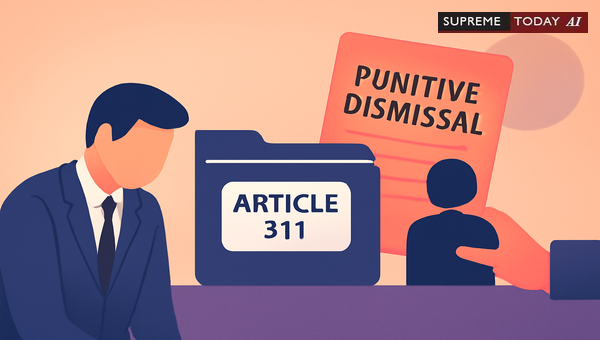
In the realm of Indian service law, certain cases stand as pillars defining the boundaries of constitutional safeguards for government employees. One such query often arises: Get me this case 1960 Cr LJ 311. This reference points to a pivotal judgment reported as Gopi Kishore Prasad v. State (AIR 1960 SC 689), which clarifies the scope of of the . offers protections against arbitrary dismissal or removal from service for civil servants, but not all terminations qualify. This blog delves into the case's holdings, its implications, and related legal principles, drawing from key judicial precedents. Note: This is general information and not specific legal advice; consult a qualified lawyer for your situation.
The case addresses whether an order terminating service constitutes a punishment under (1), which states that no shall be dismissed or removed by an authority subordinate to the appointing authority. The held that (1) applies only when there is an order of dismissal or removal by way of punishment2011 2 Supreme 309.
In Gopi Kishore Prasad, the termination was not framed as punitive but stemmed from contractual or statutory provisions. The Court emphasized that not every termination of service is an order of punishment. For instance, daily wagers or temporary employees under specific rules may not hold a , thus falling outside 's ambit 2016 0 Supreme(MP) 910.
This distinction is crucial: punitive actions for misconduct trigger safeguards like a , while simple terminations—such as expiry of a contract—do not.
The clarified: (1) applies only when there is an order of dismissal or removal by way of punishment.2011 2 Supreme 309. Non-punitive orders, like those under service rules for temporary staff, evade these protections.
A daily wager is not a holder of a and thus not entitled to safeguards, especially under rules like the 2016 0 Supreme(MP) 910. This ruling underscores that employment nature determines constitutional coverage.
Drawing from P. Balakotaiah v. Union of India (AIR 1958 SC 232), the Court noted: (1) does not say that even must be initiated only by the authority empowered to dismiss or remove, unless rules specify otherwise 1961 0 Supreme(Ker) 332. This prevents overly rigid interpretations.
Protections under (2)(b)—allowing dismissal without inquiry in public interest cases—are reserved for exceptional circumstances, like security threats, not routine matters 1996 5 Supreme 29.
The judgment establishes a fundamental distinction between dismissals for misconduct (punitive) and terminations for contractual or statutory reasons. For example:- Punitive: Requires inquiry, hearing, and competent authority.- Non-Punitive: E.g., daily wage expiry or rule-based reversion—no needed.
This principle echoes in later cases. In one instance involving reversion orders, the court upheld from to , stating it did not offend or prior judicial orders 1966 Supreme(Online)(Gau) 13. Such decisions reinforce that contextual facts matter.
Pre-dating Gopi Kishore Prasad, P. Balakotaiah (1958) laid groundwork by limiting to punitive measures 1961 0 Supreme(Ker) 332. Post-1960, courts have consistently applied this:- Terminations under probation or temporary rules typically bypass .- However, if attaches, it may be deemed punitive.
While unrelated to constitutional , discussions on in criminal trials under highlight judicial discretion's role in justice. For instance, courts invoke Section 311 to summon witnesses for a just decision, exercising caution against filling prosecution lacunae 2024 0 Supreme(Jhk) 149. This procedural emphasis parallels service law's focus on fair hearings in punitive cases.
In another context, powers ensure balancing accused and victim rights, as upheld in murder trials where re-examination was permitted 2023 0 Supreme(P&H) 1540. Though criminal, it illustrates broader themes of equity absent in non-punitive service terminations.
Key takeaway: Orders not made as punishment do not require procedural safeguards2011 2 Supreme 309.
The 1960 Cr LJ 311 case (Gopi Kishore Prasad) remains authoritative: shields against punitive dismissals only, promoting efficiency in non-disciplinary separations. Government servants should scrutinize order nature, while authorities must document intent clearly.
Key Takeaways:- (1) limited to punitive orders2011 2 Supreme 309.- No protection for daily wagers or contractual terminations2016 0 Supreme(MP) 910.- Exceptional clauses like 311(2)(b) sparingly used 1996 5 Supreme 29.- Always assess context and rules1961 0 Supreme(Ker) 332.
This precedent shapes service jurisprudence, balancing employee rights with administrative needs. For tailored advice, seek professional legal counsel.
References:1. 2011 2 Supreme 309 - Gopi Kishore Prasad (AIR 1960 SC 689).2. 2016 0 Supreme(MP) 910 - Daily wagers and .3. 1961 0 Supreme(Ker) 332 - P. Balakotaiah v. Union of India.4. 1996 5 Supreme 29 - Distinctions in terminations.5. 1966 Supreme(Online)(Gau) 13 - Reversion and .6. 2024 0 Supreme(Jhk) 149 - analogies.
#Article311, #ServiceLawIndia, #SupremeCourtCase


A conjoint reading of Section 311 of Cr.P.C. and Section 138 of the Indian Evidence Act, it is clear that petition under Section 311 Cr.P.C. cannot be allowed to destroy the defence case.” ii. ... The latter part of Section 311 states that the Court “shall” summon and examine or recall and re-examine any such person “if his evidence appears to the Court to be essential to the just decision of the case”. Section 311 contains a power upon the Court in broad terms. ... The prayer under Se....

When this post of Superintendent of Surveys was filled up on 7-6-57, in that case how two persons could DC allowed to work on this post and to get pay from 7-6-57 to 7-11-60. ... The order of reversion, dated 7-11-1960, with retrospective effect from 7-6-57 in view of the facts of the case is neither illegal nor unjustified and it did not offend, or violate the writ of Judicial Commissioner dated 19-2-1960. ... He further averred that in this case the provisions of Art.311#HL....

Supreme Court decisions, therefore, the Article 311 is not attracted in this case. ... When this post of Superintendent of Surveys was filled up on 7-6-57, in that case how two persons could be allowed to work on this post and to get pay from 7-6-57 -lo 1-11-60. ... The order of reversion, dated 7-11-1960, with retrospective effect from 7-6-57 in view of the facts of the case is neither illegal nor unjustified and it did not offend, or violate the writ of Judicial Commissioner dated 19....

Thus, fair trial must be accorded to every accused in the spirit of the right to life and personal liberty and the accused must get a free and fair, just and reasonable trial on the charge imputed in a criminal case. ... However, in the case in hand, the learned Sessions Judge has given cogent reason of exercising such power under section 311 Cr.P.C and moreover, this is based on the para meters of section 311 Cr.P.C based on certain decision of the Hon’ble Supreme Court. ... such power under section #H....

Article 311 has been construed in innumerable decisions of the supreme Court including the well known case of Khem Chand v. ... This Court accordingly held that the respondent did not get an adequate opportunity to defend himself by effectively cross examining the prosecution witnesses and there was thus contravention of the provisions of Article 311 (2) of the Constitution. ... Ganga singh, AIR 1960 SC 356. ... this court holds, in a particular case, that the public servant did not #H....

Whether the evidence sought to be led in under Section 311 is noted by the court for a just decision of a case? ... On production of this order, the trial court shall get Rs.10,000/-deposited by the revisionists and then fix a date for cross-examination of P.W.1 Balwant Singh. ... The primary factor for deciding the application u/s 311 Cr.P.C. is essentiality of the evidence to arrive at a just decision of the case. ... Now, it is desirable to examine the facts of the case in the light....

In Khatta Singh Versus CBI, Chandigarh and others (Supra), an application under Section 311 Cr.P.C was moved by the witness for recalling him as a witness in the case. ... The latter part of Section 311 states that the Court 'shall' summon and examine or recall and re-examine any such person 'if his evidence appears to the Court to be essential to the just decision of the case. Section 311 contains a power upon the Court in broad terms. ... of any party, should not hesitate to interject and prompt the p....

in support of his case. ... Furthermore, even after his cross-examination, the complainant had sufficient notice of the defence taken by the accused and the documents relied upon by him, thus, he could have taken appropriate steps to get the relevant witnesses examined and documents adduced in his evidence, as the case at that ... as ‘complainant’) since the latter was his counsel in a case. ... on the ground that it will lead to filling up the lacunae of the prosecution’s case. ... It has been argued b....
In the instant case, if the concerned record keepers are examined on oath, then the petitioners will get an opportunity to cross-examine them. ... of the case. ... Counsel for the complainant has contended that in the instant case, FIR was registered on the basis of the documents regarding which, the complainant has filed the present application under Section 311 of Cr.P.C. ... Even in Swapan Kumar Chatterjee’s case (supra) which has been relied upon by the counsel for the petitioners,....

Whether the evidence sought to be led in under Section 311 is noted by the Court for a just decision of a case? ... It is, therefore, imperative that the invocation of Section 311 of the Code, and its application in a particular case, can be ordered by the Court, only, by bearing in mind the object and purport of the said provision, namely, for achieving a just decision of the case. ... the case. ... The Hon’ble Supreme Court in the case of Varsha Garg (supra), after ....

Similarly, culpable negligence is acting without the consciousness that dangerous consequences will follow, but in the circumstances which show that the actor has not exercised the caution that was incumbent of him. J.C. May, In re, MLJ: QD (1956-1960) Vol. IV C144: 1960 CrLJ 239 : AIR 1960 Mad 50 : 1960 Mad LJ (Cri) 570.

At this stage there is no question of application of Section 319 Cr.P.C. Similar contention was negatived by this Court in Raghubans Dubey v. State of Bihar (1967)2 SCR 423, AIR 1967 SC 1167. 1967 Cr.LJ 1081) by holding thus (para 9 of AIR Cr. LJ):- "In our opinion once cognizance has been taken by the Magistrate he takes cognizance of an offence and not the offenders.
1977 Cr. LJ 1473 (A. P.), 1989 Cr. LJ 468 (Gujarat), 1991 Cr. LJ 3273 (Orissa), 1981 Cr. LJ 838 (P and H), 1986 Cr. LJ 1429 (Patna) support the views above as held by me. ( 14 ) THE argument of the learned advocate for State is supported by some of the rulings relied upon by him although some others are irrelevant.

31. Mr. Khem Chand has also cited before me the case of Bhagwan Das Keshwani v. State of Rajasthan, 1974 Cr. LJ 751 (SC) Their Lordships of the Supreme Court were considering the scope of Section 10 of the Evidence Act.
5. Mr. Gupta also cited before me the case of Babulal v. State of Rajasthan 1982 Cr. LJ 1001 , in which this court held as under: "One of the objects sought to be achieved by the new Cr.PC 1973 was to avoid delay in investigation and trial while ensuring a fair trial to the accused on the principles of natural justice. It was a notorious fact that under-trials remained behind the bars for long periods even without a charge-sheet being filed against them as many of such accused were unable to furnish bail or were not granted bail.


An indispensable Tool for Legal Professionals, Endorsed by Various High Court and Judicial Officers
Please visit our Training & Support
Center or Contact Us for assistance

Scan Me!
India’s Legal research and Law Firm App, Download now!


For Daily Legal Updates, Join us on :



 Back to top


