


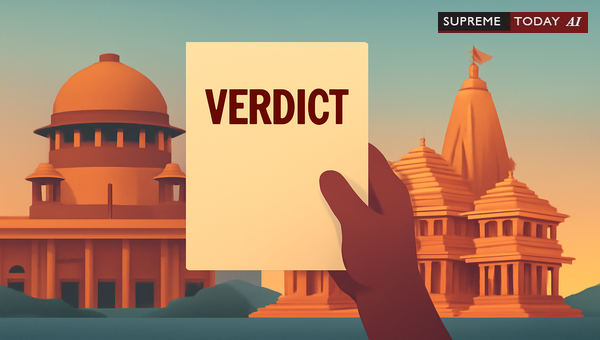
Supreme Court's Landmark Ayodhya Ram Temple Judgment Explained
The 's judgment on the Ayodhya dispute stands as one of the most significant rulings in modern Indian legal history. Delivered on , it resolved a decades-long conflict over a 2.77-acre plot in Ayodhya, Uttar Pradesh, revered by Hindus as the birthplace of Lord Ram and claimed by Muslims as the site of the Babri Masjid. While the query references the Judgement of Upholding Demonetisation Jn 2016, this post focuses on the provided detailed analysis of the Ayodhya case, a pivotal decision that balanced faith, history, and law. Note: This is general information for educational purposes and not specific legal advice; consult a qualified lawyer for personalized guidance.
Historical Background of the Dispute
The Ayodhya dispute traces back centuries, with Hindus believing the site to be Ram Janmabhoomi, where Lord Ram was born, and a mosque, Babri Masjid, built there in the 16th century by Mir Baqi under Babur's orders. Tensions escalated post-independence, marked by the placement of Ram idols inside the mosque, leading to its locking, and the demolition, sparking nationwide riots.
Multiple suits were filed: by , , and others, culminating in the 's trifurcation order, stayed by the Supreme Court in . 2019 0 Supreme(All) 724 The apex court finally adjudicated in , emphasizing secularism, evidence, and justice. 2019 8 Supreme 1
Key Findings of the Supreme Court Judgment
The unanimous 1045-page verdict by a five-judge bench led by CJI Ranjan Gogoi made several groundbreaking holdings:
Title to the Disputed Land: Awarded to Hindu parties, recognizing the site's status as Lord Ram's birthplace based on historical evidence of Hindu worship predating the mosque. The Supreme Court awarded the disputed land to the Hindu parties, recognizing their claim to the site as the birthplace of Lord Ram. The Court ruled that the evidence presented supported the belief that the site was a place of worship for Hindus prior to the construction of the Babri Masjid. 1993 0 Supreme(Pat) 1
: Not applicable here, as it preserves religious character post-1947 but doesn't bar title determination. The judgment clarified that the ... was not applicable in this case. The Court noted that the Act does not bar the determination of title to the land. 2023 0 Supreme(All) 1665
Alternate Land for Mosque: Directed 5 acres for nearby, invoking for complete justice, acknowledging and dispossession. 2019 8 Supreme 1
Trust for Temple: Mandated a trust for Ram Temple construction per Hindu practices. The judgment mandated the establishment of a trust to oversee the construction of a Ram Temple at the site... 1974 0 Supreme(Pat) 201
(ASI) evidence was pivotal: There is adequate basis... to lead to conclusions that Babri mosque was not constructed on vacant land; excavation indicates presence of an underlying structure below disputed structure. 2019 8 Supreme 1
Legal Principles Established
The ruling elucidated core concepts:
of Deities: Hindu idols are legal persons capable of holding property. Courts in India have held that Hindu idols are legal persons – To be a legal person is to be recognised by law as a subject which embodies rights, entitlements, liabilities and duties. 2020 0 Supreme(Kar) 169 Legal personality is conferred on pious purpose of individual making endowment. 2019 8 Supreme 1
Evidence and Faith: Court deferred to Hindu belief in the site's sanctity, supported by scriptures, travelogues, and ASI findings. Faith and belief of Hindus regarding location of birthplace of Lord Ram is from scriptures... which faith and beliefs, cannot be held to be groundless. 2019 8 Supreme 1
Possession and Limitation: Hindus proved continuous possession of outer courtyard; Muslim claims failed on . Hindus have established exclusive possession over inner courtyard and that they were visiting it for offering prayers. 2019 8 Supreme 1
and Management: Distinguished from shebaits (managers); not but included in trust. 2019 8 Supreme 1
Insights from Related Legal Precedents and Sources
The judgment drew from broader jurisprudence:
Corporate Legal Personality Analogy: Branches of a company don't gain independent personality, akin to religious sites. 2020 0 Supreme(Kar) 169
Limitation and Fraud: Suits not barred if fraud discovered later, per . 2020 0 Supreme(Del) 967
: Magistrate's possession orders don't adjudicate title. 2019 8 Supreme 1
Post-verdict, courts stressed communal harmony: Religious tolerance has been one of the great traditions of the people of India. 2019 0 Supreme(All) 724 Petitions for namaz were dismissed, urging clean hands in litigation. 2018 0 Supreme(All) 2486
Counterarguments and Criticisms
Critics argue the verdict prioritizes sentiment over strict secularism, potentially opening floodgates for other claims. The judgment has faced criticism for potentially inflaming communal tensions... could set a precedent for similar claims. 1990 0 Supreme(MP) 17 on other sites non-binding: Any observations... were not binding as they were not part of the issues framed. 2023 0 Supreme(All) 1665
Questions persist on historical claims vs. legal standards. 1956 0 Supreme(SC) 71
Implementation and Ongoing Developments
A trust was formed, temple construction underway (as of 2024), with inauguration in January 2024. Central government allotted alternate land. Monitoring ensures compliance. 2019 8 Supreme 1
Conclusion and Key Takeaways
The Ayodhya judgment exemplifies balancing faith with law, using evidence like ASI reports and juristic principles to deliver justice. It reinforces secularism via , promoting harmony.
Key Takeaways:- Title favors possessory faith-based claims with evidence. 1993 0 Supreme(Pat) 1- Deities as juristic persons protect religious endowments. 2020 0 Supreme(Kar) 169- Act not a bar to title suits in exceptional cases. 2023 0 Supreme(All) 1665- Equity demands alternate relief for aggrieved parties. 2019 8 Supreme 1
Recommendations:- Monitor trust implementation closely.- Foster community dialogue for peace.- Document claims proactively for future disputes.
This ruling shapes India's approach to religious disputes, prioritizing evidence and equity. For case-specific advice, seek professional counsel.
References: 1993 0 Supreme(Pat) 1 2023 0 Supreme(All) 1665 1995 0 Supreme(MP) 710 1996 0 Supreme(Mad) 1273 1956 0 Supreme(SC) 71 1990 0 Supreme(MP) 17 2020 0 Supreme(Kar) 169 2019 8 Supreme 1 2019 0 Supreme(All) 724 2020 0 Supreme(Del) 967
#AyodhyaVerdict #RamMandir #SupremeCourt












