


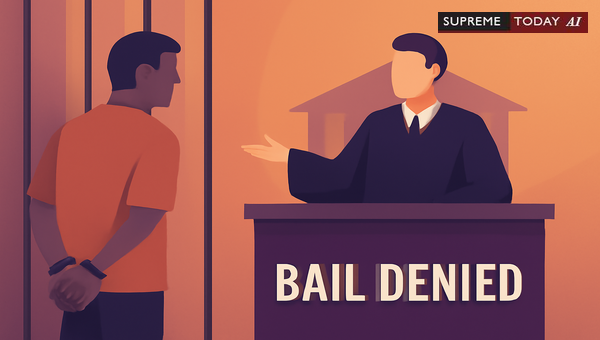
: Understanding Denial in Serious Murder Cases
In the realm of Indian criminal law, few issues garner as much attention as the granting or denial of in like murder. The case of exemplifies how courts balance individual rights with public safety, particularly when accused individuals are labeled as '.' This blog delves into the nuances of this landmark matter, drawing from judicial documents and related precedents to provide clarity on considerations in cases involving (murder) and .
If you've ever wondered about the factors influencing in high-stakes murder trials—such as prior violent conduct, witness threats, and societal risks—this analysis is for you. We'll break down the core findings, legal principles, and broader implications.
The Core Issue:
The question at the heart of revolves around applications for accused persons implicated in multiple murders and conspiracies. Specifically, it addresses whether individuals convicted or charged under —murder with common intention—should be released on given their history of violence 2024 4 Supreme 43.
Courts in such cases scrutinize not just the charges but the accused's character, potential for further crimes, and threats to the judicial process. Here, the primary legal finding is clear: is typically denied when the offenses are grave, involving organized violence, and the release poses risks to public order 2024 0 Supreme(Gau) 958.
Key Legal Principles on in Serious Crimes
Indian jurisprudence, governed by the , emphasizes that is not an absolute right, especially in like murder. The and have repeatedly cautioned against leniency for '.'
Gravity of Offenses and Accused's History
The accused in , including Chandra Kumar and Rishi Kumar, faced for murder under . Compounding this, a police constable, Ajay Kumar, was killed during the trial, highlighting the accused's dangerous propensity 2024 4 Supreme 43. The complainant expressed fears of further conspiracies upon release, a concern echoed in judicial reasoning.
Courts generally deny when:- There is credible evidence of prior murders or violent acts 2024 4 Supreme 43.- Risk of or evidence manipulation exists 2024 0 Supreme(Gau) 958.- The accused are involved in or 2023 0 Supreme(Gau) 1482.
As noted in related precedents, courts are cautious when the accused have committed , and especially when they have previously been involved in violent acts or conspiracies 2024 0 Supreme(Gau) 958.
Judicial Caution in Matters
In , the emphasis was on maintaining law and order. Release could facilitate , witness influence, or additional crimes. This aligns with broader case law, such as instances where testimony reliability is upheld despite enmity claims, as in , where the Apex Court held that testimony of witnesses cannot be discarded or disbelieved merely on the ground of enmity with accused or relation with deceased 2015 0 Supreme(All) 2546.
Similarly, in another matter involving lantern light during occurrences, courts relied on witness credibility, reinforcing under 2014 0 Supreme(All) 1827. These principles underscore that decisions prioritize evidence strength and public safety.
Detailed Analysis: Factors Leading to Denial
Nature of Crimes and Prior Conduct
The documents reveal a pattern of violence: for murder, , and even the trial-period killing of a constable 2024 4 Supreme 43. Such acts classify the accused as ',' tipping the scales against . The legal approach prioritizes the risk of , threat to witnesses, and potential for further criminal acts 2024 0 Supreme(Gau) 958.
Comparison with Similar Cases
Related judgments provide context. For instance, in a case, Dinesh and Dharmveer were scrutinized for a non-premeditated murder where one held the victim while the other struck
DINESH KUMAR AND ANR vs STATE OF RAJ
. Though not identical, it illustrates how courts assess roles in violent assemblies.In pleas, like , courts take counter-affidavits on record and hear arguments before deciding, often denying relief in serious crimes
DHARMVEER SINGH @ DHARMVEER SINGH PUNDHIR Vs State
. Another appeal, , involved Sessions Trial for murder under IPC sections, upholdingBHAGWAN DAS vs STATE OF U.P
.Even in non-criminal contexts, like electricity theft under the , courts dismissed when procedural lapses didn't vitiate prosecutions, showing consistency in upholding charges against repeat offenders 2013 0 Supreme(All) 2013.
Exceptions and Limitations
may be granted in exceptional cases, but the gravity here—multiple murders, police killing—serves as a significant bar. Courts impose strict conditions if considered, such as passport surrender or police reporting 2023 0 Supreme(Gau) 1482. However, the right to is not absolute and can be restricted in cases where the accused pose a threat to society 2024 0 Supreme(Gau) 958.
Broader Implications for Accused and Prosecution
For prosecutions, substantiating threats and violent history is crucial. Courts balance accused rights with public safety, often denying to prevent chaos. In , this balance favored denial.
Related sources highlight evolving standards:- Prompt FIRs and reliable witnesses strengthen cases 2015 0 Supreme(All) 2546.- Non-examination of some witnesses doesn't undermine reliable testimony 2014 0 Supreme(All) 1827.- Sanction requirements in specialized laws (e.g., ) don't halt investigations 2019 0 Supreme(P&H) 747.
Recommendations and Best Practices
- Prosecution: Bolster cases with evidence of prior conduct and risks 2024 4 Supreme 43.
- Courts: Weigh personal liberty against societal threats meticulously.
- Accused: Demonstrate no flight risk or tampering intent for better chances.
- If is granted, enforce conditions like regular reporting and witness non-contact.
Conclusion and Key Takeaways
reinforces that in murder and cases under IPC is exceptional for . Courts prioritize public safety, witness protection, and crime prevention, denying relief amid credible threats 2023 0 Supreme(Gau) 1482.
Key Takeaways:- History of violence heavily influences outcomes 2024 4 Supreme 43.- risks and witness threats are pivotal 2024 0 Supreme(Gau) 958.- Testimony reliability trumps minor inconsistencies 2015 0 Supreme(All) 2546.
Disclaimer: This post provides general information based on judicial documents and is not legal advice. Consult a qualified lawyer for case-specific guidance. Legal outcomes may vary by facts and jurisdiction.
References:1. 2024 4 Supreme 43: and violent acts.2. 2024 0 Supreme(Gau) 958: principles in serious crimes.3. 2023 0 Supreme(Gau) 1482: Caution for .4. 2015 0 Supreme(All) 2546: Witness testimony standards.5. 2014 0 Supreme(All) 1827: Reliability in low-light occurrences.
#DharmveerCase #BailDenial #CriminalLawIndia












