


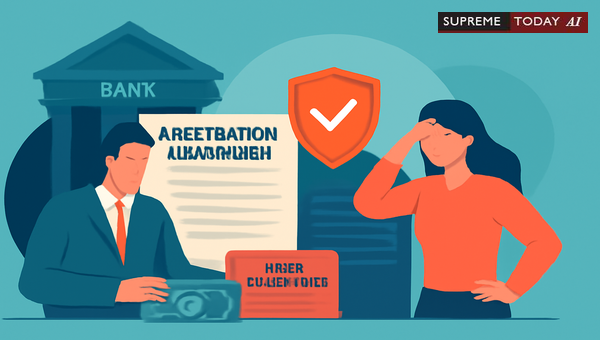
Bank Clause: Can Customers Bypass Civil Courts?
In the world of banking, disputes between banks and customers are common—think loan defaults, account issues, or service complaints. But what if your account agreement includes an clause? Can you still head straight to ? The question arises: when a bank is having an agreement with customer and customer approached , does the court entertain the suit?
Generally, no. Courts prioritize agreements as binding contracts, directing parties to resolve disputes through rather than litigation. This principle upholds efficiency and party autonomy. However, exceptions exist, such as when the agreement is invalid due to fraud or coercion. Let's dive into the legal framework, precedents, and practical insights.
The Power of Agreements in Banking
is a preferred () mechanism under the in India. When a bank and customer sign an agreement with an clause, it typically covers disputes related to accounts, loans, or services. Courts have consistently held that such clauses oust jurisdiction for covered matters.
Key Principle: The existence of a valid agreement bars civil courts from entertaining related disputes. As noted, disputes covered by an agreement must be referred to and that the civil courts' jurisdiction is precluded unless the agreement is found to be invalid, non-existent, or inapplicable 2015 0 Supreme(Ker) 980.
This respects the parties' contractual intent, reducing court backlogs and offering quicker resolutions.
Judicial Precedents Enforcing
Indian courts emphasize 's preferential status. In 2015 0 Supreme(Ker) 980, the judgment states: Parties may either appoint a sole arbitrator consensually; failing which, an application u/S. 11 for appointment of arbitrator may be made before , underscoring enforcement of valid clauses.
Similarly, 2023 0 Supreme(SC) 451 clarifies: the presence of an agreement restricts jurisdiction, mandating referral to unless invalid. Courts discourage bypassing , viewing the clause as an enforceable obligation 2023 0 Supreme(Ker) 859.
In banking contexts, this applies to loan agreements and service contracts. For instance, in a Co-operative Bank loan dispute, the court ruled that matters fall under as per the , Section 69(1)(f), directing parties away from other forums like the Ombudsman 2015 0 Supreme(Ker) 1515.
When Can Civil Courts Intervene?
Exceptions are narrow but critical:- Invalid Agreement: If proven fraudulent, coerced, or , courts may proceed. Mere allegations aren't enough; evidence is required 2015 0 Supreme(Ker) 980.- Non-Arbitrable Disputes: Certain matters like statutory rights (e.g., some consumer protections) may remain with courts.- No Agreement: Courts first check validity and intent to arbitrate M/S AIRWORTH TRAVEL & TOURS PVT. LTD. vs INTERNATIONAL AIR TRANSPORT ASSOCIATION-28_2015).
Example: Invocation of is rarely stayed. Courts interfere only on proof of fraud or . In 2023 0 Supreme(HP) 237, A confirmed Bank Guarantee/irrevocable Letter of Credit cannot be interfered with unless there is established fraud or involved. Even with disputes pending , guarantees can be invoked; mere disputes aren't grounds for relief under the Act.
Another case echoes: petitioner failed to prove fraud or irretrievable loss against guarantee invocation, as claims were arbitrable 2023 0 Supreme(HP) 237.
Related Banking Dispute Scenarios
Banking clauses appear in agent agreements, loans, and accounts. In an airline ticketing agency dispute, Clause 14 mandated , but the court dismissed relief due to no case and pending civil suits 2015 0 Supreme(Del) 845. The petitioner couldn't establish .
Consumer forums also defer: A share trading complainant wasn't a 'consumer' under the , as investments were commercial; disputes went to per the broker-client agreement 2015 0 Supreme(UK) 203.
In cheque dishonor cases tied to accounts, penal liability under persists despite account closure motives, but may handle underlying debts
. Courts lean toward statutory objects, not excuses.
For internal bank matters, like employee penalties, service regulations enforce -like proceedings, but customer disputes follow contract clauses 2020 0 Supreme(Cal) 288.
Practical Recommendations for Banks and Customers
To navigate these:- Validate Clauses: Ensure agreements are clear, consensual, and cover foreseeable disputes.- Invoke Promptly: Upon dispute, apply under for arbitrator appointment if needed 2015 0 Supreme(Ker) 980.- Challenge Strategically: Customers alleging invalidity must prove fraud/coercion explicitly before civil courts.- : Beneficiaries can invoke without court stay unless exceptional fraud proven 2007 Supreme(Online)(Del) 1.- Seek Wisely: Interim relief requires strong case; pendency alone insufficient
M/S AIRWORTH TRAVEL & TOURS PVT. LTD. vs INTERNATIONAL AIR TRANSPORT ASSOCIATION
.Parties should consult counsel early— often saves time and costs.
Key Takeaways
- clauses in bank agreements generally preclude civil suits for covered disputes 2023 0 Supreme(SC) 451.
- Courts refer matters to unless invalidity proven 2015 0 Supreme(Ker) 980.
- Exceptions like fraud are rare and evidence-based.
- Banking specifics (guarantees, loans) reinforce non-interference.
Disclaimer: This is general information based on precedents, not specific legal advice. Laws vary by jurisdiction; consult a qualified lawyer for your situation.
In summary, while tempting, approaching civil courts with a valid agreement risks dismissal or stay. Embrace for efficient justice—it's the contractual path courts uphold.
#ArbitrationLaw, #BankingDisputes, #LegalInsights















