SupremeToday Landscape Ad

AI Overview

AI Overview...

Analysis and Conclusion:The consistent legal position across the cited cases underscores that allegations of malafide are not sufficient to challenge transfer orders unless supported by clear evidence of malafide exercise of power or statutory violations. Transfer policies are generally regarded as guidelines, and courts exercise restraint, intervening only when malafide or procedural violations are proven. Therefore, in the absence of such proof, courts uphold the legality of transfer orders, emphasizing their role as part of service conditions and executive discretion.

Can't Challenge Govt Policy Without Proving Mala Fide?

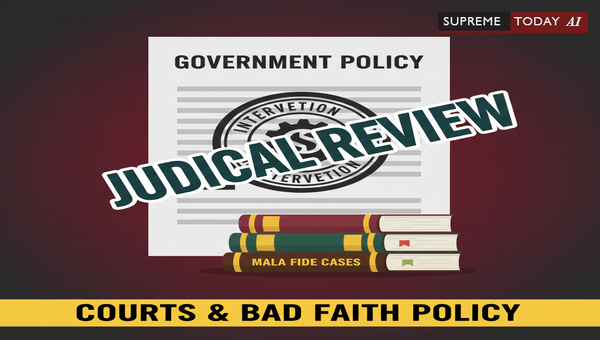
Can't Challenge Government Policy Decisions Without Proving Mala Fide?

In the realm of administrative law, government policy decisions often carry significant weight, shaping public services, transfers, and resource allocation. But can these decisions be freely challenged in court? The short answer is no—not without substantial grounds. A common query arises: Policy Decision of Govt can Not be Challenged Without Malafide. This principle underscores the judiciary's restraint in reviewing executive actions, emphasizing that challenges typically fail unless mala fide (bad faith) is explicitly pleaded and proven.

This blog post explores the legal framework, key principles, case insights, and practical recommendations. Note: This is general information based on precedents and not specific legal advice. Consult a qualified lawyer for your situation.

Legal Principles Governing Challenges to Policy Decisions

Courts in India exercise caution when reviewing government policy decisions, recognizing the separation of powers. Interference is limited to exceptional cases where the decision is:

The Critical Requirement: Pleading Mala Fide

A cornerstone of successful challenges is the explicit pleading of mala fide. Courts have repeatedly held that this ground must be clearly stated and substantiated. Without it, petitions are often dismissed. As noted, the ground of malafide must be explicitly pleaded and argued. If malafide is neither pleaded nor substantiated, the court is unlikely to consider it as a valid ground for challenging a policy decision Rajkumar Verma vs Chief General Manager, State Bank of India - DelhiUnion of India, rep. by its Principal Director (Staff) Office of the Comptroller & Auditor General of India & Others VS Jayashree Govindarajan, & Another - Madras.

The burden of proof rests heavily on the challenger. Vague allegations won't suffice; specific details, facts, and evidence are essential Digendra Sen VS State of U. P. - AllahabadBhagwat Singh Verma VS State of M. P. - Madhya Pradesh. For instance, in transfer-related disputes, mere claims of unfairness fail without proof. In AIR 1993 SC 2444, the court observed that the appellant alleged malafide against the transfer but did not produce any document in that respect that the transfer is actuated with malafide exercise of power Prasanta Kumar Sahoo vs Union of India - 2025 Supreme(Online)(Ori) 3080 - 2025 Supreme(Online)(Ori) 3080.

Judicial Review Limitations in Policy Matters

Courts do not function as appellate bodies over executive policies. They won't substitute their judgment unless fundamental rights or statutes are violated State Of Orissa VS Gopinath Dash - Supreme CourtNational Board of Examinations VS G. Anand Ramamurthy - Supreme Court. This is particularly evident in service matters like transfers, where policies serve as guidelines rather than rigid rules.

Insights from Transfer Order Challenges

Transfer policies are often non-statutory and directory, not mandatory. Violations alone don't invite interference unless mala fide or statutory breaches are proven. For example:

Courts dismiss cases lacking concrete evidence. In present case, allegation for malafide was neither expressly pleaded nor proved. There is no evidence that the petitioner acted malafide Sabarkantha District Cooperative Milk Producers VS Maljibhai Jethabhai Desai Since Decd. Thro'heirs & L/r - 2015 Supreme(Guj) 2206 - 2015 0 Supreme(Guj) 2206. Similarly, policy decisions like cancellations of recommendations are upheld if not arbitrary: Such policy decision is neither malafide nor arbitrarySorokhaibam Uttam Singh, and Anr. VS State of Manipur and Ors. - 2014 Supreme(Manipur) 47 - 2014 0 Supreme(Manipur) 47.

Even during transfer bans, policies are directory. Challengers must show prejudice or mala fide, not just procedural lapses NASEEM UDDIN vs STATE OF MADHYA PRADESH THROUGH PRINCIPAL SECRETARY VALLABH BHAWAN, BHOPAL (M.P) - Madhya Pradesh. Allegations of false implication due to malafide intention require factual adjudication, not pre-trial relief Viresh @ Veere VS State of U. P. - 2014 Supreme(All) 3718 - 2014 0 Supreme(All) 3718Amarjeet Singh VS State of U. P. and Another - 2013 Supreme(All) 2602 - 2013 0 Supreme(All) 2602Grish Chand and 2 Ors. VS State of U. P. and Another - 2013 Supreme(All) 2416 - 2013 0 Supreme(All) 2416.

Case Law Highlights: When Challenges Fail

Transfer orders by competent authorities are presumed valid absent pleaded incompetence or breaches Tushar Ranjan Mohanty vs M/o Statistics - Central Administrative Tribunal (2019)Ramadhar Pandeva vs The State Of Madhya Pradesh - Madhya PradeshKaru@Jitesh vs The State Of Madhya Pradesh - 2024 Supreme(Online)(MP) 2142. No Statutory or Policy Violation - Transfer orders issued by competent authorities are presumed lawful unless challenged with specific evidence of statutory violation or malafide.

Strategic Recommendations for Challengers

To mount an effective challenge:

  1. Explicitly Plead Mala Fide: Structure arguments with specific facts, timelines, and documents proving bad faith.

  2. Substantiate with Evidence: Avoid bald assertions; provide affidavits, records, or witness statements.

  3. Highlight Statutory Violations: Pair mala fide with clear rule breaches for stronger grounds.

  4. Anticipate Defenses: Governments often cite executive discretion; counter with irrefutable proof.

  5. Consider Alternatives: Explore administrative remedies before courts, as writs demand high thresholds.

Failure to plead mala fide strategically weakens petitions, leading to dismissals based on precedents.

Conclusion and Key Takeaways

Government policy decisions enjoy deference, challengeable primarily on grounds of mala fide, arbitrariness, or illegality. Malafide must be explicitly pleaded and substantiated to challenge a policy decision effectively. Courts prioritize evidence over allegations, upholding executive actions unless thresholds are met.

Key Takeaways:

By understanding these principles, petitioners can better navigate challenges. For tailored advice, seek professional legal counsel. This analysis draws from established precedents, reinforcing judicial restraint in policy matters.

#MalaFide #JudicialReview #PolicyChallenge
Chat Download
Chat Print
Chat R ALL
Landmark
Strategy
Argument
Risk
Chat Voice Bottom Icon
Chat Sent Bottom Icon
SupremeToday Portrait Ad
logo-black

An indispensable Tool for Legal Professionals, Endorsed by Various High Court and Judicial Officers

Please visit our Training & Support
Center or Contact Us for assistance

qr

Scan Me!

India’s Legal research and Law Firm App, Download now!

For Daily Legal Updates, Join us on :

whatsapp-icon telegram-icon
whatsapp-icon Back to top