


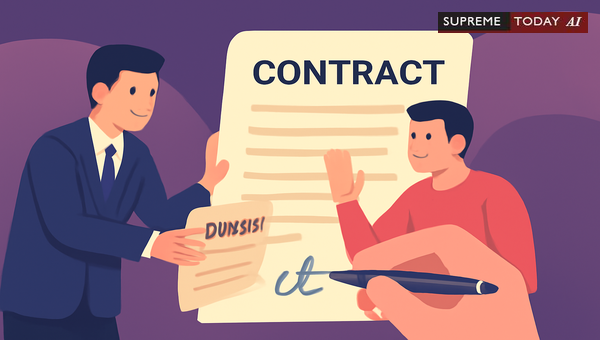
Letters Signed Under : Valid or ?
In the realm of contract law, few issues raise as much contention as documents signed under questionable circumstances. Imagine a scenario where defendants claim that letters—potentially critical to a legal dispute—were obtained through , , or . The question at the heart of this matter is: Letter Obtained by Defendants under and —can such documents hold legal weight, or are they rendered ?
This blog post delves into the legal principles, landmark cases, and evidentiary burdens under the , to provide clarity. While this analysis draws from established precedents, it is for informational purposes only and does not constitute legal advice. Consult a qualified attorney for case-specific guidance.
Understanding , , and
The foundation of valid contracts lies in . Sections 15 and 16 of the , address threats to this principle.
(Section 15)
involves committing or threatening to commit any act forbidden by the , or unlawfully detaining or threatening to detain property, to cause someone to enter an agreement. This , making the contract at the option of the aggrieved party.
(Section 16)
This occurs when one party dominates another's will and uses that position to gain an unfair advantage. Relationships of trust, dependency, or authority often trigger scrutiny, shifting the to the dominant party in certain cases.
Recognized as a subset of , arises when financial pressure compels a party to agree against their will. Courts have held that such pressure can render agreements , particularly when it leaves no reasonable alternative. 2023 0 Supreme(Del) 3866 2013 0 Supreme(MP) 818
These doctrines ensure fairness, but claims are not taken lightly. rarely suffice.
The : A High Bar to Clear
The party alleging , , or bears the . A without evidence fails. As emphasized in , is required; . 2023 0 Supreme(SC) 362 2017 0 Supreme(Del) 4763
Similarly, in , the ruled that do not invalidate contracts.
From additional precedents, courts consistently demand concrete proof. For instance, The Claimant has failed to establish any , , or in the facts of the instant case. 2017 0 Supreme(Del) 4548 This underscores that or letters signed after discussions are presumed voluntary absent evidence.
In cases involving negotiable instruments, even signatures obtained under may not invalidate if is present: Signature of a in a can be obtained even keeping him under exercising and . 2009 0 Supreme(Ker) 554
Landmark Cases Shedding Light
: When is established, the burden shifts to prove no . 2023 0 Supreme(Del) 3866
: Full settlement without timely challenge on grounds stands firm. 2013 0 Supreme(P&H) 991
Other Insights from Precedents: In arbitration matters, execution after long discussions... spanning over months was upheld, as the petitioner failed to prove , , , or . 2017 0 Supreme(Del) 2076 were deemed voluntary and free from . 2025 Supreme(Online)(NCDRC) 2876
These cases highlight a pattern: Courts examine facts meticulously. Unsubstantiated claims crumble, but proven leads to invalidation.
Applying Principles to Letters Obtained Under Pressure
Consider letters dated , allegedly signed by defendants not as free agents. To challenge validity:- Demonstrate Lack of : Evidence of threats, , or financial strangulation is essential.- Example: If payments were withheld to force signatures, this could vitiate consent, akin to cases where parties protested under pressure. 2023 0 Supreme(UK) 334 2023 Supreme(Online)(ALL) 13309 2024 0 Supreme(Ker) 1011
However, if defendants acted after negotiations or without protest, courts may uphold the letters, as in scenarios where such discharge and signing of was voluntary and free from any or . 2025 Supreme(Online)(NCDRC) 2876
Additional sources reinforce: Pleas of require pleadings and evidence; mere relationships (e.g., family ties) do not imply influence without proof. [](https://supremetoday.ai/doc/judgement/02100155461)
Strategies for Challenging Such Documents
- Gather Evidence: Witness statements, communications showing threats, or financial records proving .
- File Motions Early: Challenge admissibility or validity promptly.
- Anticipate Defenses: Opponents will cite the need for proof, as in 2022 0 Supreme(Cal) 1083.
Courts decide on facts: Proven sets aside documents; lack thereof upholds them.
Broader Implications and
and protect vulnerable parties, especially in business or family disputes. addresses modern pressures like payment holds. Yet, the emphasis on evidence prevents frivolous claims.
Sources confirm: Documents under are generally considered invalid or vitiated with proof, but without supporting material are insufficient. This balances justice and stability.
Key Takeaways
- is Paramount: (Sec 15), (Sec 16), and can void letters.
- Evidence Rules: Burden lies with claimants; provide support.
- Case-Specific: Outcomes vary—substantiate claims robustly.
In conclusion, while letters obtained under , , or may be challenged successfully, success hinges on evidence. This analysis, informed by Sections 15-16 and key rulings like New Indian Assurance2023 0 Supreme(SC) 362 and Puri Construction2023 0 Supreme(Del) 3866, equips readers to navigate such disputes. Always seek professional legal counsel.
References:- 2023 0 Supreme(SC) 362 2017 0 Supreme(Del) 4763 2023 0 Supreme(Del) 3866 2013 0 Supreme(MP) 818
2013 0 Supreme(P&H) 991 2017 0 Supreme(Del) 4548 2017 0 Supreme(Del) 2076 2009 0 Supreme(Ker) 554
[](https://supremetoday.ai/doc/judgement/02100155461) 2025 Supreme(Online)(NCDRC) 2876 #ContractLaw #Coercion #UndueInfluence





![Raja Holding (Firm) vs N.Navaneethakrishnan [Died] - 2024 Supreme(Mad) 2338](https://supremetoday-s3.b-cdn.net/Madras_small_1.png)












