


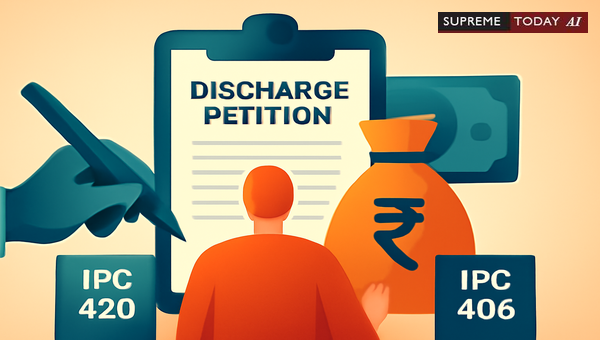
in 420/406 IPC for Loan Defaults: Essential Guide
In today's financial landscape, loan disputes often escalate into criminal complaints under Sections 420 () and 406 () of the . A common scenario arises when lenders allege failure to repay loans, leading to and prosecutions. But is non-payment alone enough to sustain criminal charges? The question at hand: Can a succeed in a case under Sections 420 and 406 IPC where the prosecution's allegation centers on failure to pay a loan amount?
Generally, courts have ruled that such cases are civil in nature unless dishonest intent () is proven from the transaction's inception. This blog explores the legal framework, key precedents, and strategies for discharge petitions, drawing from authoritative judgments. Note: This is general information, not specific legal advice. Consult a qualified lawyer for your case.
Main Legal Finding: vs. Criminal Offence
Criminal proceedings under Sections 420 and 406 IPC cannot be sustained solely on allegations of failure to repay a loan amount, particularly without evidence of fraudulent or dishonest intent from the outset. Non-payment of debt is typically a civil matter, requiring civil remedies like recovery suits rather than criminal prosecution. Discharge petitions are likely to succeed if essential criminal elements—such as —are absent. 2019 3 Supreme 204 2022 4 Supreme 42
Courts emphasize: Non-payment of loan alone does not constitute an offence under Sections 420 or 406 IPC; dishonest or fraudulent intent at the time of transaction is essential.2022 4 Supreme 42
Key Principles Under Sections 420 and 406 IPC
Section 406 IPC:
To establish this offence, the prosecution must prove:- Entrustment of property to the accused.- Dishonest misappropriation or conversion to their own use, violating trust.
Mere failure to repay does not suffice without proof of initial dishonest intent. The essential ingredients include that the accused was entrusted with property or dominion over it, and that they dishonestly misappropriated or converted it to their own use in violation of the trust.2019 3 Supreme 204 2022 4 Supreme 42
Section 420 IPC:
This requires:- .- Delivery of property induced by deception.- present from the inception of the transaction.
For Section 420 IPC, the core requirement is with present from the inception of the transaction, leading the victim to deliver property based on false representations.2019 3 Supreme 204 2022 4 Supreme 42
In loan cases, if the borrower intended to repay at the time of borrowing but later defaulted due to financial issues, no offence is made out. This distinction prevents criminalizing every . 2014 8 Supreme 112
Court's Approach to Discharge Petitions
Under Section 227 or 239 (for discharge) and Section 482 (for quashing), courts examine if allegations, taken at face value, disclose a . If not, proceedings are quashed to avoid harassment.
- Discharge petitions should be allowed if allegations lack dishonest intent.2019 3 Supreme 204 2024 2 Supreme 573
- The test: Do facts constitute a criminal offence? Mere civil breach does not.2019 3 Supreme 204 2024 2 Supreme 573
Civil disputes like breach of contractual obligations should not be criminalized.2019 3 Supreme 204
Judicial Precedents Supporting Discharge
Numerous rulings reinforce this:- In a case involving loan repayment allegations, proceedings under Sections 406/409/420/120B IPC were quashed as petitioners had repaid loan with no established. The court held: A does not constitute unless fraudulent intent is proven at the outset.2024 0 Supreme(Cal) 461- Another judgment clarified: Mere inability of appellant to return loan amount cannot give rise to a criminal prosecution for unless fraudulent or dishonest intention is shown right at beginning of transaction. Petition allowed. 2023 0 Supreme(Cal) 110- Non-payment of dues does not automatically imply or unless accompanied by proof of dishonest intent from the outset.2014 8 Supreme 112- In a friendly loan dispute: No prudent man would accept beyond three years... No evidence to indicate that the petitioners had misappropriated or done away with the money - Complaint, quashed.2009 0 Supreme(Del) 168- Courts quashed cases where loan was repaid or no misappropriation shown, emphasizing civil remedies. 2021 0 Supreme(Cal) 61 2026 Supreme(Online)(Mad) 570
Absence of dishonest or fraudulent inducement from the beginning negates the offence of .2024 6 Supreme 257
Exceptions: When Criminal Charges May Hold
While discharge is common, exceptions exist:- Clear evidence of fraudulent inducement or misappropriation with from inception (e.g., false documents used knowingly to obtain loan).- Specific allegations of manipulative conduct, like conspiracy under 120B IPC with proven deceit. 2004 Supreme(Online)(AP) 18- Courts caution against using criminal law for recovery or harassment: Criminal law is not a substitute for civil remedies.2019 3 Supreme 204 2014 8 Supreme 112
In one instance, quashing was denied where trial was ongoing and Section 420 could stand alone, directing expeditious trial. 2021 0 Supreme(Cal) 61
Practical Recommendations
- File discharge early if no evidence of initial dishonest intent; highlight civil nature.
- Gather proof of repayment intent (e.g., communications, partial payments).
- Pursue civil suits for recovery; avoid parallel criminal misuse.
- Under Section 482 , seek quashing if . Jurisdiction under Section 482 Cr.P.C. allows quashing complaints lacking prima facie case or where prosecution is .2024 0 Supreme(Cal) 461
Focus on : It is this which is crux of offence.2023 0 Supreme(Cal) 110
Conclusion and Key Takeaways
A under Sections 420/406 IPC for mere loan non-payment is likely to succeed absent proof of dishonest intent at inception—a high threshold for prosecution. Courts protect against converting civil debts into criminal matters, promoting justice over harassment.
Key Takeaways:- Non-repayment alone ≠ or breach of trust.- Prove or face quashing/discharge.- Opt for civil remedies first.
Stay informed, but always seek professional legal counsel tailored to your facts. This analysis draws from established precedents to guide understanding.
References:1. 2019 3 Supreme 204: Principles on quashing civil-like disputes.2. 2014 8 Supreme 112: Non-payment sans intent not criminal.3. 2022 4 Supreme 42: Ingredients of 406/420 IPC.4. 2024 0 Supreme(Cal) 461, 2023 0 Supreme(Cal) 110, others as cited.
#IPC420, #DischargePetition, #LoanDefaultIPC















