


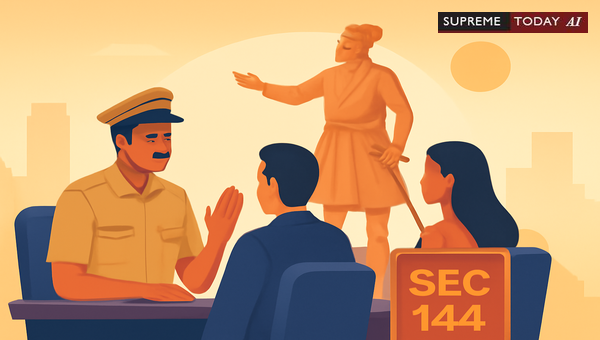
Police Deny Shivaji Statue Inauguration Meetings: Key Legal Citations
In India, public events like the inauguration of a Shivaji statue often symbolize cultural pride and community gathering. However, organizers frequently face hurdles when police deny permissions for such meetings, citing concerns. If you're wondering, suggest citations for police not allowing to conduct meeting for inauguration of Shivaji statue, this post dives into the legal landscape. While no direct precedents exist for Shivaji statue inaugurations specifically, general principles under the and related cases provide valuable insights. We'll explore these, drawing from court judgments and statutory powers, to help you understand your options.
Disclaimer: This article offers general information based on legal materials and is not a substitute for professional legal advice. Consult a qualified lawyer for your specific situation.
The Core Issue: Police Powers to Restrict Assemblies
Police authorities in India have broad powers to regulate public assemblies, meetings, and processions to maintain . The question of police denying permission for a meeting to inaugurate a Shivaji statue typically falls under these powers. However, such denials must be reasonable and backed by imminent threats to public peace.
No documents directly address police preventing Shivaji statue inauguration meetings. References to Shivaji often involve names (e.g., victims like Shivaji Ananda Dalvi 1977 0 Supreme(SC) 290 1985 0 Supreme(Guj) 77), locations (Shivaji Peth 2012 0 Supreme(Bom) 1119), or unrelated permissions like road access to Shivaji Maharaj Statue (paver blocks and e-rickshaws 2025 0 Supreme(SC) 1218). A murder near a Raj Kapoor statue in Shivaji Peth involved police response to a crime, not assembly bans: receiving a telephonic call that murder was committed near statue of Raj Kapoor... P.W.14 reached the spot of incident behind statue of Rajkapoor in Shivaji Peth 2012 0 Supreme(Bom) 1119.
Section 144 CrPC: The Primary Tool for Restrictions
The cornerstone for police restrictions is , allowing magistrates to prohibit assemblies if there's a risk to . Courts have upheld this but stressed proportionality.
- In a general case, police dispersed crowds at Ramlila Maidan using Section 144, tear gas, and lathi charge: Fast unto death by Baba Ramdev... Imposition of an order under – Refusal... Forcible eviction 2012 2 Supreme 36. Courts criticized hasty enforcement: undue haste on the part of Police authorities to enforce the orders under instantaneously had resulted in the unfortunate incident 2012 2 Supreme 36.
- Closer to statue events, a was issued under Section 144 CrPC preventing the activities involving installation, inauguration, construction and garlanding of any statue in public places situated at Niruvi Commune Panchayat 2022 Supreme(Online)(MAD) 13545. This expired after two months, showing such orders are temporary and must be justified.
These cases illustrate that while police can act, orders require written reasons and evidence of urgency—typically not for routine inaugurations.
Permissions for Statues, Processions, and Meetings: Insights from Cases
Several judgments highlight police discretion in granting or refusing permissions for similar events:
Statue-Related Permissions
- Road access to Shivaji Maharaj Statue was disputed over infrastructure: issues: (ii) If the answer to issue (i) is in the affirmative, then which type of paver blocks should be permitted... (iii) As to whether e-rickshaws should be permitted on the said road between Dasturi Naka to Shivaji Maharaj Statue 2025 0 Supreme(SC) 1218. No mention of meetings or bans.
- Broader bans on statues in public spaces: We further direct that henceforth, State Government shall not grant any permission for installation of any statue or construction of any structure in public roads, pavements... 2023 0 Supreme(Ker) 94. This ties into public way restrictions under Kerala laws.
Processions and Assemblies Near Statues
- Police powers under S. 41 of the Act allow regulation of assemblies: The Commissioner of Police has the power to regulate and organize all assemblies, meetings, and processions in public places under S. 41... it is for the Commissioner to consider and grant or refuse permission, taking into consideration the situation 1993 0 Supreme(Mad) 604. Courts won't issue to force refusals, leaving it to executive discretion.
- For a procession garlanding statues (Ambedkar and Periyar), police handled permissions based on 1993 0 Supreme(Mad) 604.
Meeting Permissions and Challenges
- Police cannot arbitrarily refuse representations for peaceful meetings: So long as the petitioner seeks permission for conduct of peaceful meeting... the police may not be justified in refusing to receive the petitioner's representation 2018 0 Supreme(Mad) 594. Courts directed permissions subject to restrictions for birth anniversary celebrations.
- No prior police clearance needed for certain meetings: Organisers of the meeting do not require any police clearance... Once the meeting is permitted... the question of cancelling the permission will not arise except for reasons beyond control 2012 0 Supreme(Mad) 4209.
- In another, authorities were directed to permit a meeting without disturbance, framing guidelines against arbitrary cancellations 2012 0 Supreme(Mad) 4209.
These cases emphasize under and (c) for assemblies, subject to under .
No Shivaji-Specific Precedents: Tangential Mentions
- Crowds near Jotiba temple (not Shivaji): altercation between Shivaji and a crowd... near the Jotiba temple... a huge unnamed crowd (including one Shivaji More) 2008 1 Supreme 317
Sambhaji Hindurao Deshmukh VS State of Maharashtra - Crimes (2008)
. Police powers applied generally. - Election speeches at Shivaji Park: No police-meeting issues 1995 0 Supreme(SC) 1307.
- Shivaji Square incident: Police post near statue, but crime-related 2021 3 Supreme 73.
Recommendations: How to Navigate Denials
If police deny permission:- Seek Written Reasons: Demand justification under Section 144; challenge hasty orders via ().- Apply Early: Submit representations; police must consider peacefully proposed events 2018 0 Supreme(Mad) 594.- Cite Precedents: Use Section 144 cases stressing urgency 2012 2 Supreme 36, statue bans as temporary 2022 Supreme(Online)(MAD) 13545, and police act powers requiring balance 1993 0 Supreme(Mad) 604.- Alternatives: Propose conditions like time limits or venues to mitigate concerns.- Judicial Review: Courts review for arbitrariness; e.g., no refusal to even receive applications 2018 0 Supreme(Mad) 594.
External research may uncover local precedents, as provided materials lack high-confidence Shivaji-specific matches.
Key Takeaways
- No Direct Citations: For Shivaji statue inaugurations, but general CrPC and police act principles govern.
- Police Discretion Limited: Must be reasonable; challenge via courts if unjustified.
- Proactive Steps: Apply formally, document refusals, and seek permissions under guidelines.
Understanding these nuances empowers organizers. For tailored advice, reach out to a legal expert. Stay informed on evolving laws to celebrate cultural events smoothly.
Word count approximation: 1050
#ShivajiStatue #PolicePermissions #LegalCitations















