


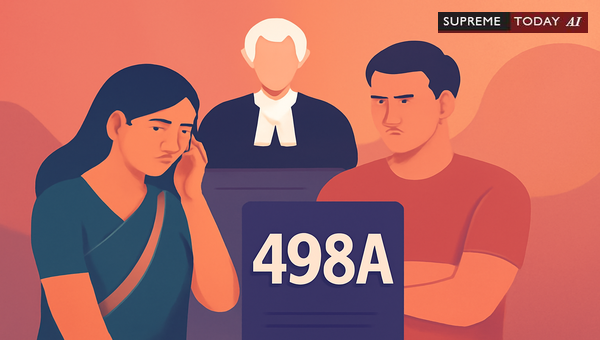
Is a Valid Defense Ground?
In the realm of Indian matrimonial disputes, Section 498A of the (IPC) often emerges as a contentious provision. Commonly invoked in cases alleging cruelty or harassment by a husband or his relatives, it raises a frequent question among the accused: Is 498A a registered ground for defense? This query stems from misunderstandings about whether this section can be turned into a defensive shield rather than a prosecutorial sword.
This blog post delves into the legal nuances, drawing from judicial precedents and analyses. We'll clarify the position of Section 498A, explore how allegations can be challenged, and highlight strategies for defense. Note: This is general information based on case law and not specific legal advice. Consult a qualified lawyer for personalized guidance.
Understanding
criminalizes cruelty by a husband or his relatives towards a woman, encompassing both physical and mental harassment, often linked to dowry demands. Introduced to protect married women, it is , , and , making it a powerful tool for prosecution. 2019 4 Supreme 737
However, courts have repeatedly emphasized that mere allegations are insufficient; the prosecution must prove cruelty . As noted in key judgments, allegations of cruelty under ...must be established by leading evidence in course of trial. 2017 0 Supreme(Pat) 867
This burden of proof is pivotal. Without concrete evidence, charges may falter, leading to acquittal or .
Is Section 498A a Registered Ground for Defense?
No, Section 498A is not a registered ground for defense—it's a . It cannot be invoked as a defense mechanism itself but can be contested vigorously. The legal position is clear: failure to prove the elements of cruelty under this section effectively results in a defense victory through acquittal. 2002 1 Supreme 545
Key Judicial Clarifications
Offense, Not Defense: Courts treat Section 498A as an offense requiring proof. The concept of cruelty under Section 498-A need not be physical and can include mental torture, but the absence of legal evidence to support cruelty leads to acquittal. 2002 1 Supreme 545
Evidence is King: In 1971 0 Supreme(SC) 638, the court held, there is no evidence of demand of dowry by accused from deceased or her relatives, and that no such offence under Section 498-A is established, leading to the conclusion that the accused are entitled to acquittal.
Challenging Unsubstantiated Claims: Judgments like 2022 0 Supreme(Gau) 121 and 2002 3 Supreme 583 stress that allegations of cruelty or harassment need to be substantiated with specific evidence. Lack thereof can lead to dismissal. 2002 3 Supreme 583
These rulings underscore that while Section 498A isn't a defense ground, disproving it forms the core of any robust defense strategy.
Challenging Section 498A Allegations in Court
Defendants can refute charges by highlighting the absence of proof. Common defenses include:
Lack of Specific Evidence: Vague complaints without dates, witnesses, or corroboration often fail. Courts quash FIRs if allegations are false or unsubstantiated. 2017 0 Supreme(Pat) 867
Mutual Settlements: In cases like
, proceedings under Section 498A were sought to be quashed via petitions, especially with affidavits supporting closure. Similarly, Criminal proceedings can be quashed if there is a mutual settlement between parties, with no further public interest in prosecution. This aligns with precedents like , allowing quashing under for private disputes.
and Procedural Relief: Sources indicate denials aren't automatic; factors like investigation progress matter.
Insights from Related Case Law
Broader jurisprudence supports flexible defenses in matrimonial matters:
Adding or Altering Defenses: Civil analogies show courts permit adding a new ground of defence or substituting or altering a defence. 2015 0 Supreme(Mad) 1843 Though primarily civil, this principle influences criminal defenses where new evidence emerges.
: In
, petitions to quash FIRs under 498A, 406, 323 were filed, emphasizing . Courts weigh if continuation serves justice.
Evidence-Based Amendments: Even in written statements, is governed by ... The court has wide power and discretion. 2015 0 Supreme(Mad) 1843 This extends to criminal trials where defenses evolve with facts.
These cases illustrate that while 498A is stringent, judicial discretion favors evidence over presumptions.
Exceptions, Limitations, and Strategies
Limitations
- No Automatic Defense: Accused can't claim 498A as a legal ground but must prove non-establishment of the offense. 1971 0 Supreme(SC) 638
- Baseless Counter-Allegations: Mere accusations of falsity without proof won't suffice.
Practical Recommendations
When facing 498A charges:1. Gather Counter-Evidence: Collect communications, witnesses disproving cruelty.2. Seek Quashing Early: File under if allegations lack merit or settlement is reached.3. Focus on : Highlight protracted trials invoking rights, as in narcotic cases analogously. 2001 0 Supreme(Guj) 2804. Professional Help: Engage counsel experienced in matrimonial laws to challenge FIRs pre-trial.
Section 498A does not contemplate that complaint for offence under Section 498A should be filed only by women who are subjected to cruelty, reminding courts scrutinize complainant credibility. 2019 4 Supreme 737
Conclusion and Key Takeaways
remains a formidable offense, not a defense ground. Yet, its strength lies in proof—which, if absent, paves the way for acquittal or quashing. Judgments consistently affirm: allegations must be evidenced, or they crumble.2022 0 Supreme(Gau) 121
Key Takeaways:- Section 498A is an offense to prove, not a defense to invoke.- Challenge via evidence gaps, settlements, or procedural motions.- Courts prioritize justice over misuse, offering relief where warranted.
For those navigating these waters, understanding these principles can be empowering. Always seek expert legal counsel tailored to your case.
References:- 2017 0 Supreme(Pat) 867, 2002 1 Supreme 545, 1971 0 Supreme(SC) 638, 2022 0 Supreme(Gau) 121, 2002 3 Supreme 583, 2019 4 Supreme 737,
, 2015 0 Supreme(Mad) 1843
Stay informed, and remember: knowledge is your first line of defense.
#Section498A, #IPCDefense, #MatrimonialLaw












