


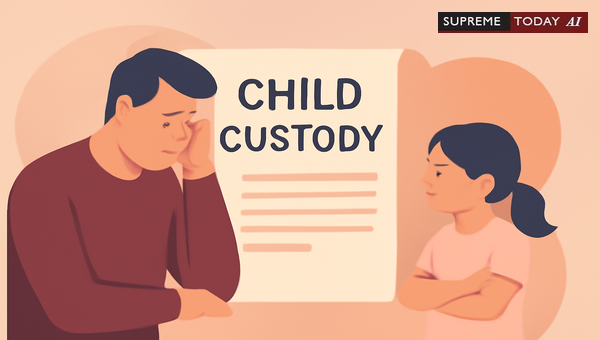
Child Custody When Father is on Duty or Seriously Ill: Legal Insights
In family law, one pressing question often arises for parents in demanding professions: Kya father ke on duty rahte hue gambhir bimar ho jaane par uske sthan par bachche ko liya ja sakta hai? (Can the child be taken in place of the father while he is on duty and becomes seriously ill?). This issue touches on , , and the under Indian law. Whether due to military service, essential work, or sudden health crises, a father's temporary unavailability raises concerns about who cares for the minor.
This blog post breaks down the legal framework, key precedents, and practical considerations. Note: This is general information based on legal principles and cases, not specific legal advice. Consult a qualified lawyer for personalized guidance.
Understanding Child Custody and Basics
Under Indian law, particularly the , and , the welfare of the minor is paramount in all custody decisions. Courts emphasize continuous care, emotional stability, and the child's best interests over rigid parental rights. The father's presence or absence due to duty or illness does not automatically disqualify him from custody, as long as the child's welfare is safeguarded 2017 2 Supreme 371.
- Natural : Fathers are typically for legitimate children, but this can be overridden if circumstances demand.
- Temporary Arrangements: Courts may entrust custody to the mother or another guardian during the father's unavailability, prioritizing health, safety, and emotional well-being 2017 2 Supreme 371.
No explicit prohibition exists against transferring custody when the father is on duty or severely ill, provided the child's needs are met. However, neglect or harm due to absence could trigger intervention.
Key Legal Precedents on Custody During Father's Absence
Courts have addressed similar scenarios, focusing on immediate child needs rather than the parent's status alone.
Case of Minor Kunika
In a notable instance involving family disputes and the father's temporary absence, the court prioritized the child's health and safety. It considered the incident's circumstances over the father's duty status, underscoring that immediate welfare trumps temporary unavailability 2011 0 Supreme(SC) 468.
Broader Principles from Judgments
- Child's Best Interests Override: can shift to the mother if the father is unavailable due to duty or health, ensuring proper care 2017 2 Supreme 371.
- Health and Safety Decisive: Courts weigh the child's physical, emotional, and psychological needs 2017 2 Supreme 371.
These precedents affirm that custody is flexible, not fixed by parental role or occupation.
Real-Life Risks and Vulnerabilities During Father's Absence
Legal discussions often draw from real-world accounts highlighting dangers when a father is on duty or incapacitated. Multiple documented cases reveal patterns of vulnerability, particularly involving children left unsupervised.
For instance, personal testimonies describe incidents of misconduct occurring during periods of absence:- BEHOSH KARNE KE BAAD USKE SAATH BHI SEX KIYA YA NAHI YE MERE KO PURI TARAH SE DHYAN NAHI HAI... USKE BAAD MAINE JO HAI, KUCHH DIN MAHINA KE KAREEB GHAR GAYA HUA THA 2023 Supreme(Online)(ALL) 13940 2023 Supreme(Online)(ALL) 15982 2023 Supreme(Online)(ALL) 13941 2023 Supreme(Online)(All) 27967 2023 Supreme(Online)(All) 24518 2023 Supreme(Online)(ALL) 2756 2023 Supreme(Online)(All) 28576 2023 0 Supreme(All) 1378.
These accounts, repeated across sources, illustrate scenarios where individuals (including contexts implying family or child involvement) faced violence or exploitation after being rendered unconscious (behosh), often when primary caregivers like the father were away on duty or work-related absences. Such narratives underscore neglect risks:- New workers were hired in place of absent ones, mirroring how guardians might step in for unavailable parents: NE NAYA AADMI RAKH LIYA THA, AUR MUJHE KAAM PAR NAHI RAKHA 2023 Supreme(Online)(ALL) 13940.- Themes of physical assault, control, and harm emerge during unsupervised periods, emphasizing the need for protective custody arrangements.
While these are not direct custody cases, they highlight why courts intervene: to prevent harm from parental unavailability2017 2 Supreme 371. Children mentioned in such volatile family dynamics become especially vulnerable, prompting transfers to stable guardians.
Legal Restrictions, Exceptions, and Conditions
When Custody Transfer is Likely
- Neglect or Harm: If absence leads to inadequate care, courts may reassign custody 2017 2 Supreme 371.
- Child's Preference: For older minors, views are considered alongside guardian capability.
- Temporary vs. Permanent: Duty-related or illness-induced absences often result in , not permanent loss of rights.
Exceptions and Limitations
- Father's recovery or duty end can restore status quo if welfare is proven.
- No automatic bar; evidence of best interests governs.
Other tangential sources reinforce proactive measures:- Family pleas for peace amid disputes: Ap logo ne meri khushi ke liya jo bhi ho skta tha wo kiya
, showing emotional toll on children during conflicts.
Practical Recommendations for Parents
If facing this situation:1. Document Everything: Medical reports, duty schedules, and care arrangements.2. Seek Interim Custody: File under for temporary orders.3. Prioritize Welfare: Arrange reliable childcare; involve early.4. Child Protection: Report risks to authorities; agencies like can assist.5. Legal Consultation: Approach or for petitions.
Courts balance rights: Father's duty service is respected, but child's daily needs prevail 2011 0 Supreme(SC) 468.
Conclusion and Key Takeaways
The father's duty or serious illness does not bar custody retention, but courts can entrust the child to the mother or another guardian if it serves the best interests2017 2 Supreme 371 2011 0 Supreme(SC) 468. Prioritizing health, safety, and emotional stability, Indian law ensures flexibility without punishing parental obligations.
Key Takeaways:- Welfare Paramount: Always the deciding factor 2017 2 Supreme 371.- No Automatic Disqualification: Absence alone insufficient; prove neglect for change.- Safeguard Vulnerabilities: Real accounts warn of risks during unsupervised times 2023 Supreme(Online)(ALL) 13940.- Act Promptly: Courts favor proactive parents protecting minors.
For tailored advice, contact a family law expert. Stay informed, protect your family.
#ChildCustody #FamilyLawIndia #ChildWelfare












