


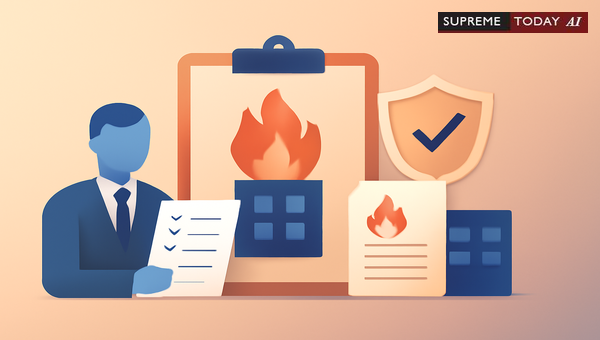
Can Companies Be Consumers for Fire Insurance Under CPA 2019?
In today's business landscape, companies often secure fire insurance to protect their premises from unforeseen disasters. But what happens when an insurance claim is denied? Can the company turn to for redressal under the (CPA 2019)? The question arises: Whether a Company which Availed Fire Insurance for its Premises Could be a under Protection Act 2019.
This issue hinges on statutory definitions, judicial interpretations, and a critical distinction between commercial and . While companies are broadly included as '' under the Act, their status depends on how the insurance is used. This blog post breaks down the legal framework, key judgments, and practical insights to help business owners navigate this complex area. Note: This is general information and not specific legal advice. Consult a qualified lawyer for your situation.
Understanding the
The CPA 2019 replaced the 1986 Act to provide robust protections against and . It defines a '' under Section 2(7) as someone who buys goods or services for a consideration, but excludes those availing them for commercial or trade purposes unless specified otherwise.
Key to this is the definition of 'person' under Section 2(31), which is inclusive and broad, covering individuals, firms, companies, and bodies corporate. As noted in a key judgment: The definition of ‘person’ as provided in is inclusive and not exhaustive – Protection Act being a , a has to be given to statute – Very fact that in Act of 2019, a has been brought within definition of ‘person’, by itself indicates that legislature realized incongruity in unamended provision and has rectified the anomaly by including word ‘company’ in definition of ‘person’. 2024 3 Supreme 379
This liberal approach favors including companies as potential consumers, but only under certain conditions.
Companies as '' and Potential Consumers
The Act's beneficial nature warrants expansive interpretation. Companies, as bodies corporate, qualify as '' and may be consumers if they meet the criteria. Several rulings affirm this:
- Entities availing services for fall within the scope. 2010 8 Supreme 613
- Even commercial entities can claim status if the service is for personal or non-trade use. 2023 3 Supreme 300
However, the purpose of availing the service is pivotal. Fire insurance for premises used residentially or personally could qualify, while business-use policies typically do not.
The Deciding Factor: Commercial vs. Non-
(mirroring the 1986 Act) excludes services hired for commercial purposes. For fire insurance:
- Non-Commercial Use: If premises are for personal activities (e.g., company-owned residential quarters), the company may be a . Courts emphasize scrutinizing the nature of premises and policy purpose.
- Commercial Use: Insurance for showrooms, factories, garages, or offices protects business assets, rendering it a commercial transaction. Companies here are generally not consumers.
Judgments reinforce this:- In cases involving commercial premises like showrooms, insurers argued successfully that complainants were not consumers due to trade purposes. 2022 Supreme(Online)(Del) 7396 2021 Supreme(Online)(Del) 4462- A mining company shareholder's insurance claim was challenged as commercial. 2021 Supreme(Online)(Del) 4496- Polymer company vs. insurer: Complainant deemed not a for business insurance. 2021 Supreme(Online)(Del) 4524
One ruling states: The contention that the complainant is not a is raised in the above background. But the contention is that since the service is availed for , the complainant goes outside the purview of the provisions of the Protection Act. No doubt service of a insurance company comes under the definition of service availed under Protection Act.
Conversely, non-commercial scenarios support inclusion, aligning with the Act's broad 'service' definition, even extending to insurance-linked medical services. 2007 4 Supreme 775
Judicial Precedents: A Balanced View
Courts have clarified boundaries through case law:
Support for Inclusion (Non-Commercial)
- : Bodies corporate are ''; favors consumers. 2024 3 Supreme 379 2010 8 Supreme 613
- Fixed deposits or non-trade services: Companies qualify if not for business.
Managing Director & CEO, Ind Swift Ltd. VS A. K. Ganesan -
BNAL Prefabs Pvt. Ltd. VS Puma Realtors Pvt. Ltd. -
Exclusions for Commercial Insurance
- Harsolia Motors and similar cases: Fire insurance for garages/showrooms is commercial, excluding . 2023 3 Supreme 300
- Insurance appeals under CPA dismissed for business entities.
Met Life India Insurance Company Ltd. VS Urvashi Goyal -
- : Commercial contracts bypass remedies. (Insights from
Royal Sundaram Alliance Insurance Co. Ltd. VS Patel Tours & Travels -
,)
These precedents show consistency: Purpose trumps entity type. A company insuring personal premises may succeed; commercial ones typically fail.
Practical Implications for Businesses
- Assess Purpose: Review policy documents and premises use before filing claims.
- Alternative Remedies: Commercial disputes may go to or , not .
Royal Sundaram Alliance Insurance Co. Ltd. VS Patel Tours & Travels -
- Additional Remedy: CPA offers , but only for qualifying consumers.
Royal Sundaram Alliance Insurance Co. Ltd. VS Patel Tours & Travels -
Recommendations:- Scrutinize at Claim Time: Determine if premises were for trade/business. 2010 8 Supreme 613- Legal Practitioners: Examine insurance intent and usage. Non-commercial? Proceed under CPA.- Business Owners: Consider hybrid policies or clarify non-commercial aspects.
Key Takeaways and Conclusion
A company availing fire insurance for its premises can be a under CPA 2019 if used for personal or , thanks to the Act's inclusive 'person' definition and . 2024 3 Supreme 379 However, commercial premises (e.g., factories, showrooms) exclude it, as affirmed in multiple judgments. 2023 3 Supreme 300 2022 Supreme(Online)(Del) 7396
Summary: Purpose is king—non-trade use opens CPA doors; business protection does not. Businesses should evaluate their case meticulously.
For tailored advice, consult legal experts. Stay informed on evolving jurisprudence.
References
- 2024 3 Supreme 379: Inclusive 'person' definition.
- 2010 8 Supreme 613: Non-commercial status.
- 2023 3 Supreme 300: Commercial exclusions.
- 2007 4 Supreme 775: Broad 'service' scope.
- 2022 Supreme(Online)(Del) 7396, 2021 Supreme(Online)(Del) 4462, etc.: Commercial insurance cases.















