


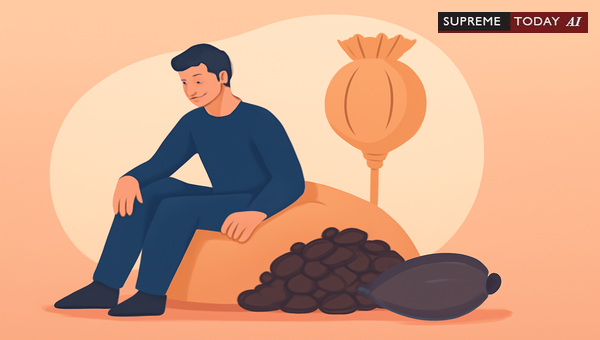
Sitting on Poppy Husk: Does It Lead to Conviction Under the NDPS Act?
Imagine this scenario: police raid a location and find you sitting on bags containing poppy husk. Are you automatically guilty of possessing under the ? The question, Sitting on Poppy Husk Acquittal, arises frequently in NDPS cases, especially in regions like Himachal Pradesh and Punjab where poppy straw recovery is common.
Important Disclaimer: This article provides general information based on judicial precedents and is not legal advice. Consult a qualified lawyer for case-specific guidance. Outcomes depend on individual facts and evidence.
Courts have repeatedly clarified that mere , such as sitting on or near poppy husk, does not establish required for conviction under . Let's break this down with key legal principles, landmark judgments, and practical insights.
Understanding Poppy Husk and Legal Possession Under NDPS Act
Poppy husk, also known as poppy straw, refers to all parts (except seeds) of the opium poppy plant (Papaver somniferum L.) after harvesting, in any form—original, cut, crushed, or powdered. 2013 0 Supreme(HP) 904 This is punishable under Section 15, but conviction hinges on proving —meaning the accused must have knowledge, awareness, and control over it.
Mere presence or sitting on bags is insufficient. As courts emphasize, the prosecution must prove that the accused had knowledge and control over the ; absence of such proof leads to acquittal. 2007 0 Supreme(HP) 422
01800048688
Key Elements of
- Knowledge: Did the accused know the bags contained poppy husk?
- Control: Was there evidence of ownership, custody, or dominion?
- Awareness: Suspicious conduct alone (e.g., sitting or hiding) doesn't suffice without corroboration.
The burden lies squarely on the prosecution. If they fail, acquittal follows. 2007 0 Supreme(HP) 422
Landmark Judgments: Acquittals for Sitting on Poppy Husk
Indian courts, including High Courts and the Supreme Court, have acquitted accused in numerous cases where the only evidence was proximity to poppy husk.
In Rajiv Kumar alias Guglu v. State of H.P.2011 0 Supreme(HP) 2653, the court held: the mere fact of the accused sitting on or near bags of poppy husk, without evidence of their knowledge or control, does not constitute possession. It stressed that presence and conduct of the accused alone cannot lead to the conclusion that they were in .
Similarly, Deepak Gupta2021 0 Supreme(Guj) 851 noted suspicious behavior like sitting on bags and hiding, but ruled it insufficient to prove possession without evidence of their knowledge or control.
The 2001 1 Supreme 625 confirmed: absence of proof of ownership, control, or knowledge leads to acquittal, even if sitting on poppy husk.
Another case reinforces this: The persons who were merely sitting on the bags, in the absence of proof of anything more, cannot be presumed to be in possession of the goods. 2011 0 Supreme(Raj) 207
In a detailed analysis, one judgment stated: sitting on poppy husk or straw does not automatically establish possession, and the prosecution must prove awareness and control. 2007 0 Supreme(HP) 422
Contrasting Cases: When Conviction Occurs
While acquittals are common, convictions happen with additional evidence. For balance, consider these nuances from other precedents:
In a case where three persons sat on bags, the Supreme Court inferred partly because two fled on seeing police, leaving one behind. 2015 0 Supreme(P&H) 2043 On seeing the police party, two of them fled away from the spot and appellant Megh Singh was apprehended at the spot.
Recovery from a truck driver with credible police testimony upheld conviction, as can be inferred from conduct and awareness. Non-joining of independent witnesses or procedural delays didn't vitiate the case.
Where an accused sat under a tree near poppy husk and fled, but other factors like exclusive location supported possession, sentence was upheld (though reduced for a young offender). 2014 0 Supreme(P&H) 574
Importantly, even in hidden spots like a cluster of trees and wild growth, sitting on bags wasn't enough without more proof. 2008 0 Supreme(P&H) 1930
These show courts scrutinize totality: fleeing, exclusive control, or unreliable alibis can tip the scale toward guilt.
and
Under Sections 35 and 54 of NDPS Act, once physical possession is shown, presumptions of arise—but they're rebuttable. The accused must get an opportunity to explain under .
One court acquitted because the prosecution failed to establish ... and did not give the accused an opportunity to rebut the presumptions. It stressed: the accused would be guilty... if it is established that he was in conscious and intelligent possession and not merely the physical presence... in proximity. 2010 0 Supreme(P&H) 1418
Once possession was established, the person who claims that it was not a has to establish it because how he came to be in possession of the same is within his special knowledge. 2007 0 Supreme(HP) 422
Scientific proof matters too: Tests for meconic acid/morphine alone don't confirm poppy straw; species identification is key. 2013 0 Supreme(HP) 1068 Mere info like a young boy... sitting near bathroom alongwith three cartons of poppy husk requires corroboration. 2025 Supreme(Online)(SC) 9390
Practical Recommendations for NDPS Defenses
For accused or lawyers:- Challenge Proximity Evidence: Argue lack of knowledge/control; explain presence (e.g., resting, laborer).- Demand Procedural Compliance: Independent witnesses, , timely samples.- Rebut Presumptions: Use Section 313 to explain circumstances.
Prosecution should:- Prove exclusive custody or awareness beyond doubt.- Avoid relying solely on sitting or suspicious acts.
Conclusion: Acquittal Likely Without Proof
In summary, sitting on poppy husk generally does not lead to conviction under NDPS Act. Courts demand clear evidence of knowledge and control, leading to acquittals in proximity-only cases. 2011 0 Supreme(HP) 2653 2007 0 Supreme(HP) 422
Key Takeaways:- Proximity ≠ Possession.- Prosecution bears the burden.- favor thorough defense.
Stay informed, but seek professional advice for NDPS matters. Judicial trends favor fairness over assumption.
References
- 2013 0 Supreme(HP) 904 - Definitions of poppy straw.
- 2013 0 Supreme(HP) 1068 - Proof beyond chemical tests.
- 2007 0 Supreme(HP) 422 - Prosecution's burden.
- 2011 0 Supreme(HP) 2653 - Mere sitting insufficient.
- 2001 1 Supreme 625 - Acquittal sans ownership proof.
- Others integrated as cited.












