


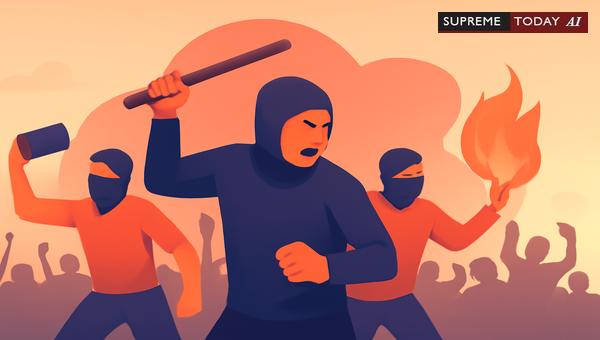
Rioting Essentials: Key Elements Under IPC Section 146
In an era of frequent protests and public gatherings, understanding what constitutes rioting under Indian law is crucial. Many individuals participating in assemblies wonder: what are the essential elements that turn a gathering into a criminal offence? This blog post delves into the legal framework of rioting, primarily governed by Section 146 of the , providing clarity on its definition, ingredients, and implications. Whether you're a law student, legal professional, or concerned citizen, this guide offers general insights into rioting essentials 2006 0 Supreme(Gau) 667 2023 0 Supreme(Pat) 2.
Note: This is general information and not specific legal advice. Consult a qualified lawyer for personalized guidance.
What is Rioting? Definition Under
Rioting is a serious offence involving collective action with violent intent. defines rioting as the use of by an , or any member thereof, in prosecution of the of such assembly2006 0 Supreme(Gau) 667 2023 0 Supreme(Pat) 2 2014 0 Supreme(Del) 2296 2022 0 Supreme(Cal) 1018 1962 0 Supreme(MP) 138 2015 0 Supreme(Guj) 898. Every member of such an assembly becomes guilty of rioting upon this act 2022 4 Supreme 168.
The term rioting is defined under . As per Section 146, whenever is used by an , or by any member thereof, in prosecution of the of such assembly, every member of such assembly is guilty of the offence of rioting. 2022 4 Supreme 168
This definition emphasizes , distinguishing rioting from individual crimes.
Essential Ingredients of Rioting
To establish rioting, prosecutors must prove several fundamental elements. These are non-negotiable and form the backbone of any conviction 2006 0 Supreme(Gau) 667 2014 0 Supreme(Del) 2296 2022 0 Supreme(Cal) 1018.
1.
An is the cornerstone. It must comprise at least five persons1998 0 Supreme(Guj) 452 2014 0 Supreme(Del) 2296 2022 0 Supreme(Cal) 1018 2023 0 Supreme(Pat) 2 1962 0 Supreme(MP) 138 2015 0 Supreme(Guj) 898. Moreover, their must align with one of the purposes under , such as:- Resisting lawful authority- Committing - 2014 0 Supreme(Del) 2296 2022 0 Supreme(Cal) 1018 2023 0 Supreme(Pat) 2
Without proving this , rioting cannot be established 2023 0 Supreme(Del) 2223 1995 0 Supreme(Pat) 305 1962 0 Supreme(MP) 138. In one case, convictions were set aside because the convicted persons did not number five, failing the test: Those who were convicted were not of sufficient number to make an , and, if they committed acts of , they were not guilty of rioting.
2. Use of
Mere presence or assembly isn't enough—there must be actual use of by the assembly or its members to pursue the 2006 0 Supreme(Gau) 667 2023 0 Supreme(Pat) 2 2014 0 Supreme(Del) 2296 2022 0 Supreme(Cal) 1018 1962 0 Supreme(MP) 138 2015 0 Supreme(Guj) 898.
Important clarification: Mere blocking of a road or non-violent conduct without evidence of does not constitute rioting 2014 0 Supreme(Del) 2296 2022 0 Supreme(Cal) 1018. The offence hinges on tangible acts of aggression, not passive protests.
On a fair reading of the definition of rioting as per , for the offence of rioting there has to be: (i) an of 5 or more persons as defined in ... (ii) the must use . 2021 5 Supreme 106
Additional Elements and Escalations
Prosecution of
The force must be used in prosecution of the 2006 0 Supreme(Gau) 667 2014 0 Supreme(Del) 2296 2022 0 Supreme(Cal) 1018. This links individual actions to the group's intent.
and
If deadly weapons are involved, the offence escalates to (), attracting harsher penalties 2006 0 Supreme(Gau) 667 1998 0 Supreme(Guj) 452 2022 0 Supreme(Cal) 1018 2022 4 Supreme 168. Furthermore, imposes : all members are liable for offences in furtherance of the , if the assembly is unlawful 1998 0 Supreme(Guj) 452 2023 0 Supreme(Del) 2223.
In a sentencing example, accused were punished variably for rioting: The sixth accused, Pitawatugedara Menika, is sentenced to three months' rigorous imprisonment for rioting.
Legal Principles and Key Clarifications
Courts consistently stress: presence of at least five persons and use of force are fundamental2006 0 Supreme(Gau) 667 2014 0 Supreme(Del) 2296 2022 0 Supreme(Cal) 1018. The is pivotal—if unproven, no rioting 2023 0 Supreme(Del) 2223 1995 0 Supreme(Pat) 305 1962 0 Supreme(MP) 138.
Rioting does not require a breach of peace; it's about collective force
. Rioting is characterized by the use of by an or its members in pursuit of a , and the offence does not require proof that a breach of peace was caused
.
Distinctions from Related Offences
- Rioting vs. : Mutually exclusive; trials don't bar rioting charges
.
- Rioting vs. : Convictions can be altered on appeal, but not interchangeable
.
- Once is proven, each member is guilty, even if participation is unclear 2025 0 Supreme(All) 3041.
Evidence like presence at the scene suffices, though large crowds complicate identification 2025 3 Supreme 549. Actual rioting isn't needed if acts provoke it 2023 0 Supreme(Ker) 218.
In workplace contexts, rioting undermines safety: Acts of violence particularly those committed in the presence of, or involving, fellow employees may undermine the integrity, safety, and order essential... This is especially so when the rioting and assault occur within the Company's premises.
THANAKODY RENGANATHAN vs KUALA LUMPUR KEPONG BERHAD - Industrial Court Kuala Lumpur
Rioting also appears in broader definitions, like railway offences: (iii) the indulging in rioting, shoot-out or arson 2019 0 Supreme(Gau) 392 2016 0 Supreme(Jhk) 1106 2013 0 Supreme(MP) 1462
Practical Recommendations for Legal Proceedings
To build a strong case:- Prove assembly composition: At least five persons with Section 141 object.- Demonstrate force/violence: Concrete evidence in prosecution of .- Consider escalations: Apply Sections 148/149 for arms or .
Focus on these to avoid acquittals, as seen in cases lacking numbers or violence
.
Conclusion and Key Takeaways
Rioting under IPC is a collective crime rooted in unlawful assemblies wielding force. Summary:- Requires of 5+ persons with Section 141 object.- Force/violence in pursuit thereof.- Escalates with deadly weapons (Section 148).- via Section 149.- Non-violent acts like roadblocks don't qualify.
Understanding these rioting essentials helps navigate public order laws. Rioting Essential hinges on collective unlawful violence, with the legal framework emphasizing the group’s conduct and intent rather than individual acts alone.
Stay informed, participate responsibly, and seek professional advice for specific scenarios. For more legal insights, subscribe to our blog!
#RiotingLaw #IPCIndia #UnlawfulAssembly















