


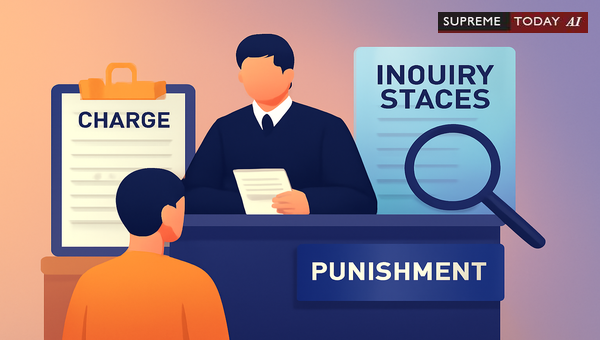
Stages of Departmental Enquiry: A Guide Backed by and Judgments
Departmental enquiries are a critical mechanism for maintaining discipline in public service and private organizations. They ensure accountability while upholding . But what exactly are the different stages of a departmental enquiry? And how do and judgments shape these processes? This article breaks down the sequential stages, supported by key judicial precedents, to provide clarity on this essential legal procedure.
Whether you're an employee facing charges, a disciplinary authority, or simply interested in service law, understanding these stages can help navigate potential proceedings effectively. Note that while this overview draws from established case law, it is general information and not specific legal advice—consult a qualified lawyer for your situation.
What Triggers a Departmental Enquiry?
A departmental enquiry typically begins when allegations of misconduct arise against an employee. The process is administrative and fact-finding in nature, distinct from criminal trials, though they may overlap on facts. As per rulings, it starts with the initiation of proceedings through a charge sheet or memo specifying the alleged misconduct. This ensures the employee is informed and given a chance to respond. 2020 2 Supreme 725 2011 0 Supreme(SC) 241
The charge sheet must be precise, outlining the substance of the accusation. Courts emphasize that this stage sets the foundation for fairness: The first stage involves the formal initiation of disciplinary proceedings, usually through issuing a charge sheet or memo specifying the misconduct alleged. 2020 2 Supreme 725
Key Stages of Departmental Enquiry: Step-by-Step Breakdown
and judgments outline a structured, sequential process. Here's a detailed numbered summary:
Initiation of Proceedings: Issue of charge sheet/memo detailing misconduct. The employee receives it at least before enquiry commencement in some rules, like Rules. 2020 2 Supreme 725 2011 0 Supreme(SC) 241 2015 0 Supreme(Gau) 1347
Appointment of Inquiry Officer & Conduct of Inquiry: A competent officer is appointed to examine evidence, record witness statements, and allow the employee to defend, cross-examine, and produce evidence. The standard is ',' not '.' The enquiry is conducted according to prescribed procedures, and the evidence is evaluated on . 2020 2 Supreme 725 2022 5 Supreme 443 1987 0 Supreme(SC) 858
Recording of Findings: The inquiry officer objectively assesses evidence and determines if charges are proved. Findings must be based solely on inquiry evidence. 2020 2 Supreme 725 2022 5 Supreme 443
Review & Decision by Disciplinary Authority: The authority reviews the report, accepts, modifies, or rejects findings, and issues a punishment order or exoneration. It acts as the '.' Courts rarely reappreciate evidence unless perverse or based on '.' The disciplinary authority is the , and courts generally do not reappreciate evidence unless the findings are perverse or based on . 2020 2 Supreme 725 2022 5 Supreme 443 2011 0 Supreme(SC) 241
Imposition of Punishment or Exoneration: Appropriate penalty is applied if charges hold, or the employee is cleared. This stage marks finality, subject to appeals. 2020 2 Supreme 725 2022 5 Supreme 443
Appeal & (if applicable): Higher authorities may review, but courts intervene only for procedural lapses, natural justice violations, or . is confined to procedural irregularities, violations of natural justice, or findings based on . 2020 2 Supreme 725 2021 6 Supreme 715 2022 5 Supreme 443
This framework ensures transparency and due process, as reinforced in multiple judgments.
: Limited Interference by Courts
Courts do not act as appellate bodies. Their role is supervisory: checking for fairness, not merits. In Union of India & Ors. vs. P. Gunasekaran (2015), the laid grounds for interference, such as perversity or procedural flaws. 2022 0 Supreme(Pat) 704
High Courts echo this: In exercising its jurisdiction under ... the cannot consider the question about the sufficiency or adequacy of evidence. 2022 0 Supreme(Pat) 704 Interference occurs if no enquiry was held or natural justice violated, like failing to examine key witnesses. 2015 0 Supreme(Gau) 1347
Departmental Enquiry vs. Criminal Proceedings: Key Distinctions
A common query is whether criminal cases impact departmental enquiries. Judgments clarify they can proceed simultaneously, as purposes differ—discipline vs. punishment. The purpose of departmental enquiry and of prosecution are two different and distinct aspects. 2023 0 Supreme(Chh) 642 2024 0 Supreme(MP) 140
Simultaneous Proceedings: Allowed unless prejudice shown, e.g., common witnesses. Stays are rare; criminal trials should conclude expeditiously. In Capt. M. Paul Anthony vs. Bharat Gold Mines Ltd. (1999), the permitted both. 2024 0 Supreme(MP) 140 2023 0 Supreme(AP) 1047
Acquittal Effect: Criminal acquittal doesn't automatically halt or nullify departmental action due to differing proof standards. Acquittal by a criminal court would not debar an employer from exercising power to conduct departmental proceedings. 2025 0 Supreme(Kar) 1186
Stays: Granted only if charges/evidence overlap significantly and prejudice is evident, e.g., staying departmental till criminal conclusion for . 2023 0 Supreme(Chh) 642
These principles prevent abuse while upholding efficiency: Departmental and criminal proceedings can proceed simultaneously. 2024 0 Supreme(P&H) 522
Common Pitfalls and
Violations like inadequate opportunity to defend or biased inquiry vitiate proceedings. The inquiry officer must remain neutral, not act as prosecutor. 2022 0 Supreme(Pat) 704
In one case, absence of a material eyewitness led to quashing: It is a salutary principle that a witness whose evidence is essential... should be called. 2015 0 Supreme(Gau) 1347
Finality attaches post-punishment, but appeals allow reappreciation by higher authorities. Criminal acquittals post-enquiry don't automatically invalidate unless vitiated. 2020 2 Supreme 725 2022 5 Supreme 443
Key Takeaways for Employees and Authorities
- For Employees: Respond promptly to charge sheets, demand fair hearings, and note proof standards differ from criminal law.
- For Authorities: Follow stages meticulously to withstand judicial scrutiny.
- Judicial Stance: Limited review promotes administrative autonomy.
| Stage | Key Requirement | Judicial Backing ||-------|-----------------|------------------|| Initiation | Precise charge sheet | 2020 2 Supreme 725 || Inquiry | Cross-examination opportunity | 2022 5 Supreme 443 || Findings | Evidence-based | 2011 0 Supreme(SC) 241 || Authority Decision | Independent review | 2020 2 Supreme 725 || Review | Procedural fairness only | 2021 6 Supreme 715 |
Conclusion
Departmental enquiries safeguard organizational integrity through well-defined stages, as affirmed by and precedents. From charge sheet to punishment, each step demands adherence to natural justice. While criminal overlaps exist, they rarely derail proceedings. Stay informed, ensure compliance, and seek professional guidance for specific cases—this is not legal advice but a synthesis of judicial wisdom.
For more on service law, explore our related posts on disciplinary actions and employee rights.
#DepartmentalEnquiry #SupremeCourt #DisciplinaryProceedings















