Searching Case Laws & Precedent on Legal Query.....!
Analysing the retrieved Case Laws
Scanned Judgements…!



Searching Case Laws & Precedent on Legal Query.....!
Analysing the retrieved Case Laws
Scanned Judgements…!
There is a clear procedural distinction between Sections 245(1) and 245(2), with the latter offering a wider scope to discharge at any earlier stage, even before evidence or framing of charges ["2024 0 Supreme(All) 76"], ["2011 0 Supreme(All) 2687"].
Analysis and conclusion:
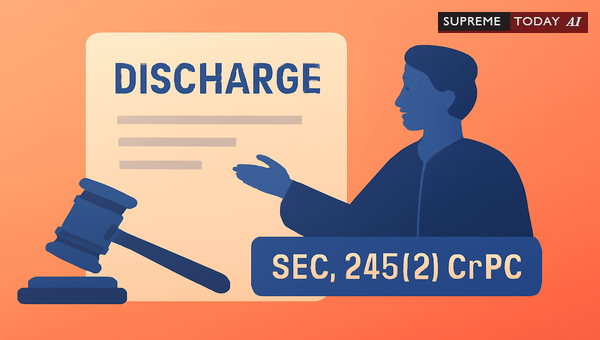
In criminal proceedings, particularly instituted on a , the question of discharge under often arises early. Can a discharge an accused even before recording evidence if the charge seems groundless? This provision offers a vital safeguard against , allowing for swift justice and resource conservation. But its application requires careful .
This blog delves into the nuances of , drawing from key judicial precedents and related cases. Whether you're an accused facing charges or a legal practitioner, understanding this power can make a significant difference.
Note: This is general information based on legal precedents and not specific legal advice. Consult a qualified lawyer for your case.
, governs the discharge of an accused in instituted otherwise than on a police report. While Section 245(1) allows discharge after evidence under Section 244 is recorded, Section 245(2) provides an exception.
The provision states: Nothing in this section shall be deemed to prevent a from discharging the accused at any previous stage of the case if, for reasons to be recorded by such , he considers the charge to be groundless. This empowers Magistrates to act proactively, even before the accused appears or evidence is led under . 2023 0 Supreme(All) 1350
This mechanism prevents unnecessary trials, harassment, and judicial backlog, especially when initial materials lack substance.
Courts have consistently upheld this power while stressing restraint. In Ajay Kumar Ghose, the clarified: the previous stage includes stages before the completion of evidence under Section 244, such as from Sections 200 to 204 CrPC. It emphasized recording reasons and limiting use to cases. 2023 0 Supreme(All) 1350
The Court noted this as an exception to prevent unwarranted trials. 2015 0 Supreme(Raj) 852
A clear divide exists between subsections:- 245(1): Discharge post-evidence under Section 244 if no ground for proceeding. 2022 0 Supreme(Gau) 1218- 245(2): Early discharge sans evidence, if groundless. 2023 0 Supreme(All) 1556 2023 8 Supreme 99
In one case, the court observed: there is a clear difference in Sections 245(1) and 245(2) of CrPC... If there is no discernible incriminating material in the evidence, then the proceeds to discharge the accused under .2023 8 Supreme 99
The accused retains rights like under Section 244 before charge framing, even if seeking 245(2) relief. The revision was dismissed, affirming: the accused will have the right to cross-examine the prosecution witnesses at the stage of evidence under Section 244 Cr.P.C. and before framing of charge.2023 0 Supreme(All) 1556
have a duty to shield against baseless cases. In a theft and matter, the discharged appellants, noting: Protection against vexatious and unwanted prosecution... is a duty cast on . No grave suspicion existed, making trial unjustified. 2023 8 Supreme 99
Not always successful. In cheque bounce cases under , Magistrates erred in entertaining 245(2) applications, rendering orders bad in law. 2025 Supreme(Online)(Tel) 57492 2025 Supreme(Online)(Tel) 57501
In power theft under , discharge was allowed post-testing showed no theft, quashing mechanical rejections. 2023 0 Supreme(Pat) 797
For public servants, discharge under 245(2) was scrutinized sans sanction under if acts unrelated to duties: Sanction under Section 197 Cr.P.C. is required only when the alleged acts... are directly connected to... official duties.2024 Supreme(Online)(TEL) 24745
In complex disputes like mutual wills and trusts, early dismissal was rejected: complaints aren't quashed initially on ; credibility assessed later. 2006 2 Supreme 19 2006 2 Supreme 19
These illustrate judicious use—success hinges on clear groundlessness, not mere defense pleas.
Typically viable when:- Complaint alleges improbable facts.- No offence from initial documents.- Frivolous due to enmity or civil disguise. 2023 0 Supreme(All) 1556
Limitations:- Not on suspicion; needs clear reasons. 2022 0 Supreme(Gau) 1218- No substitute for inquiry; post-discharge, higher courts review via or . 2010 0 Supreme(SC) 521- Reasons must be explicit for accountability. 2023 0 Supreme(All) 1350
Aggrieved parties can challenge unjust orders upwards.
For accused: File timely 245(2) applications with strong grounds, backed by precedents like Ajay Kumar Ghose. 2023 0 Supreme(All) 1350
For Magistrates: Exercise cautiously, record meticulous reasons to avoid reversals.
Prosecutors/Complainants: Ensure robust case to withstand early scrutiny.
In summary, Section 245(2) balances efficiency and fairness, curbing abuse while upholding procedure.
Discharge under is a powerful tool for Magistrates to nip groundless cases, fostering expeditious justice. As affirmed: the power allows for early termination... saving judicial resources and preventing unnecessary harassment.2023 0 Supreme(All) 1350
Stay informed on evolving precedents. For tailored guidance, approach legal experts.
References:1. 2023 0 Supreme(All) 1350: Ajay Kumar Ghose on scope and timing.2. 2015 0 Supreme(Raj) 852: Exception requiring caution.3. 2022 0 Supreme(Gau) 1218: Procedure distinctions.4. 2023 0 Supreme(All) 1556, 2023 8 Supreme 99, others as cited.
#CrPC2452, #MagistrateDischarge, #CriminalLawIndia


evidence, jurisdiction under Section 245 (2) Cr.P.C. can be exercised. ... Furthermore, any such discharge under Section 245(2) Cr.P.C. is only upon a satisfaction reached at by a Magistrate that the charge to be groundless. ... , the petitioner requested for a direction to call for Bank statements and without disposing of the same, it was followed by the order of discharge under Section 245(2) Cr.P.C. ... Behera, learned counsel fo....

Issues: The issues revolved around the rejection of the revisionist's discharge application, the interpretation of Section ... State of Jharkhand and Others, 2009 (14) SCC 115, Hon'ble Apex Court has held that there is clear difference in Section 245 (1) and 245 (2) Cr.P.C. In Section 245(1) Cr.P.C. ... Section 245(2) Cr.P.C. dealt with power of trial court discharging an accused even before evidence under #HL_STA....
.] - The court discussed the application of Section 245(2) Cr.P.C. for discharge before trial court, the difference between Sections ... The revisionist moved an application under Section 245(2) Cr.P.C. for discharge before the trial court, claiming that he has been ... Issues: The issues revolved around the application of Section 245(2) Cr.P.C. for discharge, the right of the accused to cross-examine ... If there is no discernible....

Sub section (2) of Section 245 contains the words “at any previous stage of the case” and it further states that the magistrate for “reasons to be recorded” may discharge the accused if he considers the charge to be groundless. ... WEST BENGAL.- After sub-section (2) of the Section 245 insert the following sub-section namely :-"(3) If the evidence referred to in Section 244 are not produced in support of the prose....

This did not happen and instead, the accused proceeded to file an application under Section 245(2) CrPC on the ground that the charge was groundless. 24. Now, there is a clear difference in Sections 245(1) and 245(2) of CrPC. ... If there is no discernible incriminating material in the evidence, then the Magistrate proceeds to discharge the accused under Section 245(1) CrPC. 25. The situation under Section 245(#HL_....

The learned Magistrate dismissed the application filed under Section 245(2) of Cr.P.C. seeking discharge for the offence under Section 138 of the Negotiable Instruments Act, 1881 (for short ‘the N.I.Act’). 4. ... Learned Magistrate has clearly committed an error in entertaining the application filed under Section 245(2) of Cr.P.C. seeking discharge. The impugned order is bad in law, as such, the question of maintaining the revision does not arise. 6. ... 2#....
The learned Magistrate dismissed the application filed under Section 245(2) of Cr.P.C. seeking discharge for the offence under Section 138 of the Negotiable Instruments Act, 1881 (for short ‘the N.I.Act’). 4. ... Learned Magistrate has clearly committed an error in entertaining the application filed under Section 245(2) of Cr.P.C. seeking discharge. The impugned order is bad in law, as such, the question of maintaining the revision does not arise. 6. ... 2#....

Section 245(1) and Section 245 (2) Cr.P.C. ... otherwise than on a police report are covered under Section 245 Cr.P.C. ... On the other hand, the stage for discharge under Section 245 is reached only after the evidence referred to in Section 244 Cr.P.C has been taken. 31. ... The appellant, thereafter, in 1996 joined O.N.G.C. as D.G.M., keeping his lien with B.S.F.C. on 21.02.2000, an FIR came to be instituted unde....

6 Section 245 (2) Cr.P.C. states that nothing in this Section shall be deemed to prevent a Magistrate from discharging the accused at any previous stage of the case if, for reasons to be recorded by such Magistrate, he considers the charge to be groundless. ... As stated supra, feeling aggrieved by the order of the learned Sessions Judge, the petitioner / A.2 filed this criminal revision case. ... Hence he is guilty of offence under Section 166 IPC. ... 2 Heard Sr....

of Section 155(2) of the Code. ... The High Court says that the appellants could very well appear before the court and move an application under Section 245(2) of the Code and that the Magistrate could discharge them if he found the charge to be groundless and at the same time it has itself returned the finding that there are sufficient ... We do not think that the High Court was correct in coming to such a conclusion and in coming to that it has also foreclosed the matter for the Magistrate as well, as....

Thus, Section 438 Cr.PC would be included within the scope of Section 439(2) Cr.PC. The Chapter of the Code would be Chapter XXXIII starting from Section 436 Cr.PC to Section 450 Cr.PC.

In this connection, reliance was placed on several decisions of this court, more important being R.P. Kapur v. State of Punjab [AIR 1960 SC 866]; State of Haryana and Ors. v. Bhajan Lal & Ors. [1992 Suppl. 1 SCC 335]; Madhu Limaye v. The State of Maharashtra [1977 (4) SCC 551] and Madhavrao Jiwajirao Scindia & Ors. v. Sambhajirao Chandraojirao Angre & Ors. [1988 (1) SCC 692]. In this connection, reliance was placed on the judgment of this Court in the case of Pepsi Foods Ltd. in a warrant case instituted otherwise than on a complaint did not impinge on the inherent power of the High Court un....

In this connection, reliance was placed on several decisions of this court, more important being R.P. Kapur v. State of Punjab [AIR 1960 SC 866]; State of Haryana and Ors. v. Bhajan Lal & Ors. [1992 Suppl. 1 SCC 335]; Madhu Limaye v. The State of Maharashtra [1977 (4) SCC 551] and Madhavrao Jiwajirao Scindia & Ors. v. Sambhajirao Chandraojirao Angre & Ors. [1988 (1) SCC 692]. Learned counsel submitted that the power of the court to grant discharge under section 245(2), Cr.PC. in a warrant case instituted otherwise than on a complaint did not impinge on the inherent power of....

For the proceedings under Section 125 of the Cr.PC, procedure is envisaged under Section 126 of the Cr.PC. Though Family Courts are vested with the powers to decide the matter under Hindu Marriage Act and other Acts, but so far as proceedings under Chapter IX of the Cr.PC are concerned, there is specific provision to adopt same procedure as envisaged in the Cr.PC. Procedure.-- (1) Proceedings under Section 125 may be taken against any person in any district-- (a) where he is, or (b) where he or his wife resides, or (c) where he last resided with his wife, or as the case may....

8. Section 245 Cr.PC deals with the provisions when an accused shall be discharged.


An indispensable Tool for Legal Professionals, Endorsed by Various High Court and Judicial Officers
Please visit our Training & Support
Center or Contact Us for assistance

Scan Me!
India’s Legal research and Law Firm App, Download now!


For Daily Legal Updates, Join us on :



 Back to top


