




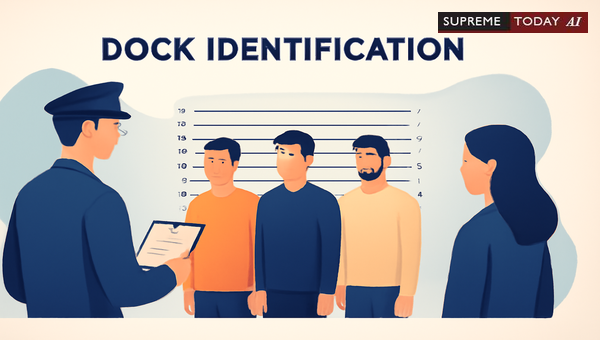
Is Substantial Evidence in India?
In high-stakes criminal trials, often plays a pivotal role. But what happens when the prosecution relies solely on a witness pointing out the accused in court—known as dock or —without prior (TIP) or other corroboration? The question arises: Only Doc Identification is the Substantial Piece of Evidence? This blog delves into Indian criminal law principles, drawing from and judgments to clarify why such evidence is typically viewed as weak and insufficient for conviction on its own.
Whether you're a legal practitioner, a defendant navigating charges, or simply interested in courtroom dynamics, understanding the nuances of identification evidence can make all the difference. Let's break it down step by step.
Main Legal Finding
In Indian criminal law, evidence obtained solely through identification by the witness in court () is generally considered weak and insufficient as substantive proof of guilt unless corroborated by other reliable evidence. Identification in court alone, without prior TIP or corroborative material, is inherently of a weak character and typically not sufficient to sustain a conviction. 2023 6 Supreme 329 2017 0 Supreme(SC) 985 1997 7 Supreme 262
The remains the testimony given in court, but courts approach it with caution, especially absent prior procedures. As noted in key rulings, The substantial evidence is the evidence of identification in Court. The evidence of test identification is not substantial piece of evidence. 2020 0 Supreme(Guj) 650
Key Points on Identification Evidence
- Substantive vs. : Identification in court is the primary 2023 6 Supreme 329 2017 0 Supreme(SC) 985 1997 7 Supreme 262. However, TIP serves only as a corroborative tool to bolster trustworthiness, not as standalone proof.
- Weakness of Sole : Reliance solely on , without TIP or other support, is generally insufficient for conviction 2019 0 Supreme(SC) 1352 2023 6 Supreme 329 1997 7 Supreme 262.
- Judicial Caution: Courts must treat first-time court identifications with extreme care, particularly if the witness is a stranger or there's a significant delay 2019 0 Supreme(SC) 1352 2023 6 Supreme 329 1999 2 Supreme 76.
- TIP Not Mandatory: While advisable, TIP is not required in every case, and its absence doesn't automatically invalidate evidence—but it reduces its weight 2023 6 Supreme 329 2017 0 Supreme(SC) 985.
These principles are echoed across judgments, emphasizing reliability over ritual.
Detailed Analysis: The Nature of Identification Evidence
Lies in Court Testimony
Multiple decisions affirm that the of an accused’s guilt is the testimony in court (the evidence of identification in court is the ) 2023 6 Supreme 329 2017 0 Supreme(SC) 985 1997 7 Supreme 262. Yet, the same rulings caution that first-time lacks strength without prior checks.
In one case, the court observed: Law is well settled that evidence of test identification is corroborative in nature and can be used only to lend support to the substantial evidence of identification in the Court. 2019 0 Supreme(Raj) 1154 This highlights prosecution's duty to ensure proper identification during trials, noting failures where witnesses testified without diligence from the court or investigators.
Role and Importance of Test Identification Parade (TIP)
TIP tests eyewitness reliability during investigation. It is not a substantive piece of evidence but a corroborative tool 2023 6 Supreme 329 2017 0 Supreme(SC) 985 1997 7 Supreme 262. Failure to conduct it doesn't doom the case, but courts weigh this heavily.
For instance, in scenarios with prolonged abductor-victim contact, gains credibility: abductees remained with abductors for about two months -- abductors did not cover their faces -- evidence of abductees cannot be discarded only due to want of test identification parade -- is substantial evidence -- test identification parade has only corroborative value. 2018 0 Supreme(MP) 606 Here, extended observation trumped TIP absence.
Courts' Approach to Unc corroborated
Judgments consistently hold that , especially post-long delay or with strangers, has weak unless supported by other evidence 2019 0 Supreme(SC) 1352 1999 2 Supreme 76. Sole reliance is often fatal: prosecution failed miserably in its duty to seek of identification of the accused when the statement of the witnesses were being recorded. 2019 0 Supreme(Raj) 1154
In a murder appeal, lack of during testimony led to acquittal: for lack of of identification of the accused in the court during the testimony of the witnesses, it cannot be safely concluded that accused appellant was person responsible. 2019 0 Supreme(Raj) 1154
Exceptions: When May Suffice
Courts aren't absolute; exceptions exist:
- Ample Observation Opportunity: If the witness clearly saw the accused during the crime, court ID may stand alone 2019 0 Supreme(SC) 1352 1999 2 Supreme 76.
- Prolonged Contact: In kidnappings, months-long detention allows reliable recognition without TIP 2018 0 Supreme(MP) 606 2018 0 Supreme(MP) 333. One ruling noted: where abductees remained in custody of abductors for a sufficient long period... doc identification of appellant was reliable. 2018 0 Supreme(MP) 333
- Known Accused: Familiarity reduces misidentification risk 1999 2 Supreme 76 1971 0 Supreme(SC) 424.
However, limited visibility or delays discourage sole reliance. Even then, corroboration is preferred.
Insights from Additional Cases
rulings reinforce these tenets. In a rape appeal, conviction stood despite issues, but evidence was corroborated beyond mere ID 2020 0 Supreme(Guj) 650. Conversely, no victim court ID and absent TIP led to acquittal critiques: There is no identification of accused by victim in the Court. ... The Test Identification parade was not conducted.
US cases offer comparative notes, like reliable ID despite procedural flaws if overall evidence suffices 2023 Supreme(US)(ca8) 242, but Indian law prioritizes caution in eyewitness matters.
Property disputes highlight ID's broader role: identification of the suit property was crucial
, underscoring context-specific weight.
Legal Principles from
Summarizing key takeaways:
- Court ID is primary but weak sans TIP 2023 6 Supreme 329 2017 0 Supreme(SC) 985.
- TIP absence isn't fatal if circumstances justify 2023 6 Supreme 329.
- Credibility hinges on observation chance, delay, familiarity 1999 2 Supreme 76 1971 0 Supreme(SC) 424.
- Sole court ID rarely convicts without more 1997 7 Supreme 262.
Practical Recommendations
- For Prosecutors: Conduct TIP early; document observation details meticulously.
- For Defense: Challenge uncorroborated ID via cross-examination on delays, lighting, stress.
- For Courts: Seek motive, recovery evidence, or forensics before convicting.
- Always pursue TIP, though not mandatory, to fortify cases.
Conclusion and Key Takeaways
is in theory but practically frail without corroboration or TIP. Indian courts demand , treating sole court pointers skeptically to prevent miscarriages. While exceptions for strong observation exist, the rule favors multiplicity.
Key Takeaways:- Court ID = substantive, but weak alone.- TIP = valuable corroboration, not essential.- Always corroborate for robust convictions.
This post provides general insights based on precedents and is not legal advice. Consult a qualified lawyer for case-specific guidance.
References
- 2019 0 Supreme(SC) 1352: Court ID substantive but weak without TIP.
- 2023 6 Supreme 329: TIP corroborative; circumstances key.
- 2017 0 Supreme(SC) 985: Weight depends on facts.
- 1997 7 Supreme 262: Needs corroboration.
- 1999 2 Supreme 76: Limited value sans support.
- 2020 0 Supreme(Guj) 650, 2019 0 Supreme(Raj) 1154, 2018 0 Supreme(MP) 606, others as cited.
Stay informed on evolving evidence law!
#DockIdentification, #CriminalLawIndia, #EyewitnessEvidence















