Searching Case Laws & Precedent on Legal Query..!
Scanned Judgements…!



Searching Case Laws & Precedent on Legal Query..!
Scanned Judgements…!
References:- ["2024 0 Supreme(Jhk) 844"]- ["2023 0 Supreme(Mad) 2696"]- ["2022 0 Supreme(Guj) 1769"]- ["2024 Supreme(Online)(DEL) 28647"]- ["2023 0 Supreme(Del) 10015"]
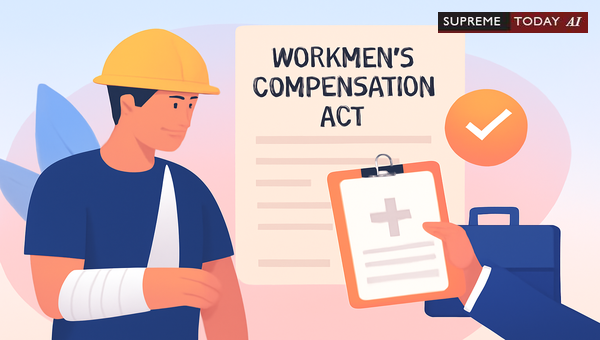
Imagine a factory worker hired to operate machinery but asked to unload supplies on the day of an accident. Does a deviation from the original job description bar compensation? This is a common dilemma in Indian labour law: A Workmen Working for a Different Purpose other than for what he is Hired Eligible for Compensation? Under the (now known as the ), eligibility hinges on specific definitions and circumstances, not rigid job titles. This post breaks it down, drawing from statutes, amendments, and case law to guide employers, workers, and legal seekers.
We'll explore the definition of a ',' key eligibility factors, judicial insights, and practical tips. Note: This is general information based on legal precedents; consult a lawyer for case-specific advice.
The defines a under Section 2(1)(n) as any person employed for the purposes of the employer's trade or business, excluding those whose employment is casual and not for the employer's trade or business. 2005 0 Supreme(Kar) 30
This exclusion is crucial. Pre-, outside the trade/business were often denied coverage. However, the amendment removed this blanket exclusion for not engaged in the trade, broadening protection.
2018 0 Supreme(Del) 2347
As noted in precedents, the ‘’ is defined in the , means, any person (other than a person whose employment is of a causal nature and who is employed otherwise than for the purpose of the employer's trade or business)…..
This underscores that proof of employment tied to the employer's operations is key.
Eligibility isn't solely about the hiring purpose; courts assess multiple factors at the time of injury:
Nature of Employment: Casual employment alone doesn't disqualify if linked to the employer's trade. A worker may qualify even if casually engaged for business purposes. 2021 0 Supreme(AP) 30
Purpose at Time of Incident: The predominant factor is the activity during the accident. If aligned with the employer's trade or business, compensation is typically available, regardless of original hiring intent. 2021 0 Supreme(AP) 30
Cumulative Exclusion Conditions: To exclude a worker, both must apply:
In related contexts, courts affirm broad interpretations. For instance, under the Employee's Compensation Act, the definition of 'employer' is inclusive, covering temporary hiring: The court emphasized the inclusive definition of 'employer' and its application to temporary hiring... 2023 0 Supreme(Del) 5598
Temporary or casual status doesn't automatically bar benefits. Cases under awards like Kalelkar highlight entitlements for temporary employees akin to permanents, rejecting narrow exclusions. 2024 Supreme(Online)(SC) 9820 2024 0 Supreme(SC) 796
Indian courts favor a to advance the Act's , ensuring benefits reach injured workers. 1990 0 Supreme(Guj) 33
: Post- amendment, even in non-trade activities qualify as workmen.
In disputes over employment proof, tribunals demand evidence beyond self-serving claims: ...in absence of proving employment of deceased with owner of vehicle they are not entitled to claim any compensation.
Yet, the Act's urges thorough evidence gathering.
Supervisory or estate roles require : Courts remand cases where '' status isn't framed as an issue. 2024 0 Supreme(Guj) 1905
Broader overlaps, like vs. WC Act, bar dual claims if ESI covers: creates an absolute bar against receiving compensation under any other law... 2012 0 Supreme(Mad) 3634
These rulings emphasize context over strict hiring labels.
To substantiate eligibility:
Employers should clarify roles in writing to mitigate disputes, while workers benefit from union or legal support.
Related precedents affirm: Temporary workers under schemes like Kalelkar enjoy parity in benefits, countering exclusion arguments. Temporary employees under the Kalelkar Award are entitled to the same holiday benefits and overtime pay as permanent employees... 2024 Supreme(Online)(SC) 9820
Not all deviations qualify. Purely personal tasks or unproven employment fail. In one case, family ties didn't prove driver employment without independent evidence.
Additionally, ESI-covered workers can't claim WC compensation, as ESI offers comprehensive, periodical benefits. 1998 0 Supreme(Del) 649 2012 0 Supreme(Mad) 3634
A may still be eligible for compensation even if working a different purpose from hiring, provided activities relate to the employer's trade/business and exclusion conditions aren't met. The amendment and liberal judicial stance protect broader classes, including casual/temporary workers.
Key Takeaways:- Focus on incident-time purpose, not original hire.- Prove employment nexus via evidence.- Liberal interpretation aids claimants.- Check ESI applicability to avoid bars.
For employers: Train on risks; insure adequately. For workers: Document everything.
This overview draws from statutes and cases like 2005 0 Supreme(Kar) 30, 2021 0 Supreme(AP) 30,
,
, 1990 0 Supreme(Guj) 33,
, 2023 0 Supreme(Del) 5598, 2024 0 Supreme(Guj) 1905, 2012 0 Supreme(Mad) 3634, 2024 Supreme(Online)(SC) 9820, 2024 0 Supreme(SC) 796, 1998 0 Supreme(Del) 649. Always seek professional legal counsel, as outcomes depend on facts.
Disclaimer: This is not legal advice. Laws evolve; verify with experts.
#WorkmensCompensation #LabourLawIndia #EmployeeRights


On the basis of these documents, it was asserted that he along with other concerned workmen were working for more than 240 days in a year in a permanent nature of job but management stopped them from working since 1993 without any notice or compensation. ... BCCL), wherein in relation to unskilled workmen compensation of Rs.2 lakh each was directed to be paid and in the said case, the workmen were engaged between the period 1987 and 1989. ... He produced two sheets of....

Different amounts were claimed by the respective workman based on the monthly wages earned by them. ... It is the further submission of the learned senior counsel that the contract cannot be attacked by the workmen as sham for the purpose of claiming relief u/s 33-C (2) of the ID Act. ... It is the further submission of the learned senior counsel that the workmen cannot divest their association with the contractor for the purpose of claiming relief by invoking the jurisdiction u/s 33-C (2) of the ID Act....

Hence, she is ordered to pay lump sum compensation of Rs.3,00,000/-. V. ... The petitioner had stated on oath that he was working on permanent vacant post and the duties performed by him are also of permanent nature. The duties performed by the petitioner and other permanent workmen is the same and there is no difference in their duties. ... The petitioner is working on the vacant post of permanent peon, but is only paid minimum wages. ... Learned Advocate for the petitioner submitted that the petitioner was wo....

districts under different projects. ... But in the said demand, there was no provision regarding working applicable to the workmen of Technical Union working in the workshops the holiday on Second and Fourth Saturday which are admissible to the other employees working on these establishments. ... Similarly, it has also come to the notice of the Government that the holidays on Second and Fourth Saturday are not admissible to the workmen working in the Regional Workshop....
under different projects. ... But in the said demand, there was no provision regarding working applicable to the workmen of Technical Union working in the workshops the holiday on Second and Fourth Saturday which are admissible to the other employees working on these establishments. ... Similarly, it has also come to the notice of the Government that the holidays on Second and Fourth Saturday are not admissible to the workmen working in the Regional Workshops at Ahmad....

Yet they remain eligible for travel compensation. The regulation confirms this point with an ex- ample: “[I]f an employee regularly works 9 a.m. to 5 p.m. from Monday through Friday the travel time during these hours is [compensable] worktime on Saturday and Sunday as well as on the other days.” ... Because he often did so during what he con- sidered his normal workday, and what clients would later designate as his normal working hours, Walters believes he is entitled to compensation for his time spent traveling. ... B ....

Compensation, Mysore District, Mysore. ... The award dated 21.04.2010 in WCA/NFC/CR- 331/2007 passed by the Labour Officer and Commissioner for Workmen Compensation, Mysore District, Mysore is set aside to ... the extent that the liability to pay compensation is fastened on the appellant herein. ... It is the case of the claimant that on 27.11.2006 at about 11.00 am, while he was working as an employee under respondent No.1 Sri.H.B.Puttaswamappa (before learned ... appeal is at the instance of....

Lastly, the decision in the case of Rashida Haroon Kupurade (supra) again emanates from the Workmen Compensation Act, 1923 wherein apart from the fact that the definition of the „workman‟ was entirely different, Section 3(1) of the Workmen Compensation Act, 1923 as it stood prior to its ... Zulfikar Ali (supra) cited by the learned counsel for the appellant is also distinguishable as it was a case under the Workmen Compensation Act, 1923, wherein the definition of „w....
Lastly, the decision in the case of Rashida Haroon Kupurade (supra) again emanates from the Workmen Compensation Act, 1923 wherein apart from the fact that the definition of the `workman' was entirely different, Section 3(1) of the Workmen Compensation Act, 1923 as it stood prior to its amendment ... Zulfikar Ali (supra) cited by the learned counsel for the appellant is also distinguishable as it was a case under the Workmen Compensation Act, 1923, wherein the definit....

an are technical, or then the even if stray hired. ... Admittedly, the respondent-workman was working as an Estate Supervisor and getting the salary of Rs.38,3851/-. ... However, at both the places, the said term is used in different context. In the first place, in the main Section 2(s) itself, the word used in the context of a person doing supervisory work for hire or reward. ... This Court is of the view that in absence of determining issue with regard to the workmen learned Labour Court has committed grave error in co....

The benefits, which an employee gets under the Employees State Insurance Act, are more substantial than the benefits what he gets under the Workmen's Compensation Act. The Employees State Insurance Act is subsequent Act and is having wider coverage and is more comprehensive. The very purpose of enacting Employees State Insurance Act is to see that a workmen, in the case of personal injuries and death, would get more compensation than what is provided for under the Workmen's Compensation Act.
In the absence of any evidence showing nod on the part of the landlady permitting the tenant to conduct a different business, it could not be concluded that with her permission he is dealing with the book selling business. It has been clearly established that the tenanted premises is being utilised for different purpose other than for what purpose it was leased out. In other words, it could be stated that the tenant has been running the book business violative of the stipulations recited in Ex.P.1.

The ‘workman’ is defined in the Section 2(n) of the Workmen's Compensation Act, 1923, means, any person (other than a person whose employment is of a causal nature and who is employed otherwise than for the purpose of the employer's trade or business)….. From the said provision, it is clear, that to maintain the claim against the owner of the vehicle or insurer of the vehicle, defendants have to necessarily prove the employment of the workman. In this case, it is the case of the applicants that the deceased was employed by his own father, who was the first Opposite Party an....
Under Column 014 setting out the checklist of the application that are to be included, it is stated that the candidate should enclose copies of the residence certificate. Therefore, what is contemplated in this regard is a certificate to establish that the petitioners are eligible for admission from the respective districts, since residences of other district s are not eligible to be considered for selection in a different district than their residence. Even in the counter affidavit, in para 6, it is stated that the petitioners are to include the certificates such as nativi....

It also provides for more compensation than what a workman would get under the Workmen s Compensation Act. The only disadvantage, if at all it can be called a disadvantage, is that he will get compensation under the ESI Act by way of periodical payments and not in a lump sum as under the Workmen s Compensation Act. The benefits which an employee can get under the ESI Act are more substantial than the benefits which he can get under the Workmen s Compensation Act.


An indispensable Tool for Legal Professionals, Endorsed by Various High Court and Judicial Officers
Please visit our Training & Support
Center or Contact Us for assistance

Scan Me!
India’s Legal research and Law Firm App, Download now!


For Daily Legal Updates, Join us on :



 Back to top


