


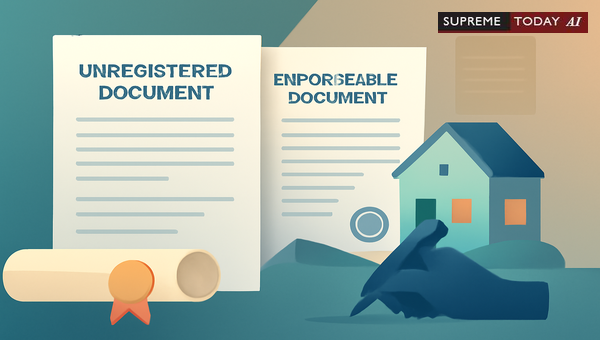
Are Unregistered Documents Enforceable in Law?
In the realm of property transactions, one common question arises: Whether Unregistered Documents are Enforceable in Law? Many individuals execute agreements to sell, powers of attorney, or other contracts related to without registering them, only to face challenges later in court. This blog post delves into Indian law, primarily the , and precedents, to clarify when such documents hold weight and when they don't.
Understanding this is crucial for homebuyers, sellers, and investors to avoid costly disputes. While this provides general insights, consult a legal professional for advice tailored to your situation.
Main Legal Finding: Generally Inadmissible for Primary Rights
Unregistered documents related to or contractual rights are generally of a completed transaction affecting the property or creating enforceable rights. However, they can be used as evidence of a contract or for collateral purposes under specific provisions like Sections 17(1-A) and 49 of the Registration Act.
Key points include:- Unregistered documents cannot affect or transfer or confer enforceable rights unless exceptions apply.- They are admissible as evidence of a contract in a suit for or as . 2021 0 Supreme(Mad) 1440 2021 0 Supreme(AP) 613- rulings emphasize that documents containing contracts to transfer must be registered to enforce rights under . 2009 0 Supreme(SC) 517
Legal Principles Under the Registration Act
Section 17 of the Registration Act mandates registration for certain documents, such as those affecting valued over Rs. 100. Section 49 explicitly states that unregistered documents required to be registered shall not be received as evidence of any transaction affecting such property. The proviso to Section 49 carves out exceptions: they can be used as evidence of a contract in a suit for or for collateral transactions not requiring registration. 2016 5 Supreme 60 2000 0 Supreme(AP) 82
For instance, in cases involving unregistered sale agreements or leases, courts have held them inadmissible for establishing ownership or enforceable rights unless falling under exceptions. 2025 0 Supreme(Telangana) 166 An unregistered lease deed, for example, is not valid for proving terms or eviction unless for collateral purpose.2025 0 Supreme(Telangana) 166
From additional judicial insights: if the intent of the Law was to create an absolute bar for receiving an unregistered document in evidence for any purpose whatsoever, the bar would not be circumscribed by the phrase 'evidence of any transaction affecting such property'.2021 Supreme(Online)(Kar) 294 This highlights the nuanced approach—not an absolute bar, but limited to primary transactions.
Clarifications
The in ruled: no title could be transferred with respect to immovable properties on the basis of an unregistered or on the basis of an unregistered . It stressed that such documents do not create enforceable rights or transfer title. Even registered documents do not automatically confer ownership without valid execution. 2007 0 Supreme(Kar) 681
Earlier, in , the Court reiterated that unregistered documents containing contracts to transfer are admissible as evidence of a contract but not as evidence of a transfer of title. This aligns with precedents where unregistered sale deeds cannot confer title but can evidence an agreement.2021 0 Supreme(AP) 613
Exceptions: Collateral Purposes and
Unregistered documents aren't entirely powerless. They may be used as evidence of a contract in a suit for under Section 49 or for collateral purposes, such as proving possession, character of possession, or admissions. 2021 0 Supreme(Mad) 1440
Kamala Devi VS Y. Anthi Reddy - Current Civil Cases
Courts have noted: even if these documents are unregistered, they can be admitted for collateral purpose.
Kamala Devi VS Y. Anthi Reddy - Current Civil Cases
2019 0 Supreme(Telangana) 165 For example:- Establishing possession or nature of possession without proving title transfer. 2024 0 Supreme(Mad) 2518Gugilla Aruna VS Adluri Ramesh Babu - Current Civil Cases
- like showing an agreement existed, but not the transaction itself. 2023 0 Supreme(Cal) 320 2025 0 Supreme(Kar) 1046Unstamped and unregistered documents are admissible in evidence for such limited uses, as seen in disputes over agreements. 2016 0 Supreme(Raj) 1111 However, they cannot enforce primary rights like title or ownership.2017 0 Supreme(Del) 137
Implications for Enforcement and Property Deals
Reliance solely on unregistered documents for asserting ownership or enforceable rights is legally untenable. The law strongly favors registration for to ensure public notice and validity. Unregistered firm liabilities might be enforceable in some contexts, like negotiable instruments, but not for property transfers.2018 0 Supreme(HP) 512 2023 0 Supreme(All) 2608
Post-amendment, Section 49(a) and (c) apply to unregistered Agreements to Sell, barring them from affecting or serving as evidence of such transactions.2023 3 Supreme 21
In practice:- Unregistered agreements do not transfer title under the . 2007 0 Supreme(Kar) 681- Suits based on them may proceed for , but not for direct enforcement of transfer. 2023 0 Supreme(Mad) 2284
Recommendations for Legal Security
To safeguard your interests:- Register all relevant documents like sale deeds, agreements to sell, and powers of attorney affecting .- If using unregistered documents, limit their purpose to or suits.- Pay proper to avoid further inadmissibility issues. 2016 0 Supreme(Del) 2100- Seek registration promptly to establish enforceable rights.
Proper registration is crucial for legal recognition and enforceability. Avoiding it risks invalid claims, as courts discard such evidence for primary purposes. 2017 0 Supreme(Del) 2097
Key Takeaways
- Unregistered documents are generally inadmissible for proving transfer, title, or ownership in .
- Admissible for collateral purposes (possession, agreements) or under Section 49.
- precedents reinforce: No title transfer without registration.
- Always prioritize registration for property transactions to ensure enforceability.
This analysis draws from Sections 17 and 49 of the Registration Act and numerous judgments, including
,
, 2021 0 Supreme(Mad) 1440, and others listed in references. For full case details, refer to legal databases.
Disclaimer: This is general information based on established law and not specific legal advice. Laws may vary by facts and jurisdiction—consult an attorney.
#UnregisteredDocuments, #PropertyLawIndia, #LegalEnforceability















