


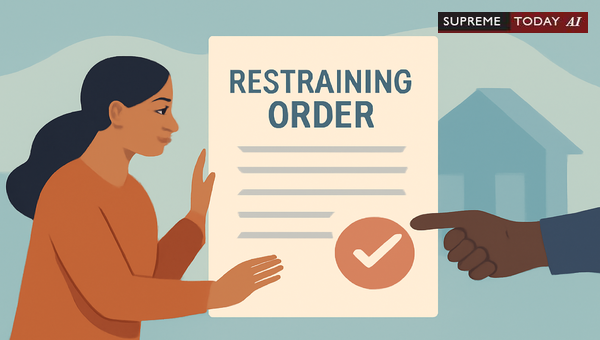
Must Respondents Follow DV from the in India?
In domestic violence cases, victims often seek urgent protection through court orders. A common question arises: In a Domestic Violence Case, if the Court Orders to Restrain the Respondent from the House, it should be Followed? The short answer is yes—these orders are legally binding and must be strictly adhered to under Indian law. Failure to comply can lead to serious criminal consequences. This blog post explores the legal framework, enforcement mechanisms, and key judicial insights under the (PWDVA).
We'll break down the statutes, procedures for issuance and breach, and real-world applications from case law, helping you understand the importance of compliance.
Legal Framework Under
The is the cornerstone legislation protecting women from domestic violence, empowering to issue protection orders. Key provisions include:
- Section 12: Allows the aggrieved person to apply for protection orders, including . 2024 0 Supreme(All) 2302
- Section 19: Authorizes to prohibit the respondent from entering the , committing violence, or alienating assets.
2024 0 Supreme(All) 2302
- Section 31: Treats any breach of protection orders as a and . 2022 0 Supreme(Mad) 650 2024 0 Supreme(All) 2302
The Magistrate may pass protection orders if satisfied that domestic violence has occurred or is likely to occur.
2014 0 Supreme(All) 2021 2015 0 Supreme(P&H) 277
(Judicial and certain ) hold primary enforcement authority, while have limited roles. 2024 0 Supreme(All) 2302
Issuance of from the
Courts issue to safeguard victims, often restraining the respondent from the . These may direct alternative accommodation or payments. For instance:
- Orders prohibit entering or remaining in the house, harassment, or threats.
- Under Section 19 of the Domestic Violence Act, the magistrate... can pass a residence order restraining the respondent from dispossessing or in any other manner disturbing the possession of the aggrieved person. 2019 0 Supreme(Del) 109
In one case, the ordered the respondent to restrain respondent No. 1 from committing any kind of Domestic Violence... and also directed him to provide alternate accommodation. 2017 0 Supreme(Kar) 1024
Shared households include joint family homes: If the husband and the other members are in the joint family house, then that can be called as ‘shared house’ and other relatives of husband... can also be made as parties to restrain them from committing any domestic violence by throwing out the wife.
2014 0 Supreme(Kar) 349
These orders are typically passed after hearing both parties, ensuring fairness.
Ensuring Compliance: What Happens if Orders Are Ignored?
Compliance is mandatory. Breaches trigger swift enforcement:
Reporting a Breach
- Victims must report violations immediately to the local police station. Police treat breaches as offences under Sections 31 and 32. 2022 0 Supreme(Mad) 650
Police and Court Action
- Police can arrest without a warrant if a violation is suspected. 2022 0 Supreme(Mad) 650 2024 0 Supreme(All) 2302
- Courts may impose bonds, restrict alcohol use, or issue .
2014 0 Supreme(All) 2021
For (e.g., maintenance under Section 20), enforcement follows , including . 2024 0 Supreme(All) 2302
Breach of protection orders is and non-bailable, leading to criminal proceedings... penalties, including imprisonment, fines, or both. (Derived from enforcement sections) 2024 0 Supreme(All) 2302
Consequences of Non-Compliance: Judicial Precedents
Courts emphasize strict adherence. In various rulings:
- Orders to stay away from the and to secure alternative accommodation or pay compensation are enforceable.
Appa Pogula Rajesh Kumar VS S. H. O. W. P. S. Saroornagar Ano - Crimes
- Failure to execute led to reconsideration, underscoring compliance. 2024 0 Supreme(Ker) 1712
- Consent terms post-mediation can modify restraints, but original orders bind until altered. 2024 Supreme(Online)(Bom) 7237
Court orders to restrain respondents from entering or remaining in the are legally binding... Non-compliance can lead to legal consequences. (From analysis of 2008 2 Supreme 413,
Appa Pogula Rajesh Kumar VS S. H. O. W. P. S. Saroornagar Ano - Crimes
)Resistance, like obstructing police, is itself a breach. 2022 0 Supreme(Mad) 650
pass orders but enforce them via mechanisms. 2024 0 Supreme(All) 2302
Special Safeguards and Considerations
- Civil-Criminal Blend: uses for efficiency over pure civil remedies. 2024 0 Supreme(All) 2302
- Modifications: Courts may adjust orders based on changed circumstances, but violations invite prosecution. 2010 0 Supreme(Del) 697 2024 Supreme(Online)(Bom) 7237
- Victim Protection: Orders prevent further violence, with police mandated to act promptly.
The Act explicitly integrates with procedures for enforcement, including arrest, warrants, and offences. 2024 0 Supreme(All) 2302 2022 0 Supreme(Mad) 650
Key Takeaways for Victims and Respondents
- For Victims: Report breaches immediately—police must respond.
- For Respondents: Violating a restraint from the house risks arrest, fines, or jail. Seek legal modification if needed.
- General Rule: These orders protect rights and must be followed unless .
| Aspect | Key Action | Legal Basis ||--------|------------|-------------|| Issuance | After hearing | Section 19
|| Breach Report | To police | Sections 31-32 2022 0 Supreme(Mad) 650 || Enforcement | Arrest/Warrants | 2024 0 Supreme(All) 2302 || Penalties | Imprisonment/Fines | offence 2024 0 Supreme(All) 2302 |
Conclusion
Court orders restraining respondents from the in domestic violence cases are robustly enforceable under . They integrate criminal and civil remedies for victim safety, with and police ensuring compliance. As seen in precedents, non-adherence leads to severe repercussions—always follow or seek court variation. 2024 0 Supreme(All) 2302
Appa Pogula Rajesh Kumar VS S. H. O. W. P. S. Saroornagar Ano - Crimes
Disclaimer: This is general information based on statutes and cases, not specific legal advice. Consult a qualified lawyer for your situation.
#DomesticViolenceLaw, #PWDVAIndia, #RestrainingOrder















