Searching Case Laws & Precedent on Legal Query.....!
Analysing the retrieved Case Laws
Scanned Judgements…!



Searching Case Laws & Precedent on Legal Query.....!
Analysing the retrieved Case Laws
Scanned Judgements…!
Erroneous decisions in departmental proceedings involving judicial officers cannot be subjected to departmental enquiry or interfered with by courts, especially when such decisions are made in accordance with statutory or constitutional provisions and after proper departmental procedures ["2024 0 Supreme(MP) 400"].
Judicial review is limited to examining the manner of decision-making, not the merits or correctness of the decision itself. Courts do not reappreciate evidence or substitute their judgment for that of disciplinary authorities; instead, they ensure fairness, adherence to rules, and natural justice principles during enquiry proceedings ["2024 0 Supreme(Chh) 159"] ["2023 0 Supreme(Jhk) 961"] ["2023 0 Supreme(Raj) 558"].
The role of the enquiry officer is quasi-judicial, requiring impartiality and fairness. The officer must not be biased, especially if they are witnesses or have a vested interest in the matter. The enquiry must be conducted without a closed mind, and principles of natural justice must be followed ["2025 0 Supreme(Gau) 1237"] ["2023 0 Supreme(All) 1613"] ["2025 0 Supreme(MP) 542"] ["02000054283"] ["2025 Supreme(Online)(Gau) 7588"].
Findings of guilt in departmental enquiries are based on evidence analyzed by the enquiry officer, and courts generally do not interfere with these findings unless there is a clear violation of principles of natural justice, bias, or illegalities in the process ["2023 0 Supreme(All) 1613"] ["2023 0 Supreme(Jhk) 1067"] ["2023 0 Supreme(AP) 1047"] ["2024 0 Supreme(Jhk) 521"] ["2025 Supreme(Online)(MP) 9812"].
An erroneous or illegal decision cannot be the subject matter of departmental enquiry against a judicial officer, as such decisions are protected under constitutional provisions and cannot be revisited through departmental proceedings ["2024 0 Supreme(MP) 400"].
Analysis and Conclusion:The legal framework emphasizes that departmental enquiries are quasi-judicial processes designed to ensure fairness and adherence to natural justice, not to re-evaluate the merits of decisions already made by judicial officers or authorities. Courts restrict their review to procedural fairness and legality, and cannot entertain challenges based solely on the correctness of the decision. Therefore, an erroneous decision, especially in the context of judicial officers, cannot be the subject matter of departmental enquiry, and courts will generally refrain from interfering with such decisions unless procedural violations or bias are evident ["2024 0 Supreme(MP) 400"].
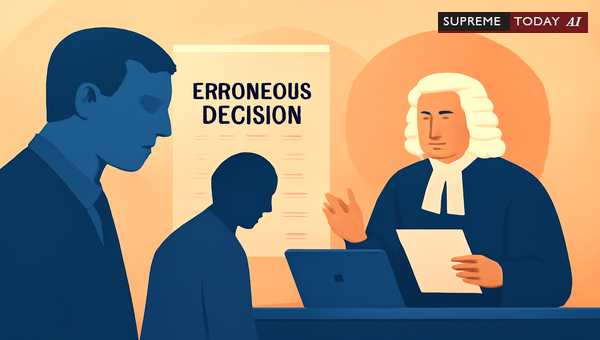
In the realm of , a pressing question often arises: an erroneous decision cannot be subject matter of for a judicial officer. This notion sparks debate among legal practitioners, judicial officers, and authorities. While is paramount, accountability for misconduct remains crucial. This post delves into precedents and legal principles, clarifying that an erroneous decision alone does not preclude departmental proceedings—provided they adhere to and lack .
Drawing from key judgments, we'll explore the boundaries of departmental enquiries, the limited scope of , and exceptions where proceedings may falter. This analysis integrates established rulings to offer clarity on this nuanced issue.
An erroneous decision in departmental proceedings against a judicial officer does not inherently prevent initiation or continuation of such enquiries. Courts have consistently held that these proceedings are permissible if conducted per principles of , without or . 2022 5 Supreme 443
Key points include:- Departmental inquiries are not barred merely because the officer is judicial or the decision was erroneous.- focuses on , legality, and absence of —not factual merits or correctness. 1999 9 Supreme 42- Courts/tribunals should not act as over departmental findings, especially on judgment errors. 2006 7 Supreme 758- Validity hinges on procedural adherence, not the challenged decision's error. 2022 5 Supreme 443 1999 9 Supreme 42
As emphasized, an erroneous decision cannot be a bar to departmental inquiry when is observed. 2006 7 Supreme 758
Departmental proceedings target misconduct or , separate from correcting judicial errors. The in 2022 5 Supreme 443 clarified that under scrutinize and legality, not decision merits.
For instance, in , it was reiterated that departmental inquiries remain valid even if the involved judgment was erroneous or challenged. 2020 2 Supreme 725
This distinction protects while allowing accountability. However, other sources highlight safeguards: complaints must disclose misconduct; vague allegations warrant no . 2020 0 Supreme(All) 1272 Complaints which do not disclose a act of misconduct, cannot cause a to be conducted against a judicial officer.
is confined to:- Proper inquiry conduct.- compliance.- Absence of or perversity. 2022 5 Supreme 443 1999 9 Supreme 42 2006 7 Supreme 758
Courts do not re-appreciate evidence or substitute views unless proceedings are arbitrary or evidence-less. This Court in exercise of power of examines the decision making process and not the decision itself. 2016 0 Supreme(Pat) 688
In bias concerns, the must remain unbiased: If an officer is a witness to any of the incidents... he should not be the . 2024 0 Supreme(Mad) 1497 Enquiries cannot proceed with a closed mind. 2023 0 Supreme(MP) 954
An erroneous judicial decision does not bar proceedings. Enquiries may proceed if alleging misconduct beyond the decision itself, like corruption or rule violations. For example:- Proven misconduct, such as suspicious transactions, justifies dismissal if is followed. 2024 0 Supreme(Mad) 1497 The burden shifts to the officer to disprove charges.- Even absent a , no vitiates the process. 2023 0 Supreme(MP) 954
Yet, basing enquiries solely on judicial orders risks undermining independence: if the High Court goes on instituting departmental enquiries on the basis of decisions of a judicial officer... no Judge would be able to function independently. 2019 0 Supreme(Kar) 1765
Judicial officers must impart justice faithfully; inconsistent conduct justifies dismissal. 2016 0 Supreme(Jhk) 302
Proceedings falter if:- Lacking misconduct. 2020 0 Supreme(All) 1272- Violating , e.g., bias or closed mind. 2024 0 Supreme(Mad) 1497 2023 0 Supreme(MP) 954- Mala fide or perverse. 2022 5 Supreme 443- Treating enquiry casually or preventing effective defense. 2019 0 Supreme(Kar) 1765
Acquittal in criminal trials or decision errors do not automatically invalidate enquiries. 1999 9 Supreme 42 Strict evidence rules are inapplicable; some evidence suffices for judicial officers. 2010 0 Supreme(Mad) 3115 Even for regular departmental proceedings... strict rules of evidence are not applicable.
by disgruntled litigants threaten judicial functioning: Judicial officers can discharge their judicial functions without fear... only if a conducive environment is built. Costs or contempt may deter such abuse. 2020 0 Supreme(All) 1272
To balance accountability and independence:- Initiate enquiries only on misconduct, adhering to and rules.- Limit review to procedures; avoid merits re-assessment.- Scrutinize error/ claims cautiously, ensuring safeguards.- Distinguish judicial errors from procedural violations. 2006 7 Supreme 758
Generally, an erroneous decision does not bar departmental enquiries against judicial officers, as affirmed in rulings like 2022 5 Supreme 443, 1999 9 Supreme 42, and 2006 7 Supreme 758. The focus remains on fair process over outcome correctness. However, proceedings must navigate strict thresholds: cases, unbiased officers, and . 2020 0 Supreme(All) 1272 2024 0 Supreme(Mad) 1497
This framework upholds judicial integrity without eroding independence. Courts reinforce: protect officers from frivolous probes while punishing proven misconduct. 2016 0 Supreme(Jhk) 302 2010 0 Supreme(Mad) 3115
Note: This post provides general information based on precedents and is not legal advice. Consult a qualified attorney for specific cases.
References:1. 2022 5 Supreme 443 – Erroneous decisions do not bar enquiries; limited review scope.2. 1999 9 Supreme 42 – Proceedings valid if fair, despite errors.3. 2006 7 Supreme 758 – essential; errors not automatic bars.
#DepartmentalEnquiry #JudicialMisconduct #NaturalJustice


of breach of statutory or constitutional provisions, decision taken to remove a judicial officer cannot be interfered with by this Court in writ jurisdiction. ... A judicial officer is required to maintain a very high standard of devotion to duty and if it is found that a judicial officer has time and again shown utter disregard to settled principles and norms of justice in discharging his duty, a decision taken to remove such a #HL....

To sum up, the scope of judicial review cannot be extended to the examination of correctness or reasonableness of a decision of authority as a matter of fact. 27. It is true that strict rules of evidence are not applicable to departmental enquiry proceedings. ... It is now well settled that the scope of judicial review against a departmental enquiry proceeding is very limited. It is not in the nature of an appeal and a review on mer....

To sum up, the scope of judicial review cannot be extended to the examination of correctness or reasonableness of a decision of authority as a matter of fact. 25. ... (ii) Insufficiency of materials cannot be a ground to annul the findings of the Enquiry Officer neither can a substituted view be taken in place of Enquiry officer/disciplinary authority in cases of departmental proceeding.” ... Neither the learned ....

Some evidence was led in departmental enquiry and enquiry officer was not able to bring home the charge. ... The disciplinary authority is directed to reconsider the matter to take decision afresh on the basis of enquiry report, if it so wishes and desires. ... Reason to agreeing with proposed punishment of enquiry officer has been disclosed to be the findings arrived in the preliminary enquiry report held in the ....

(ii) If an officer is a witness to any of the incidents which is the subject-matter of the enquiry or if the enquiry was initiated on a report of an officer, then in all fairness he should not be the enquiry officer. ... When a departmental enquiry is conducted against the government servant it cannot be treated as a casual exercise. The enquiry proceedings also cannot....

When a departmental enquiry is conducted against the government servant it cannot be treated as a casual exercise. The enquiry proceedings also cannot be conducted with a closed mind. The Enquiry Officer has to be wholly unbiased. ... Arriving at a just decision is the aim of both quasi-judicial enquiries as well as administrative enquiries. An unjust decision in an administrative enquiry may have....

/2012 cannot be sustained. ... the petitioner by enquiry officer cannot at all be substantiated and is a mere eyewash in view of the law laid down by the Hon'ble Apex Court in the case of Union of India and others vs. ... Barick, Ashok Kumar were recorded by the enquiry officer on 04.12.2010 and 31.12.2010 respectively that too behind the petitioner's back and, therefore, such deposition recorded behind the back of the petitioner cannot at all have been relied upon by....
When a departmental enquiry is conducted against the government servant it cannot be treated as a casual exercise. The enquiry proceedings also cannot be conducted with a closed mind. The Enquiry Officer has to be wholly unbiased. ... authority evidently, the Enquiry Officer cannot be said to have an open mind. ... The requirements of natural justice must depend on the circumstances of the case, the nature of the i....

When a departmental enquiry is conducted against the government servant it cannot be treated as a casual exercise. The enquiry proceedings also cannot be conducted with a closed mind. The Enquiry Officer has to be wholly unbiased. ... Arriving at a just decision is the aim of both quasi-judicial enquiries as well as administrative enquiries. An unjust decision in an administrative enquiry may have....
Judicial review is not an appeal from a decision but a review of the manner in which the decision is made. ... Thereafter, enquiry was conducted by the Enquiry Officer and report was submitted on 30.08.2012. The respondents issued show- cause notice along with report of Enquiry Officer and asked the reply. Petitioner immediately replied to the same. ... Sree Rama Rao, AIR 1963 SC 1723, a three- Judge Bench of this Court has held that the High Court i....

9. Complaints which do not disclose a prima facie act of misconduct, cannot cause a departmental enquiry to be conducted against a judicial officer. Establishing a prima facie act of misconduct by a judicial officer, is the minimum legal threshold to be reached before a prayer for holding a departmental enquiry can be considered. A roving enquiry into vague allegations against a judicial officer cannot be countenanced in law.

It is further submission on behalf of the appellant that if the High Court goes on instituting departmental enquiries on the basis of decisions of a judicial officer and judicial proceedings, then no Judge would be able to function independently, in a free and fair manner and he/she will have to work with fear of higher judiciary. The appellant is an innocent officer and he has not committed any offence much less a misconduct warranting his dismissal. The judicial pronouncements and judicial decision and decision making process shall not be the subject matter of a departmental enqu....

This Court in exercise of power of judicial review examines the decision making process and not the decision itself. Such finding of the Enquiry Officer cannot be made the subject matter of challenge before this Court in exercise of power of judicial review of this Court.

High Court of Allahabad and another" reported in (2007) 4 SCC 247 and "Iswar Chand Jain vs. The learned counsel for the petitioner contended that departmental proceeding against a judicial officer cannot be instituted on the basis of judicial orders.

Even for regular departmental proceedings, as has been observed supra, strict rules of evidence are not applicable. The case of a Judicial Officer, like the petitioner, cannot be decided on the principles applicable to a regular departmental proceedings. Normally, it is not possible to prove the corrupt charges by way of positive evidence.


An indispensable Tool for Legal Professionals, Endorsed by Various High Court and Judicial Officers
Please visit our Training & Support
Center or Contact Us for assistance

Scan Me!
India’s Legal research and Law Firm App, Download now!


For Daily Legal Updates, Join us on :



 Back to top


