


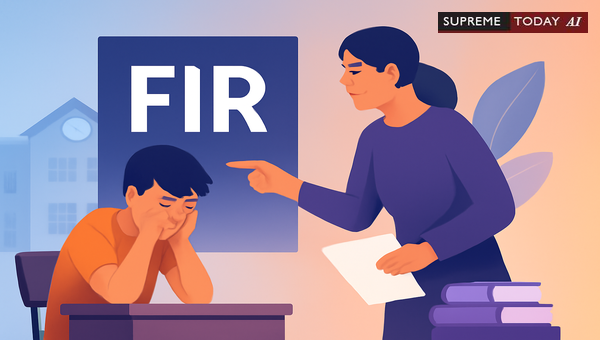
Can FIR Be Filed Against School for Harassing Ill Student?
Imagine a parent distraught because their child, battling a prolonged illness, faces ongoing issues at school—not just denial of exam access but what feels like targeted harassment. A common question arises: whether FIR can be lodged against school if they are harassing a student over her illness since long and not allowing her to give exams? This scenario pits parental concerns against school authority, raising critical questions under Indian law.
In this post, we delve into the legal nuances, drawing from court judgments and statutory principles. While schools have leeway in disciplinary matters, crossing into criminal territory requires specific evidence. Note: This is general information, not legal advice—consult a lawyer for your case.
What Constitutes an FIR and When Can It Apply to Schools?
An under kicks off criminal investigations for . But not every grievance qualifies. Schools, as educational institutions, exercise administrative and disciplinary powers, often protected unless actions veer into illegality.
Main Legal Finding: FIRs cannot be lodged against a school solely for harassing a student over her illness and not permitting her to appear for exams, unless there is evidence of specific harassment, intimidation, or illegal acts beyond mere administrative or disciplinary measures2021 7 Supreme 214.
Key courts have clarified:- Harassment must involve specific acts of misconduct, not just disciplinary actions or administrative decisions 2021 7 Supreme 214.- Reprimanding or disciplining students, including over health-related issues, does not automatically constitute harassment or criminal offence2021 7 Supreme 214.- The law does not recognize trivial household or school disputes as criminal offences unless they involve specific illegal acts such as harassment, abuse, or threats 2021 0 Supreme(Raj) 1611.- An FIR based on vague allegations of harassment without concrete evidence or specific unlawful acts may be considered an and can be quashed2021 7 Supreme 214 2021 0 Supreme(Raj) 1611.
Nature of School Actions: Discipline vs. Criminal Harassment
Schools often reprimand students for attendance lapses or health-related performance issues. The court in 2021 7 Supreme 214 emphasized: reprimanding a student for indiscipline or poor performance does not constitute provocation or harassment leading to criminal liability, unless there are repeated specific allegations of harassment or insult without justifiable cause.
Denying exams due to illness might stem from rules on attendance or fitness, not malice. However, prolonged illness demands sensitivity. Under the , prohibits or , but administrative decisions like exam bars aren't automatically criminal.
In 2023 0 Supreme(Del) 23, the directed: the school shall not bar any student from appearing in ongoing half-yearly exams, pending inquiry by the commission. Courts have intervened where exam denial infringes rights: not allowing a student to take examinations... would be infringement of the rights of a child akin to Right to Life as guaranteed under . Yet, this led to directions for reinstatement, not FIRs.
Threshold for Criminal Liability: Specific Illegal Acts Required
Vague claims of harassment since long won't suffice. FIRs need disclosures of like threats (), assault (/324), or (). In 2023 0 Supreme(Bom) 962, a teacher's stick use for discipline was acquitted under (good faith acts for child's benefit): the appellant was acting in good faith and with the intention to correct the victims. The court noted police should conduct preliminary inquiries before FIRs in school cases.
Contrast with harsher scenarios. In 2023 0 Supreme(Kar) 262, a school's rigid discipline linked to a student's suicide note alleging threats led to scrutiny under /306. The court urged: Schools which are inculcating harsh discipline should think of a paradigm shift, so that lives of young souls... may lead to devastating steps. But even here, vague notes without details didn't sustain charges.
Other considerations are not relevant at the stage of registration of FIR, such as, whether the information is falsely given... what is to be seen is merely whether the information given discloses the commission of a cognizable offence2023 0 Supreme(Bom) 962.
Exceptions: When FIR Might Be Justified
FIRs gain traction with evidence of:- Repeated threats, intimidation, or physical abuse—e.g., verbal abuse tied to illness escalating to coercion.- violating RTE or leading to severe harm.- Abetment to self-harm, as in suicide cases with provable instigation 2023 0 Supreme(Kar) 262.
Courts quash misuse: In 2025 Supreme(GUJ) 20, an FIR for extortion against a teacher was quashed as a counterblast to prior complaints, preventing abuse of judicial process. Similarly, 2021 0 Supreme(Raj) 1611 quashed FIRs in trivial disputes.
Exam rights aren't absolute. 2021 0 Supreme(J&K) 304 denied exam permission for non-attendance, even online, stressing rule compliance. In 2021 0 Supreme(Bom) 678, ineligible exam appearances were canceled, underscoring institutional verification duties.
Balancing Rights: Child Protection and School Autonomy
, 41, and 42 protect educational operations, but child rights prevail in extremes. (, 167) have prompted reinstatements for board exams to avoid wasting academic years 2023 0 Supreme(Del) 23.
Parents facing fee or reinstatement issues (as in 2016 0 Supreme(Del) 4255) often turn to civil remedies first, not FIRs.
Practical Recommendations
- Document everything: Specific incidents, dates, witnesses, communications proving threats or abuse.
- Exhaust internal remedies: Approach school principal, , or child commissions like .
- Seek for exams: Courts direct appearances pending inquiries 2023 0 Supreme(Del) 23.
- Avoid vague FIRs: Risk quashing and counter-cases for 2025 Supreme(GUJ) 20.
- Consult experts: For illness accommodations, invoke RTE or disability laws if applicable.
Schools: Ensure fair, transparent procedures2021 7 Supreme 214, offer alternatives like home exams (as in 2023 0 Supreme(Kar) 262), and shift from harsh discipline.
Conclusion: Proceed with Caution
Typically, FIRs against schools for illness-related harassment or exam denials falter without specific unlawful acts. In conclusion, FIRs against schools for merely harassing a student over her illness and not allowing her to give exams are unlikely to succeed unless there are clear, specific unlawful acts such as threats, physical violence, or intimidation2021 7 Supreme 214 2021 0 Supreme(Raj) 1611.
Prioritize evidence and alternatives to protect the child's education without escalating to criminal courts unnecessarily. This analysis draws from precedents like 2021 7 Supreme 214, 2021 0 Supreme(Raj) 1611, 2023 0 Supreme(Del) 23, and others—always verify with current law.
Disclaimer: This post provides general insights based on reported cases. Laws evolve, and outcomes depend on facts. Seek professional legal counsel for personalized advice.
#SchoolHarassment #StudentRights #FIRLegalIndia















