


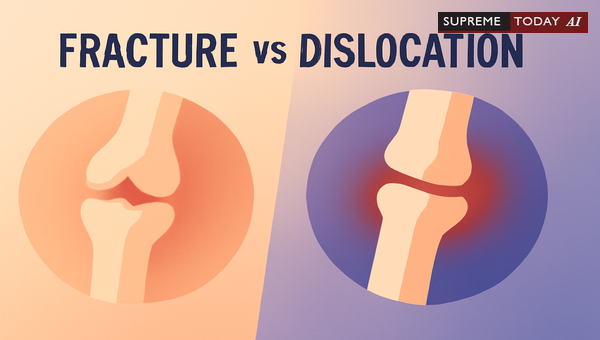
Fracture vs Dislocation: in IPC Explained
In personal injury cases, understanding the nature of harm is crucial—especially when it comes to bones and joints. Imagine a victim involved in an assault or accident: was it a fracture (a break in the bone) or a dislocation (a joint displaced from its position)? These terms are often confused, but the question arises: Fracture and Dislocation are Different Medical Science. Yes, medically they are distinct, yet under Indian law, both can qualify as when severe enough. This blog explores the medical and legal distinctions, drawing from key judgments and medical insights to clarify this for victims, lawyers, and the public.
Note: This is general information based on judicial precedents and should not be taken as specific legal advice. Consult a qualified lawyer for your case.
Medical Science: Clear Distinctions Between Fracture and Dislocation
From a medical standpoint, fracture and dislocation are fundamentally different injuries, each with unique mechanisms, diagnoses, and treatments.
Fracture refers to a break in the continuity of a bone. This can range from a simple crack to a comminuted fracture with multiple fragments. As explained in legal documents, fracture involves cutting of the bone through and through, partial cutting of the bone, cracking, splintering or rupture of a bone 2006 0 Supreme(Bom) 676. It does not require the bone to be cut completely through or for fragments to displace; a rupture or fissure suffices 2006 0 Supreme(Bom) 676.
Dislocation, on the other hand, involves the displacement of a bone or joint out of its normal position without necessarily breaking the bone. Medical literature like Campbell’s Operative Orthopaedics highlights this, noting no such terminology as minor/major elbow dislocation—severity depends on the joint and displacement
.
These distinctions are rooted in orthopedic science. For instance, a Colle’s fracture affects the distal radius from falls, while elbow dislocation requires reduction (realignment)
. Sometimes, injuries combine both, termed fracture-dislocation, like fracture dislocation right ankle with fracture posterior malleolus 2025 Supreme(Online)(SCDRC) 31669 or posterior fracture dislocation of the hip 2025 Supreme(Online)(Ker) 15428.
Legal Framework: Both as Under
Under Section 320 of the , is defined with specific clauses. explicitly includes fracture or dislocation of a bone or tooth as 2019 0 Supreme(Jhk) 885 2018 0 Supreme(Jhk) 350.
Courts have consistently upheld that:- Fracture means a break by cutting, splintering, rupture, or fissure in the bone—no full severance or displacement needed 2006 0 Supreme(Bom) 676 1993 0 Supreme(Ori) 108 2004 0 Supreme(P&H) 348.- Dislocation is the displacement of a bone or joint, equally grievous 2006 0 Supreme(Bom) 676.
The Supreme Court in key rulings emphasizes severity over superficial appearance. For example, It is not necessary that a bone should be cut through and through or that the crack must extend from the outer to the inner surface or that there should be displacement of any fragment of the bone 2006 0 Supreme(Bom) 676. Both are treated similarly legally if they impair function significantly 1992 0 Supreme(Ori) 59
2001 0 Supreme(P&H) 1.
Judicial Consistency and Precedents
Indian courts rely on medical evidence to differentiate and classify these injuries:
- In 1993 0 Supreme(Ori) 108, injuries involving fracture or dislocation of bones/teeth are deemed grievous, focusing on the nature of injury rather than description.
- 2004 0 Supreme(P&H) 348 reinforces: fracture as a break in bone continuity, dislocation as displacement, both grievous when severe.
- Cases like motor accidents highlight combined injuries: fracture of right femur, fracture of right tibial condyle, right knee dislocation 2024 Supreme(Online)(KAR) 8, or united fracture in left calcaneum and compound fracture dislocation of lisfranc joint 2022 Supreme(Online)(MAD) 41652.
Even in forensic contexts, distinctions matter: fracture-dislocation of the cervical vertebrae—common in judicial hanging but rare in strangulation
. Courts demand radiological and clinical proof; mere claims won't suffice 2021 0 Supreme(Gau) 486 2019 0 Supreme(Gau) 1138.
Insights from Medical Literature and Additional Cases
References to Dorland’s Pocket Medical Dictionary and Campbell’s Operative Orthopaedics in judgments underscore the medical divide: fracture as a break, dislocation as displacement2006 0 Supreme(Bom) 676.
Other sources affirm:- No formal minor/major dislocation terms; classification by joint and associated damage
.- Fracture-dislocations (e.g., ankle, hip) are complex, needing specialized care 2025 Supreme(Online)(SCDRC) 31669 2025 Supreme(Online)(Ker) 15428.- Post-mortem reports note: Injury, disease or deformity, fracture and dislocation – Nil or absent, stressing precise diagnosis 2015 0 Supreme(Gau) 211 2021 0 Supreme(Gau) 486.
This integration of medical science ensures fair legal outcomes, preventing minor hurts from being escalated.
Exceptions, Limitations, and Practical Considerations
Not every bone injury qualifies:- Superficial or minor damage may not count as grievous; severity is key 2006 0 Supreme(Bom) 676.- Medical evidence is essential—X-rays, CT scans, expert opinions distinguish fracture from dislocation 1993 0 Supreme(Ori) 108.- In claims, like compensation for fracture dislocation at tarso-metatarsal level stabilized by K-wires, proof sways tribunals 2022 Supreme(Online)(MAD) 41652.
Recommendations for Legal Practitioners and Victims
- Gather detailed medical reports specifying fracture (break) vs. dislocation (displacement) and severity.
- Argue under with precedents like 2006 0 Supreme(Bom) 676, emphasizing rupture/fissure for fractures.
- For combined injuries, highlight complexity for higher compensation, as in auto accident cases 2024 Supreme(Online)(KAR) 8.
Conclusion and Key Takeaways
Fracture and dislocation are indeed different in medical science—one a bone break, the other a joint displacement—but Indian law groups both as under when significant. Judicial consistency, backed by medical literature, ensures justice based on evidence, not assumptions.
Key Takeaways:- Medically: Fracture = break; Dislocation = displacement.- Legally: Both grievous if severe; prove with medicals.- Always consult experts for cases involving bones/joints.
References: 2006 0 Supreme(Bom) 676, 1993 0 Supreme(Ori) 108, 2004 0 Supreme(P&H) 348,
, 2025 Supreme(Online)(SCDRC) 31669, and others cited. #GrievousHurt #IPCSection320 #FractureDislocation















