


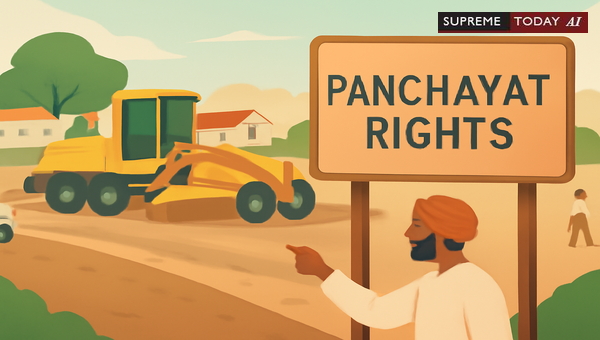
Can Gram Panchayat Raise Street Level Without Consent in Haryana?
In rural Haryana, disputes often arise when Gram Panchayats decide to level or raise streets adjacent to private houses. A common question from property owners is: can gram panchayat in Haryana uproot the level of street without the consent of owner of houses adjacent to street? This issue touches on public land management, property rights, and statutory powers under key laws like the . This blog post breaks down the legal framework, pivotal judgments, and practical implications to help you understand your rights and options.
Legal Framework: and Panchayat Authority
Gram Panchayats in Haryana manage lands, which include streets, lanes, and other common areas for village benefit. As defined in Section 2(g)(4) of the , encompasses lands used or reserved for the benefit of the village community, such as streets, lanes, playgrounds, wells, or ponds within (built-up area) or (village area) 1986 0 Supreme(P&H) 24.
Under Section 4 of the Act, all rights, title, and interests in such lands vest exclusively in the Gram Panchayat 1986 0 Supreme(P&H) 24. This vesting empowers Panchayats to manage, utilize, and even change the user of these lands for community purposes, such as constructing chaupals (village halls) or public utilities, per Rule 3 of the Punjab Village Common Lands (Regulation) Rules, 1964 1986 0 Supreme(P&H) 24.
However, these powers are not absolute. Courts emphasize that alterations to streets—essential for public access—must align with public interest and statutory limits. Arbitrary changes or those involving intent can be challenged 2018 0 Supreme(P&H) 1900.
Judicial Precedents: Panchayat's Power to Alter Street Levels
Haryana courts have consistently upheld Panchayats' authority to level or raise streets without individual property owners' consent, provided the land is .
In a key ruling by Justice Amit Rawal, the affirmed that Panchayats can change the user of street land for public welfare, including road construction or leveling, as long as actions stay within statutory bounds 2018 0 Supreme(P&H) 1900. The court noted: Panchayats are empowered to utilize land, including streets, for purposes like constructing chaupal, and can transfer such land for public welfare 2018 0 Supreme(P&H) 1900. Challenges succeed only if or extraneous considerations are proven.
Supporting this, another High Court decision states: Since the street is vested in the Gram Panchayat and is managed by it, it is the sole prerogative of the Gram Panchayat to see as to at what level the street is to be maintained
. Here, the Panchayat's plan to adjust street levels was upheld despite objections from adjacent owners, highlighting factional disputes but prioritizing public management.
In cases involving drains and passages, Panchayats have raised street levels for infrastructure. For instance, the Gram Panchayat sought to construct pacca drains as well as passage by raising level of the street, and courts favored this for village benefit, even against plaintiffs' claims
. Similarly, construction of drains under was permitted, as it served public utility without stalling on illusory apprehensions of flooding 2000 0 Supreme(P&H) 1494.
Property Owners' Rights and Limitations
Adjacent house owners typically hold possessory rights up to their boundaries but no ownership over the street itself, which vests in the Panchayat 1986 0 Supreme(P&H) 24. Courts distinguish possession from title: Encroachments on public streets or land can be removed through civil suits for , even if the land remains vested in the Panchayat 2016 0 Supreme(P&H) 1766 2018 0 Supreme(P&H) 1900.
Owners may seek injunctions against unauthorized encroachments on their property, but they cannot block Panchayat-led public works on streets. For example:- In a suit for , courts ruled that obstructing public streets warrants removal, affirming civil court jurisdiction under the 1961 Act 2000 0 Supreme(P&H) 532.- Property owners' access rights exist, but the public has a right to pass and repass over every inch of a highway or a public street, and adjacent owners have access only where their land touches it 2022 0 Supreme(Mad) 1387.
Encroachments, like gates or projections, are removable: Down the Kacha Rasta... defendants had erected iron gate which restricts entry... to the paved/pucca street constructed by Gram Panchayat 2026 Supreme(Online)(P&H) 552. Suits for removal are maintainable, even against Panchayat orders 2016 0 Supreme(P&H) 1766.
Challenges and Remedies for Property Owners
If a Panchayat oversteps—e.g., encroaching on private land or acting —owners can:1. File a civil suit for injunction or declaration of title.2. Approach the Collector under for title disputes 2017 0 Supreme(P&H) 209.3. Seek judicial review if procedural safeguards are ignored.
Civil courts retain jurisdiction for encroachments, distinguishing administrative from civil remedies: Suits for removal of encroachments on public land are maintainable and do not violate statutory provisions 2016 0 Supreme(P&H) 1766. However, title questions over bar under 2017 0 Supreme(P&H) 209.
In one case, a Panchayat's threat to dig up/uproot the pucca construction of the street was contested, but courts deferred to Panchayat management unless proven unlawful
.
Key Takeaways
- Panchayats generally can raise or level streets without adjacent owners' consent, as streets vest in them as 1986 0 Supreme(P&H) 24 2018 0 Supreme(P&H) 1900.
- Owners' rights are limited to access and protection from private encroachments, not vetoing public works.
- Encroachments removable via civil suits; public interest prevails 2016 0 Supreme(P&H) 1766.
- Challenges possible for actions or private land trespass.
Conclusion
Gram Panchayats in Haryana hold significant authority over street management to serve village needs, often without needing individual consents for alterations. While property owners have protections, public welfare typically trumps private claims. Always verify land status via revenue records and consult a lawyer for case-specific advice.
Disclaimer: This post provides general information based on judgments like 2018 0 Supreme(P&H) 1900, 1986 0 Supreme(P&H) 24, 2016 0 Supreme(P&H) 1766,
, and others. It is not legal advice; outcomes depend on facts. Seek professional counsel for your situation. #GramPanchayatLaw #HaryanaPropertyRights #ShamilatDeh












