


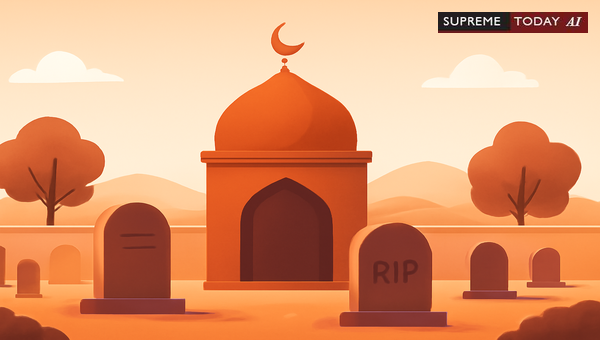
Is Graveyard Land Protected Under ?
In India, where diverse religious communities coexist, disputes over land used for religious purposes like graveyards are common. A key question arises: Land having Graveyard is Protected under . This issue touches on sacred rights, historical usage, and legal protections under Islamic principles and statutory laws. Whether it's a community claiming long-standing burial rights or authorities attempting to repurpose land, understanding the legal framework is crucial.
This blog post delves into the legal status of graveyard land under , drawing from judicial precedents and key principles. Note: This is general information based on legal precedents and not specific legal advice. Consult a qualified lawyer for your situation.
Overview of Graveyard Land Under
, also known as Muslim Personal Law, treats graveyards as sacred spaces integral to religious practices. Courts have consistently recognized the necessity of burial grounds for the Muslim community, imposing a duty on the state to provide suitable land. The has emphasized this as a 2018 6 Supreme 73.
Land designated as a graveyard often qualifies as wakf property—a dedicated to God under Islamic law. Once established through usage, it gains protected status, preventing without proper authorization 2013 0 Supreme(Gau) 630.
Key Legal Principles Protecting Graveyard Land
Several core principles underpin the protection of graveyard land:
Necessity and State Duty: The growing need for burial spaces has led courts to affirm the state's responsibility. This ensures Muslim communities have access to graveyards as essential religious facilities 2018 6 Supreme 73.
Wakf Classification: Graveyards are typically deemed wakf property. Under the the land would be deemed to be Waqf. The land will thus treated to be dedicated to God Almighty 2012 0 Supreme(All) 226. Any without sanction under is void 2022 0 Supreme(SC) 1252.
Historical and Continuous Use: Long-term usage (e.g., over 100 years) establishes community rights. Courts uphold claims based on this, as seen in disputes where land was used '' for burials, making it waqf even without formal dedication 2013 0 Supreme(Gau) 630 2017 0 Supreme(Gau) 1137 2023 0 Supreme(Pat) 1147.
Public vs. Private Graveyards: Distinctions exist. A graveyard is a which is confined only to the burial of corpses of the founder, his relations or his descendants... On the other hand, if any member of the public is permitted to be buried in a graveyard and this practice grows so that it is proved by instances adequate in character, number and extent, then the presumption will be that the ... 2007 0 Supreme(All) 3196 1996 0 Supreme(P&H) 1820. , open to the community, receive stronger protections.
Immutable Character: Under the , once a graveyard is always a graveyard. It cannot lose its identity or character as graveyard by passage of time 2007 0 Supreme(All) 3139. Evidence of graves (pucca or kuchcha) solidifies this status.
Judicial Precedents and Court Rulings
Courts have reinforced these principles in numerous cases:
In one ruling, historical community use trumped other claims, directing resolution per 2013 0 Supreme(Gau) 630.
Revenue records play a pivotal role: Entries as ', graveyard, or Masjid' are conclusive, prioritizing protection over non-use claims 2024 0 Supreme(P&H) 1316 2023 0 Supreme(P&H) 2206.
However, mere burial of a few family members doesn't create wakf: A number of instances are necessary to reach to the conclusion that the land is graveyard in the sense known to Islamic law 2012 0 Supreme(All) 3207.
Even government land used historically may gain protected status through community acknowledgment, though official records determine final classification 2025 0 Supreme(Guj) 1038.
Disputes involving encroachments (e.g., schools on graveyard land) can be challenged via , with orders for and preservation 2024 0 Supreme(J&K) 19 2023 0 Supreme(J&K) 453.
These precedents illustrate that typically, graveyard land enjoys robust safeguards, but proof of public, continuous use is essential.
Challenges and Evidence Requirements
Proving graveyard status isn't automatic. Key factors include:
Number of Burials: Single or family burials insufficient; needs 'adequate instances' for public wakf 2012 0 Supreme(All) 3207.
Revenue Entries: Pre-abolition records (e.g., '') can support wakf claims 2012 0 Supreme(All) 226.
Community Rights: Local Muslims' long-standing use affirms dedication 2023 0 Supreme(Pat) 1147.
In legal proceedings, present historical evidence, witness testimonies, and records. Engage the early for validation.
Related aspects under include and , where wakf land follows religious customs without infringing personal laws
2025 2 Supreme 624 2024 0 Supreme(UK) 292.
Practical Recommendations
Facing a graveyard land dispute? Consider these steps:
Gather Evidence: Photos of graves, revenue records, community affidavits.
Involvement: Seek certification or approval; unauthorized transfers are void 2022 0 Supreme(SC) 1252.
Legal Remedies: File suits or to protect status
.
Avoid : Sale or repurposing is generally impermissible if wakf is established.
Authorities may acquire or manage land for burials if needed, respecting religious rights.
Conclusion and Key Takeaways
Under , land used as a graveyard—especially public ones with historical, continuous community use—is generally protected as wakf property. Courts prioritize its sacred status, preventing and affirming immutable character. Revenue entries and precedents provide strong defenses in disputes.
Key Takeaways:- Historical use + community access = wakf presumption.- Once graveyard, always graveyard 2007 0 Supreme(All) 3139.- Consult and lawyers for specifics.
References:- 2018 6 Supreme 73 2013 0 Supreme(Gau) 630 2022 0 Supreme(SC) 1252 2017 0 Supreme(Gau) 1137- 2012 0 Supreme(All) 3207 2012 0 Supreme(All) 226 2007 0 Supreme(All) 3196 2007 0 Supreme(All) 3139 1996 0 Supreme(P&H) 1820 2023 0 Supreme(Pat) 1147 2024 0 Supreme(P&H) 1316 2023 0 Supreme(P&H) 2206 2025 0 Supreme(Guj) 1038 2024 0 Supreme(J&K) 19 2023 0 Supreme(J&K) 453
2025 2 Supreme 624 2024 0 Supreme(UK) 292
This framework ensures Muslim burial rights endure, balancing community needs with legal order. Stay informed on evolving jurisprudence.
#MohammedanLaw, #WaqfGraveyard, #MuslimLandRights












