


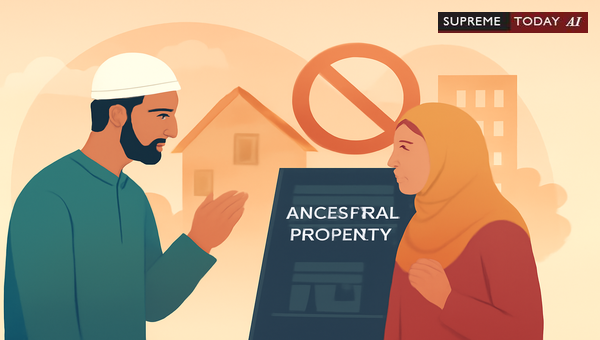
Can You Stop Your Father from Selling Under Muslim Law?
In family disputes over property, emotions often run high, especially when it involves what one perceives as '.' A common question arises: How can I stop my father from selling in Muslim law? This issue pits individual rights against familial expectations, but offers a distinct framework compared to other systems like Hindu law.
This blog explores the legal landscape, highlighting why preventing such a sale is challenging, potential avenues for intervention, and key distinctions from joint family concepts. Remember, this is general information based on established principles and case insights—always consult a qualified lawyer for advice tailored to your situation.
Understanding in Muslim Law
Unlike Hindu law's , Muslim law does not recognize the concept of ancestral or joint family property. Property inherited by a Muslim is treated as , governed strictly by rules of inheritance upon the owner's death, not during their lifetime. 2017 0 Supreme(MP) 537
As noted in legal precedents, Thus, unlike Hindu law, there is no provision for any ancestral or joint family property. Accordingly, under Muslim law of inheritance, no distinction has been made between self acquired and . 2025 Supreme(Online)(Guj) 12756 This means your father, as the owner, holds full rights to dispose of the property freely—sell, gift, or will it—absent any legal restrictions like contracts or court orders.
The owner's consent is paramount, and heirs have no to block during the owner's life. This absolute ownership stems from Islamic principles emphasizing individual disposition, contrasting sharply with systems where family members have birthrights in undivided property.
Key Differences from Hindu Law
To appreciate Muslim law's stance, consider Hindu law contrasts, often highlighted in judgments:
In Hindu law, forms part of a coparcenary, where sons (and now daughters post-amendments) have undivided interests by birth. A father (karta) can sell only for . 2012 0 Supreme(Bom) 2326 is a species of coparcenary property. The property inherited by a Hindu from his father, father's father, father's father is .
Muslim law rejects this: No coparcenary exists, so no inherent heir restrictions on sale. 2017 0 Supreme(MP) 537 2025 2 Supreme 624
For instance, Hindu cases discuss and sales for family debts, but these don't apply to Muslims. 2025 0 Supreme(Mad) 4516 In one Hindu context, sales were upheld for clearing debts and family expenses, but plaintiffs were barred by limitation if aware. Such presumptions of joint enjoyment don't translate to Muslim scenarios.
This distinction is crucial: What might be 'ancestral' in a Hindu family is simply 'owned' under Muslim law.
Legal Grounds for Challenging or Restricting the Sale
Generally, there are no specific restrictions under Muslim law on selling inherited property. However, courts may intervene on procedural or equitable grounds. Here's when you may have a case:
1. , , or
If the sale involves deceit—e.g., forged documents, , or threats—you can challenge it post-sale for annulment. Evidence is key; courts prioritize proof of illegality over familial sentiment.
2. Claim of or Heir Rights
- If the property was inherited jointly (e.g., from a grandfather, shared among siblings including your father), you might claim a share as an heir. File a or declaration of shares, potentially requiring all co-owners' consent for sale.
- But if your father received it absolutely (common in Muslim succession), this doesn't apply.
3. Imminent Sale: Seek an Injunction
- Approach court for a if sale is underway and allegedly fraudulent or collusive. Courts grant this sparingly, needing strong evidence.
- follow if rights are violated.
4. Gifts and Revocability (Limited Relevance)
Under some schools (e.g., Shafei), a father may revoke gifts to children if not disposed of, but this rarely blocks sales of owned property.
A father or any ancestor may, under the Shafei law, revoke a gift 'in favour of a child or other descendant, provided that the donee has not irrevocably disposed of the thing received, e.g., by selling...
Legal Limitations and Practical Considerations
Preventing a sale purely on 'ancestral' grounds is typically not feasible under Muslim law. Courts intervene based on:- Procedural violations (e.g., improper execution).- Rights of other heirs if co-owned.- Evidence of /.
Hindu analogies underscore this: Even there, unregistered partitions fail 2020 0 Supreme(MP) 928, or claims bar by limitation if delayed. 2025 0 Supreme(Mad) 4516 In Muslim contexts, delays weaken cases further.
Other factors:- Will or Agreement: If a will or restricts sale, enforce it.- Debts/Encumbrances: Sales to clear valid debts stand, akin to Hindu '' but without family veto.- : Suits require all potential heirs; late additions may fail. 2019 0 Supreme(Telangana) 207
Steps to Take If Concerned
- Gather Documents: Title deeds, inheritance proofs, sale agreements.
- Consult a Lawyer: Assess if or applies.
- File Urgently: For injunctions, time is critical— apply.
- Explore Mediation: Family courts or panchayats may resolve amicably.
- Post-Sale Challenge: If sold invalidly, sue for recovery/share.
Key Takeaways
| Aspect | Muslim Law | Hindu Law Contrast ||--------|------------|---------------------|| | No recognition; absolute individual ownership 2017 0 Supreme(MP) 537 | Coparcenary; birthrights 2012 0 Supreme(Bom) 2326 || Sale Restrictions | None generally; only etc. | required || Heir Intervention | Limited to /injunctions | common || Court Focus | Procedural illegality | Family equity often |
Conclusion
Under Muslim law, you generally cannot stop your father from selling his property unless proving , , or co-heir rights. The absence of ancestral coparcenary simplifies ownership but limits preemptive blocks. 2025 2 Supreme 624 2025 Supreme(Online)(Guj) 12756
Prioritize documentation and swift legal action. For personalized guidance, engage a specialist in —outcomes hinge on facts. Protecting family assets starts with understanding these nuances.
This post draws from legal principles and judgments for educational purposes. It is not legal advice.
#MuslimLaw #AncestralProperty #PropertyRights















