Searching Case Laws & Precedent on Legal Query.....!
Analysing the retrieved Case Laws
Scanned Judgements…!



Searching Case Laws & Precedent on Legal Query.....!
Analysing the retrieved Case Laws
Scanned Judgements…!
State Government Policy on Unauthorized Constructions - The Himachal Pradesh government formulated a policy via SRO 391 dated 20th September 2017 to regulate unauthorized constructions in notified areas. This policy was enacted before the deadline of 30th September 2017, as authorized by the Himachal Pradesh Act of 2014, which empowered the government to create such regulations for local areas including Jammu, Srinagar, and Katra ["2024 0 Supreme(J&K) 193"].
Judicial Review and Policy Decisions - The High Court of Himachal Pradesh has consistently held that policy decisions made by the State Government are not subject to judicial review unless they are unreasonable, arbitrary, or mala fide. Courts have emphasized that policy decisions are within the domain of the executive and generally cannot be questioned, as exemplified in cases like Delhi Science Forum v. Union of India and decisions relating to land acquisition and administrative actions ["2025 0 Supreme(HP) 855"] ["2024 Supreme(Online)(HP) 10054"] ["2022 Supreme(Online)(MAD) 9440"].
Court Interventions in Unauthorized Constructions - While the Court recognizes the authority of the government to formulate policies, it has intervened in specific cases involving illegal constructions, ordering removal or regularization when violations are evident. For example, the Court directed the removal of illegal boundary walls and emphasized the importance of compliance with legal orders, but these actions are distinguished from challenging policy formulations themselves ["2023 0 Supreme(HP) 265"].
Policy Implementation and Exceptions - The courts have upheld policies related to construction regulation, including incentives like concessional electricity rates, but have clarified that such policies are not binding if they conflict with overarching legal or constitutional provisions. Additionally, decisions regarding land acquisition and infrastructure development have been upheld when taken as part of policy frameworks, even if contested by stakeholders ["2025 0 Supreme(HP) 394"] ["2024 Supreme(Online)(HP) 10054"].
Summary - Overall, the Himachal Pradesh High Court has maintained a stance that policy decisions by the State Government, especially concerning unauthorized constructions and administrative measures, are generally immune from judicial review unless they are manifestly unreasonable or mala fide. The courts have consistently recognized the executive's prerogative to decide on policy matters, with judicial interference limited to instances of illegality or arbitrariness.
References:["2024 0 Supreme(J&K) 193"]["2023 0 Supreme(HP) 265"]["2025 0 Supreme(HP) 855"]["2025 0 Supreme(HP) 394"]["2024 Supreme(Online)(HP) 10054"]["2022 Supreme(Online)(MAD) 9440"]
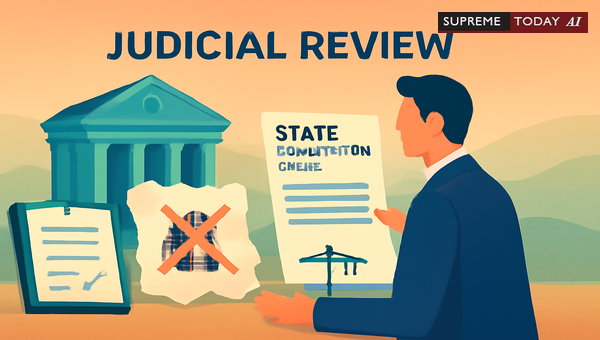
In the realm of urban development and land use, state governments often formulate policies to regulate construction activities. However, when these policies face legal challenges, courts play a crucial role in balancing with constitutional safeguards. A pertinent question arises: State government policy for construction questioned by High Court of Himachal Pradesh. This blog delves into the 's rulings, highlighting how such policies are treated as executive decisions that can be modified, yet remain subject to judicial scrutiny.
Drawing from key judgments, we'll examine the nature of these policies, the scope of , and implications for developers, landowners, and authorities. This analysis is for informational purposes only and does not constitute legal advice—consult a qualified attorney for specific cases.
The has consistently emphasized that the State government’s policy regarding construction and development is a matter of , subject to constitutional and statutory provisions. Policies are not immutable laws and can be modified or rescinded by the State, provided actions align with the law and do not violate constitutional principles 1961 0 Supreme(SC) 150.
Key points include:- State policies on construction are executive decisions and not legally binding mandates1961 0 Supreme(SC) 150.- The State holds authority to amend, modify, or revoke policies on construction, development, and regularization of 2005 3 Supreme 46.- Policies must be implemented fairly within constitutional and statutory frameworks and cannot contravene legal provisions or rights 2007 0 Supreme(SC) 730.
The Court underscores that while policy-making is the executive's domain, it is not beyond if it breaches statutes, procedural fairness, or constitutional mandates.
Policies related to construction, regularization, and development are primarily executive in nature. For instance, under the , allows exemptions from planning provisions upon payment of regularization fees. The High Court views these as , not laws, which the government can change or withdraw 2005 3 Supreme 46.
The Court highlighted that these policies are not laws but that can be changed or withdrawn by the government 2005 3 Supreme 46.
This stance aligns with broader judicial trends. In a comparable case from the , a government order halting construction of a State Level Co-operative Training Institute was upheld as a . The court noted: The decision taken by the Government in stopping the construction work... is a of the Government 2022 0 Supreme(Mad) 1686. This reinforces that such executive choices on construction projects are generally not interfered with unless unlawful.
While deference is given to executive policies, the HP High Court maintains vigilance. Policies are scrutinized if they violate statutory provisions or constitutional principles. In challenges to regularization policies for unauthorized constructions, the Court required valid reasons and proper procedures for amendments or revocations 2005 3 Supreme 46.
The Court rejected the argument that policies are beyond review, emphasizing that policies cannot be arbitrary or violative of law 2005 3 Supreme 46.
Constitutional limits, such as (equality), 21 (right to life), and 300A (property rights), bound policy-making. Any contravention invites judicial intervention 2007 0 Supreme(SC) 730.
Relatedly, in a under the , and , the court addressed construction permissions post-statutory amendments. It held that deletion of provisions like rendered permissions in perpetuity, as the normal effect of repealing a statute or deleting a provision is to obliterate it from the statute-book as completely as if it had never been passed 2024 0 Supreme(HP) 326. This illustrates how courts interpret policy shifts alongside statutes.
The State derives authority from constitutional provisions and enactments like the . Policies on land use and development are executive decisions without the force of law unless statutorily enshrined 2007 0 Supreme(SC) 730.
Amendments to policies on unauthorized constructions fall within this domain, provided they are transparent and non-arbitrary1961 0 Supreme(SC) 150. Courts intervene only if decisions are manifestly arbitrary or unlawful2005 3 Supreme 46.
Government decisions to withdraw policies, such as land regularization schemes, are permissible but must follow . The HP High Court stresses transparency: such decisions should be made transparently and in accordance with law 1961 0 Supreme(SC) 150.
Exceptions include:- subject to being struck down 1961 0 Supreme(SC) 150.- Violations of or statutes trigger review 2007 0 Supreme(SC) 730.- No interference in lawful executive domain2005 3 Supreme 46.
Supreme Court rulings reinforce restraint in policy matters. For example, courts cannot direct legislatures to enact laws, as in challenges to HP's land reforms 2017 2 Supreme 208. Similarly, prioritization of funds for infrastructure is executive prerogative, not subject to unless arbitrary 2016 3 Supreme 575.
In the Madras case, cancellation of sanctions for a training institute was deemed a valid policy shift: The said is justifiable and acceptable within the touchstone of the legal principle... within the constitutional framework 2022 0 Supreme(Mad) 1686. These parallels highlight a consistent judicial approach across states.
To navigate this landscape:- States should amend policies transparently, justifying changes and complying with laws.- Developers and landowners must monitor policy updates, ensuring compliance with current statutes like the HP Town Planning Act.- Courts uphold review to curb arbitrariness.
In summary, the recognizes state construction policies as administrative prerogatives, revocable in accordance with law, with courts safeguarding constitutional integrity. This balance promotes orderly development while respecting governance. Always seek professional legal counsel for your situation, as outcomes depend on specific facts.
#HPHighCourt #ConstructionPolicy #JudicialReview


While the aforesaid petition was pending adjudication in this Court, the then State Government came up with a policy promulgated vide SRO 391 dated 20th September, 2017 to regulate unauthorized constructions in certain notified areas. ... ––Nothing contained in any law, rule, regulation, bye-law or order, for the time being in force in the State, shall prevent the Government from formulating a policy before 30th day of September, 2017 to deal with or regulate unauthor....

“In compliance to the orders dated 29.10.2020 passed by the Hon’ble High Court of H.P. in CWP No. 2694 of 2020 titled as N.D. ... Pradesh Municipal Corporation Act, 1994, and in compliance to the orders dated 29.10.2020 passed by the Hon’ble High Court of H.P. in CWP No. 2694 of 2020 titled as N.D. ... State of H.P. the case was taken up on 06.11.2020 but despite the best knowled....
Similar view has been taken by Division Benches of this High Court in LPA No.321 of 2024, titled State of H.P. and others v. Gian Chand and others, decided on 3.1.2025; and LPA No.68 of 2025, titled State of Himachal Pradesh and others v. ... State of Himachal Pradesh and others, (2022) 7 SCC 508; Civil Appeal No.1278 of 2023, State of Himachal Pradesh....

basis by the H.P State Electricity Board and it would not be binding upon the State Government during the applicability of this Policy. ... Incentives of concessional rate of electricity charges would be notified in the Schedule of Tariff for Himachal Pradesh on year to year basis by the H.P. State Electricity Board and it would not be binding upon the State Government....

When this communication, dated 28.07.2021 was under challenge in the first writ petition, Mr.P.H.Arvindh Pandian, learned Senior counsel appearing for the petitioner would contend that, a policy decision had been taken by the State Government to establish a State Level Co-operative Training Institute ... The said decision taken by the Union Government to locate at Hubli instead of Bangalore was questioned before the High C....
of the State Level Training Institute at Yercaud since was cancelled, that Government Order also had been questioned in the second writ petition, i.e., W.P.No.25287 of 2021. ... Therefore such a policy decision cannot be questioned before this Court by way of judicial review. 49. ... The said decision taken by the Union Government to locate at Hubli instead of Bangalore was questioned#HL_EN....
The State Government has signed a MOA with the Government of India in this regard. The Revenue Department has already brought down the stamp duty from 8% to 5%. ... Further section 32 provides for appeal against the order passed under section 31 and the State Government has power of revision under section 33. ... To cut the issue short, in the year 2021, proceedings were initiated against the petitioner under Section 254(6) and 253 of the Himachal Pradesh Municipal Co....
When this communication, dated 28.07.2021 was under challenge in the first writ petition, Mr.P.H.Arvindh Pandian, learned Senior counsel appearing for the petitioner would contend that, a policy decision had been taken by the State Government to establish a State Level Co-operative Training Institute ... The said decision taken by the Union Government to locate at Hubli instead of Bangalore was questioned before the High C....

by the State Government. ... decisions were questioned. ... If at all, a policy decision already been taken by the State Government to establish a State IN THE HIGH COURT OF JUDICATURE AT MADRAS ... herein above as a policy decision, cannot be questioned before this p style="position:absolute;white-space:pre;margin:0;padding:

While making this Court peruse judgment passed by this Court in Shankar Dass v. State of Himachal Pradesh in In case titled, State of Himachal Pradesh v. Umed Ram Sharma , whereby this Court, while placing reliance upon aforesaid judgments passed by the Hon’ble Apex Court, rejected the plea of delay and laches raised by the respondents-State and directed respondents to initiate acquisition pr....

With rapidly increasing motorisation, India is facing an increasing burden of road traffic injuries and fatalities. Sections 279 and 304A can be invoked only if act of the accused is negligent and rash. As observed by this Court in the case of State of Himachal Pradesh vs.
The High Court of Himachal Pradesh held as follows:- In the case in hand it stands proved that in case the houses were ready within the stipulated period the Board would not be liable to pay interest.

These directions were issued by the Division Bench while allowing a writ petition which challenged an order dated 23 April 2014 of the revenue authorities. 3. The State of Himachal Pradesh has called into question certain directions that were issued by a Division Bench of the High Court on 23 September 2016. The High Court called upon the State Government to amend the provisions of Section 118 of the H.P. Tenancy and Land Reforms Act, 1972 within a period of ninety days.
Two principal reasons were given: firstly, it is for the State Government to determine its priorities and allocate funds, even though it might be necessary to lay a communication network; secondly, the necessity could be fulfilled only on the availability of funds. 16. In State of H.P. v. High Court of H.P., (2000) 10 SCC 646 the High Court acted on a newspaper report and directed the construction of a certain road during the current financial year and the State Government was directed to make the funds available for the purpose. This Court found it extremely difficult to u....
That explains the emerging view that despite the embargo under Sec. 306 (4) (b) Cr.P.C., the High Court may in a given case release the approver on bail by calling into aid its inherent power under Section 482 Cr.P.C. FACTS SPECIFIC IN THE CASE ON HAND" (e) The Himachal Pradesh High Court in the decision in Rajesh Kumar v. State of Himachal Pradesh [2007 Cri. L.J. 2687] has observed as follows: The submission made by the learned counsel for the applicant is that keeping the applicant in detention for too long would amount to depriving him of his liberty, even though he is n....


An indispensable Tool for Legal Professionals, Endorsed by Various High Court and Judicial Officers
Please visit our Training & Support
Center or Contact Us for assistance

Scan Me!
India’s Legal research and Law Firm App, Download now!


For Daily Legal Updates, Join us on :



 Back to top


