


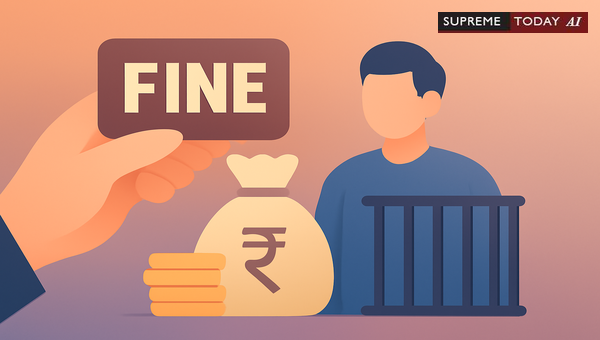
Fines Over Jail: Laws for Petty & First-Time Offenders in India
In the Indian criminal justice system, courts often prioritize rehabilitation over punishment for minor offenses, especially for petty offenders and first-time wrongdoers. A common question arises: What are the relevant provisions under law for imposing a fine instead of a sentence to petty offenders and first-time offenders? This approach not only reduces prison overcrowding but also gives offenders a chance to make amends without a full criminal record. However, fines come with caveats, particularly imprisonment in default of payment—a penalty that's distinct from a traditional sentence.
This blog explores key legal provisions under the and , drawing from judicial precedents and statutory analysis. Note: This is general information, not specific legal advice. Consult a qualified lawyer for your situation.
Understanding Imprisonment in Default of Fine
is not considered a sentence in the traditional sense but a penalty for failing to pay the imposed fine. The has clarified that this can be avoided simply by paying the fine, distinguishing it from mandatory imprisonment 2020 0 Supreme(Ker) 212 2014 0 Supreme(HP) 1330.
- It's a that ends immediately upon payment or recovery of the fine 1989 0 Supreme(Raj) 703.
- Courts treat it separately from , meaning it doesn't trigger the same legal consequences like under 2012 0 Supreme(Mad) 1500.
For petty offenders—those involved in minor thefts, public nuisances, or small-scale violations—and first-time offenders, judges frequently opt for fines to promote leniency. This aligns with the principle of .
Key Legal Provisions Governing Fines and Default Imprisonment
Provisions
: In every case in which an offender is sentenced to a fine or to , the imprisonment is in addition to any other imprisonment to which he may have been sentenced. This underscores that default imprisonment is additive and separate 1990 0 Supreme(Mad) 50.
: The imprisonment which is imposed in default of payment of a fine shall terminate whenever that fine is either paid or levied by the process of law. Exact quote: Imprisonment to terminate on payment of fine.- The imprisonment which is imposed in default of payment of a fine shall terminate whenever that fine is either paid or levied by process of law. 2023 0 Supreme(Chh) 430 2023 0 Supreme(Del) 3716.
These sections empower courts to impose fines primarily for lesser offenses, reserving jail only if unpaid.
Provisions
: Magistrates can impose imprisonment in default alongside for petty cases 2009 0 Supreme(Cal) 171 2014 0 Supreme(HP) 782.
: Does not apply to default imprisonment, as it's not a sentence 1990 0 Supreme(Ker) 15 2020 0 Supreme(Ker) 212.
For first-time and petty offenders, additional frameworks like the , allow release on probation with fines instead of jail, though not directly cited here. Default terms are capped, often at one-fourth of the maximum sentence for the offense
.
Why Default Imprisonment Isn't a 'Sentence'
Judicial consensus is clear: But the term of is not sentence. It is a penalty which the person incurs on account of non payment of fine. 2016 0 Supreme(Cal) 251 2014 0 Supreme(Mad) 34.
- Avoidable Nature: Accordingly, he can always avoid to undergo imprisonment in default of payment of fine by paying such an amount. 2023 0 Supreme(J&K) 130.
- No Concurrency: Default periods run consecutively unless specified, post-substantive sentence 2014 0 Supreme(Pat) 1127 2020 0 Supreme(Ker) 212.
- Termination on Payment: Even mid-term payment halts it 2024 0 Supreme(Raj) 1031 2022 Supreme(SRI)(SC) 672.
Example from Case Law: In one ruling, a convict faced 1-year rigorous imprisonment plus Rs. 2,000 fine, with 3 months simple imprisonment in default. Payment avoids the default entirely 2024 0 Supreme(Del) 518.
This distinction benefits petty and first-time offenders, as fines allow quick resolution without long-term stigma.
Limitations and Special Rules for Petty Offenses
- Time Granted for Payment: Imposing default imprisonment is generally illegal if time is granted for payment, barring exceptions
.
- Duration Caps: Limited to a fraction of the offense's maximum jail term
SRI00000079339
. - No : Pre-trial detention doesn't count against default periods 2012 0 Supreme(Mad) 1500.
For first-timers, courts may reduce fines or default terms, emphasizing reform. If the petitioner pays the fine/compensation now, he is not required to undergo default sentences. 2024 0 Supreme(Raj) 1031.
Strategic Considerations for Offenders and Advocates
When facing charges:
- Prioritize Payment: Prompt fine payment prevents default jail 1989 0 Supreme(Raj) 593.
- Negotiate Time: Request extensions to avoid immediate default
.
- Appeal Distinctions: Highlight that default isn't a sentence in pleas or revisions 1967 0 Supreme(All) 77.
Legal reps should clarify orders: distinguish from penalties to prevent misuse 2020 0 Supreme(Ker) 212.
Conclusion and Key Takeaways
Indian law favors fines over imprisonment for petty and first-time offenders via IPC Sections 64 & 68 and CrPC Sections 30 & 427. Imprisonment in default is a temporary penalty, not a sentence, terminable on payment—offering a practical alternative to jail 2020 0 Supreme(Ker) 212 1990 0 Supreme(Mad) 50 1989 0 Supreme(Raj) 593.
Key Takeaways:- Fines are preferred for minor offenses, with default jail avoidable.- Always pay promptly or seek time extensions.- Default periods are short, capped, and .- Consult professionals; laws evolve with case law.
By understanding these provisions, offenders can navigate minor cases effectively, aligning with justice system's rehabilitative goals. Stay informed, act swiftly.
#CriminalLawIndia, #PettyOffenders, #FineVsJail












