


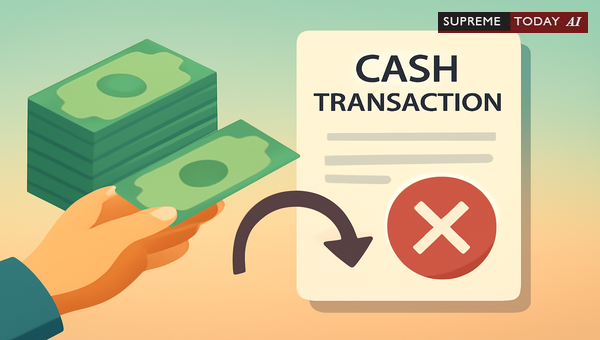
Cash Transactions Above Rs 20,000: Legal Limits in India
In today's digital economy, cash remains king for many small transactions, but when it comes to larger sums, Indian tax laws draw a firm line. A common query arises: cash transaction above Rs.20,000/- not allowed—is this true, and what are the implications? Under the , cash payments exceeding Rs 20,000 are generally restricted for business expenses, primarily to combat and promote banking channels. While not outright illegal, such transactions can lead to , penalties, and complications in legal enforceability. This post breaks down the rules, exceptions, court rulings, and practical advice.
Core Legal Provisions:
The cornerstone is Section 40A(3), which disallows deductions for business expenditures if payments exceed Rs 20,000 in cash. The , and associated rules restrict cash payments exceeding Rs. 20,000 1991 0 Supreme(SC) 374. This means if a business pays a supplier Rs 25,000 in cash, that expense cannot be claimed against taxable income, increasing the tax liability.
The provision targets : The law aims to curb and unaccounted cash transactions, and violations are viewed as contraventions with disallowances rather than outright illegality of the transaction itself 2025 7 Supreme 171. Importantly, the but loses tax benefits.
Related sections like (accepting loans/deposits over Rs 20,000 in cash) and (repaying deposits) impose similar curbs. For instance, At the time when was introduced... the amount covered under was Rs. 10,000 which was increased to Rs. 20,000 1998 0 Supreme(Mad) 1743. Violations here trigger penalties under .
Key Exceptions: Rule 6DD of Income Tax Rules
Not all cash deals are banned—Rule 6DD carves out exceptions for practical scenarios, especially in rural or unbanked areas. provides exceptions for certain transactions, such as payments to cultivators, producers, or suppliers of agricultural, horticultural, animal husbandry, dairy, poultry, fish, or related products 1967 0 Supreme(SC) 117.
Other exceptions include:- Payments in remote locations without banking facilities.- Transactions with government entities or banks.- Cases where the payee doesn't have a bank account.
The exceptions under Rule 6DD include payments to cultivators, producers of animal husbandry, dairy, poultry, fish, and horticultural products, among others, provided the conditions are met. These exceptions are meant to facilitate genuine transactions in rural or remote areas where banking facilities are unavailable 1967 0 Supreme(SC) 117. However, splitting payments to dodge the limit (e.g., two Rs 15,000 payments) is frowned upon: courts view it as evasion 2001 0 Supreme(Bom) 811 2025 0 Supreme(Ker) 1998.
Judicial Interpretations and Views
Courts have upheld these restrictions while clarifying nuances. The ruled: The has affirmed that payments for or raw materials made in cash above Rs. 20,000 are disallowed as expenditure, emphasizing that the word expenditure includes all outgoings, including payments for 1991 0 Supreme(SC) 374. The goal? Prevent circulation and do not render the transactions illegal per se but restrict their deductibility and enforceability.
In cheque bounce cases under the (), violations don't always invalidate claims. Violation of of the IT Act does not render a transaction under NI Act unenforceable 2025 Supreme(Online)(SC) 10662. One ruling set aside an acquittal, remitting for fresh consideration, stressing that tax breaches don't erase debt enforceability.
Another case affirmed: The transaction of advancement of loan of Rs.10 Lakhs, in cash, does is not illegal. The advancement of loan, in cash, to the tune of Rs.10 Lakhs is not prohibited in law 2016 0 Supreme(Del) 2730. Breach of doesn't negate the loan's existence, even without written agreements or ITR disclosure.
On repayments, applies only to deposits, not loans: The provisions of of the Income-tax Act, 1961, are not applicable to the repayment of loans 1998 0 Supreme(Mad) 1743. This distinction protects genuine loan repayments.
Penalty cases highlight discretion: Authorities must consider under . In one, the Tribunal erred in canceling a penalty for Rs 42.75 lakhs cash loans from agriculturists, as exceptions weren't proven 2016 0 Supreme(Guj) 1533.
Enforcement, Penalties, and Practical Implications
Non-compliance invites:- Disallowance of expenses under Section 40A(3).- Penalties up to the transaction amount under Sections 271D/E.- Judicial presumptions: Cash transactions over Rs 20,000 aren't without explanation, rebutting presumptions 2025 0 Supreme(Ker) 1998 1967 0 Supreme(SC) 117'>'1967 0 Supreme(SC) 117'.
Making cash payments above Rs. 20,000 without abiding by the prescribed conditions can lead to disallowance of expenses and penalties 1991 0 Supreme(SC) 374. Courts pierce veils like splitting: Judicial interpretations confirm that cash payments exceeding Rs. 20,000 in violation of these provisions are not considered 2025 0 Supreme(Ker) 1998.
In employment or recovery contexts, cash lapses can trigger scrutiny, but intent matters 2024 0 Supreme(Kar) 233. For cooperatives or auctions, tax rules don't nullify sales outright 2018 0 Supreme(Bom) 806.
Recommendations for Compliance
To stay safe:- Use cheques, drafts, or digital transfers (RTGS/NEFT/UPI) for payments over Rs 20,000.- Document exceptions under Rule 6DD meticulously—affidavits, location proofs.- Avoid splitting: In cases where cash payments are split into smaller amounts to circumvent the Rs. 20,000 limit, courts have observed such acts as attempts to evade law 2001 0 Supreme(Bom) 811.- Consult tax advisors for rural/agri deals.- Maintain records to rebut presumptions in disputes.
Entities should ensure compliance with the Rs. 20,000 limit for cash payments, or rely on valid exceptions under Rule 6DD. Proper documentation... can safeguard against disallowances and penalties 1967 0 Supreme(SC) 117.
Key Takeaways
- Cash over Rs 20,000 isn't banned but disallows tax deductions unless excepted.
- Rule 6DD protects genuine rural transactions.
- Courts prioritize substance but enforce via penalties, not invalidation.
- Banking channels minimize risks.
Disclaimer: This is general information based on prevailing laws and judgments as of the latest available data. Tax rules evolve; it does not constitute legal or tax advice. Consult a qualified professional for your specific situation.
References:- 1991 0 Supreme(SC) 374, 1967 0 Supreme(SC) 117, 2025 0 Supreme(Ker) 1998, 2025 7 Supreme 171, 2001 0 Supreme(Bom) 811, 2025 Supreme(Online)(SC) 10662, 1998 0 Supreme(Mad) 1743, 2016 0 Supreme(Del) 2730, 2016 0 Supreme(Guj) 1533 and others noted inline.
#CashTransactionLimit, #IncomeTaxIndia, #TaxCompliance















