


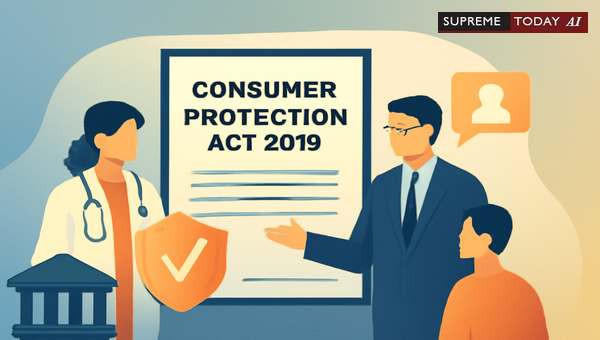
Is an Individual a Under the ?
In today's service-driven economy, consumers frequently engage individuals for various services, from freelance work to professional consultations. But can an individual who has provided a service to a be considered a '' under the (CPA 2019)? This question arises often in disputes involving claims. While the Act aims to protect consumers from , judicial interpretations have carved out specific exclusions, particularly for non-commercial or regulated professions. This post delves into the legal nuances, drawing from key judgments to clarify the scope.
Defining 'Service' and '' Under CPA 2019
The CPA 2019 does not explicitly define '.' Instead, the term is inferred from the definition of 'service' under , which covers services of any description provided for consideration in any trade or commerce. Typically, this applies to entities engaged in commercial activities. Courts have emphasized that 'service implies a commercial activity involving the provision of goods or services for consideration, which can be subject to protection laws.' 2024 4 Supreme 483
For an individual to qualify, their service must generally align with this commercial framework. However, exceptions abound, especially for professions deemed ''—unique and not purely commercial.
Key Exclusions: Professions and Institutions Not Considered Service Providers
The Nature of the Legal Profession
Judicial precedents firmly exclude advocates from being classified as service providers under CPA 2019. As observed, 'the legal profession is described as , meaning it is a unique, service-oriented, noble profession that cannot be equated with other traditional professions or commercial entities.' 2024 4 Supreme 483 The role of advocates, rooted in common law traditions, prioritizes service over commerce. Including them could flood with litigation, given the Act's . Professionals like lawyers are regulated by bodies such as the , creating a separate .
Similarly, medical practitioners face exclusion for analogous reasons, as their services are governed by the and distinct from commercial transactions. 2024 4 Supreme 483
Educational Institutions Outside the Scope
Universities and schools are generally not service providers. In a landmark view, 'an educational institution is not a under the Act, as its primary function is imparting education, which is not a commercial service.' 2010 5 Supreme 665 Students appearing for exams are not 'consumers,' rendering complaints against such institutions unmaintainable. This principle echoes in cases like Maharshi Dayanand University vs. Surjeet Kaur, affirming that education does not qualify as a service for consideration under the Act. 2010 5 Supreme 665
Co-curricular activities in schools, except coaching institutions, also fall outside CPA provisions. 2024 0 Supreme(Mad) 2331
When Individuals or Entities Qualify as Service Providers
Not all services escape the Act's ambit. Individuals or entities providing commercial services for consideration can indeed be service providers. Here are illustrative cases:
Railway Ticket Booking via : Booking tickets through establishes a clear - relationship, rejecting claims of no . 2026 Supreme(Online)(NCDRC) 47
Chit Funds and Financial Services: Operators refusing repayments after halting business are liable for deficiency. The onus lies on the to prove exclusion, and mere pleas without evidence fail. 'A plea without proof and proof without plea is no evidence in eyes of law.' 2024 4 Supreme 693
Builders and Developers: Homebuyers can approach against builders as service providers for delays or deficiencies, alongside civil remedies for specific performance. 'Or he can approach the Forum under the Protection Act, for relief as , against the builder as a .' 2019 1 Supreme 367
Arun Khanna VS Shashi Sharma
Postal Services: Delay in speed post delivery constitutes deficiency, allowing compensation under CPA, even if postal laws provide additional remedies.
Telecom Services: Individual complaints against providers remain maintainable before , distinct from group disputes under .
These examples highlight that individuals in commercial roles—like freelancers offering paid consulting (if not professions), repair services, or event planners—may qualify, provided the service is for consideration in trade or commerce.
and Status
Even if a service is commercial, the recipient must qualify as a '.' Pre-2002 amendments excluded purely commercial avails, but now, services for commercial purposes can still invoke CPA unless proven otherwise. The bears the burden: 'Onus to prove that service was obtained for a is on .' 2024 4 Supreme 693
K. KOMALAVALLY VS TELCO, ZONAL SERVICE OFFICE, COCHIN
Judicial Safeguards and Recommendations
Courts consistently limit CPA's scope to prevent overburdening forums:- Professionals' status safeguards against inclusion. 2024 4 Supreme 483- Educational roles remain non-commercial. 2010 5 Supreme 665
Key Takeaways for Businesses and Consumers:- For Providers: If you're an individual in a commercial service (e.g., builder, chit fund operator), prepare for CPA liability. Professionals should rely on regulatory bodies.- For Consumers: Verify if the provider falls under CPA; otherwise, pursue civil or professional remedies.- Policymakers: Clearer definitions in CPA 2019 could reduce ambiguity.
Conclusion
While an individual providing a service may be considered a under CPA 2019 if it's commercial and for consideration, exclusions for professions like law and medicine, or non-commercial education, are well-established. 2024 4 Supreme 483 2010 5 Supreme 665 Cases involving builders, postal delays, and financial services affirm inclusion where applicable. 2019 1 Supreme 367
This analysis is for informational purposes only and does not constitute legal advice. Consult a qualified lawyer for case-specific guidance, as interpretations may evolve with new judgments. Stay informed on rights to navigate disputes effectively.
#ConsumerProtectionAct #CPA2019 #ServiceProvider















