


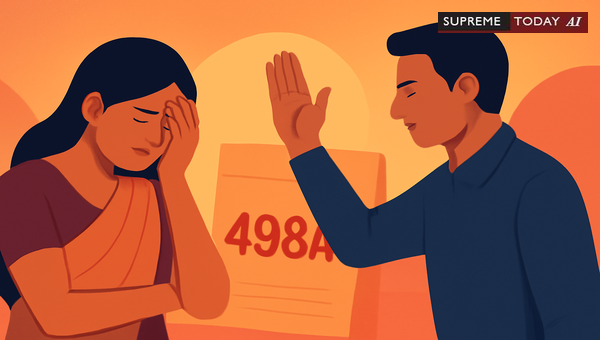
IPC 498A: Does It Constitute ? A Comprehensive Legal Analysis
In the realm of Indian criminal law, few sections generate as much debate and emotional intensity as . Enacted to protect married women from cruelty by husbands or their relatives, this provision has become a double-edged sword—hailed as a shield against domestic abuse yet criticized for misuse. A pressing question often arises: I P C Section 498a is a or Not? This blog post delves into judicial interpretations, conflicting precedents, and real-world implications, providing a balanced view.
Disclaimer: This article offers general information based on legal precedents and is not a substitute for professional legal advice. Consult a qualified lawyer for case-specific guidance.
Understanding : The Legal Foundation
refers to conduct contrary to community standards of justice, honesty, or good morals, often involving inherently immoral or unethical acts. Courts assess it on a case-by-case basis, considering factors like the offense's nature, societal impact, and whether it shocks the public conscience.
penalizes cruelty—physical or mental harassment—towards a woman by her husband or relatives, frequently linked to dowry demands. But does a conviction (or even allegation) under this section qualify as ? Judicial opinions diverge, influenced by context like employment, pensions, or service rules.
Arguments Classifying Section 498A as
Several courts have held that offenses under Section 498A involve , especially when impacting professional lives.
- In , the court explicitly stated that the offense under involves , justifying suspension or pension denial. 2014 0 Supreme(All) 1924
- Similarly, reaffirmed this, linking it to employment status and benefits. 2014 0 Supreme(All) 1924
- Under Rule 14 of the , convictions for such crimes bar pensions, classifying Section 498A accordingly. 2018 0 Supreme(Cal) 992
These rulings emphasize the offense's gravity against women, viewing it as a breach of familial and societal morals. A conviction can lead to disciplinary actions, job loss, or ineligibility for government posts.
Conviction under involves . 2014 0 Supreme(All) 1924
Counterarguments: Section 498A Not Involving
Contrasting views abound, particularly where courts deem Section 498A a private offense without inherent .
- One judgment argues: an offence under would not constitute an offence involving ... these sections do not involve the question of .
- Another states: offence under is not the offence relating to or corruption. 2018 0 Supreme(Raj) 221
- In employment contexts: allegations levelled against the petitioner in the criminal case do not constitute the offence of a ... 498A of the IPC... will not be considered eligible for appointment. Wait, this highlights scrutiny but notes non-eligibility only if turpitude applies—yet argues against it. 2024 Supreme(Online)(RAJ) 26833
Courts often note acquittals or non-serious conduct dilute claims of turpitude. For instance, offenses like Section 498A are seen as matrimonial disputes, not heinous crimes shocking societal fabric.
2023 0 Supreme(P&H) 2323
and : Offences under are generally considered private in nature and do not inherently involve unless the act shocks the moral conscience. (Summarizing integrated views from 2021 Supreme(Online)(KER) 10395 2022 0 Supreme(P&H) 545)
Judicial Precedents: A Split Verdict
| Case/Reference | View on | Key Quote/Implication ||---------------|--------------------------|----------------------|| 2014 0 Supreme(All) 1924 | Yes | Offence under involves – Affects pensions/employment. || 2018 0 Supreme(Cal) 992 | Yes | Denies benefits under service rules. ||
| No | Section 498A... would not constitute an offence involving . || 2018 0 Supreme(Raj) 221 | No | Not relating to or corruption. || 2024 Supreme(Online)(RAJ) 26833 | No | Allegations do not constitute for appointments. || 2019 0 Supreme(AP) 192 | Debated | Questions if 498A involves turpitude post-definition. |
This table illustrates the divide. High Courts like Punjab & Haryana
lean against automatic classification, while others prioritize victim protection. Factors like (e.g.,
) or non-listing in turpitude schedules (similar to in
) bolster the 'no' side.
Practical Implications: Employment, Pensions, and Beyond
- Employment: Suppression of 498A cases in job applications can lead to termination if discovered, even sans turpitude. Courts advise disclosure but protect against blanket disqualification. 2025 Supreme(Online)(CAT) 2550 2022 0 Supreme(P&H) 545
- Government Service: Police or judicial roles scrutinize heavily; convictions may halt careers unless appealed successfully. 2024 Supreme(Online)(CG) 8453
- Pensions/Benefits: Forfeiture possible if turpitude found, but reversible on . 2018 0 Supreme(Raj) 221
The impugned conviction would certainly affect his service career. 2024 Supreme(Online)(CG) 8453 (Though for , analogous caution for 498A.)
Exceptions exist: yet private nature under limits broader stigma. 2023 0 Supreme(P&H) 2323
Key Takeaways and Recommendations
- No Uniform Stance: Section 498A may involve per some courts (e.g., 2014 0 Supreme(All) 1924), but typically not in others (e.g.,
). Case facts matter.
- Seek Early Counsel: Accused should anticipate employment risks and pursue quashing/.
- Disclosure is Key: Honesty in applications prevents worse outcomes.
- Evolving Law: guidelines on 498A misuse (e.g., Arnesh Kumar v. State of Bihar) aid defenses.
In conclusion, while prevailing views in certain contexts label as with severe repercussions, a growing judicial consensus treats it as non-turpitudinous in private disputes. Each case demands individual scrutiny—highlighting the need for nuanced legal strategy.
References (Partial List): 2018 0 Supreme(Cal) 992 2014 0 Supreme(All) 1924 2018 0 Supreme(Bom) 47 2007 8 Supreme 405
2024 Supreme(Online)(RAJ) 26833 2018 0 Supreme(Raj) 221 2022 0 Supreme(P&H) 545 2021 Supreme(Online)(KER) 10395 #IPC498A, #MoralTurpitude, #IndianLaw












