


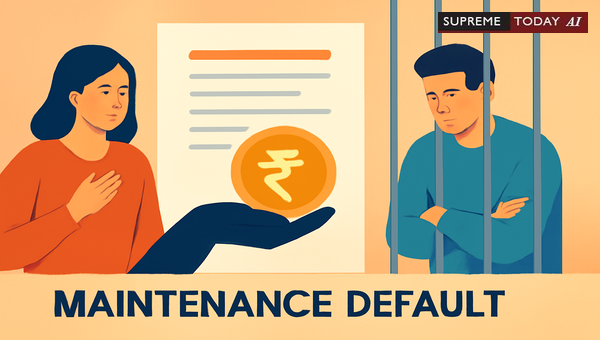
Does Jail Time Erase Husband's Maintenance Debt?
In family law disputes, are crucial for supporting spouses and children. But what happens when a husband defaults? A common question arises: Will sending the husband to jail for non-payment of maintenance exonerate him from his liability? This issue often leads to confusion, with some believing imprisonment settles the debt. However, Indian courts, guided by the , have clarified that jail time is merely a for —not a way to wipe out the obligation.
This blog post breaks down the legal framework, precedents, and practical implications. We'll draw from key judgments to explain why imprisonment does not discharge liability and what alternatives exist for recovery. Note: This is general information based on judicial trends and not specific legal advice. Consult a qualified lawyer for your situation.
The Core Legal Principle: Imprisonment as , Not
Under , if a person fails to pay maintenance without sufficient cause, the court may impose imprisonment for the whole or part of each month's allowance... to imprisonment for a term which may extend to one month or until payment if sooner made. 2021 0 Supreme(Raj) 1290 2021 0 Supreme(Raj) 1891. This provision underscores that jail is a mode of , not a substitute for payment. The liability persists even after serving time.
The in Shahada Khatoon emphasized: the maximum imprisonment is one month per default, and it does not satisfy the . Courts cannot impose indefinite or extended sentences beyond this limit for each defaulted period. 2021 0 Supreme(Raj) 1290. As one ruling notes, imprisonment is a mode of , not a mode of of the liability, and cannot be indefinite or coextensive with the default period. 2021 0 Supreme(Guj) 131 2008 0 Supreme(Guj) 325.
In essence:- No exoneration: Serving jail for a specific default does not erase the debt for that period.- Limit per default: Strictly one month maximum per month's unpaid maintenance.- Ongoing liability: Post-imprisonment, recovery shifts to civil methods like .
Clarification in Shahada Khatoon
The landmark Shahada Khatoon case resolved pre-existing ambiguities. Before this, some allowed cumulative sentences for multiple defaults, potentially exceeding one month total. However, the ruled that imprisonment cannot exceed one month per defaulted period, even in consolidated applications for several months' . 2021 0 Supreme(Raj) 1290 2021 0 Supreme(Raj) 1891.
Key takeaway from the judgment: The power of the Magistrate to impose imprisonment in maintenance cases is explicitly limited to one month per default. 2021 0 Supreme(Raj) 1290. This prevents courts from using jail as a punitive tool indefinitely, focusing instead on compelling payment.
Judicial Trends and High Court Interpretations
Post-Shahada Khatoon, have reinforced these limits. For instance, in a case under Section 125 CrPC, the court held: Where a person who has served imprisonment for a particular default—Then in that case he would not be liable to any further imprisonment for default of that period even that remains unpaid after serving imprisonment. Thereafter person entitled for maintenance can take recourse to recover amount only through a . 2007 0 Supreme(MP) 57.
This aligns with the -only purpose. Another ruling quashed improper imprisonment orders in maintenance execution under the , stressing due process and noting that warrants for require proper notice under . 2020 0 Supreme(P&H) 251. The court remanded the case, criticizing the 's failure to serve notice correctly, which led to an imminent threat of judicial custody.
In execution proceedings, courts have also clarified that while may run concurrently under , (like those for maintenance) do not merge in the same way. 2022 0 Supreme(Raj) 804. This prevents abuse where prolonged jail terms could indirectly satisfy debts they aren't meant to.
Pre- vs. Post-Shahada Khatoon Views
- Pre-Shahada: Some courts permitted separate one-month sentences for each default, leading to longer totals. 2021 0 Supreme(Raj) 1290
- Post-Shahada: Consolidated orders allowed, but capped at one month per default. Total jail cannot exceed statutory limits. 2021 0 Supreme(Raj) 1891
Limitations, Exceptions, and Practical Recovery Options
Imprisonment is coercive, not punitive. It cannot be coextensive with the default duration—e.g., no year-long jail for a year's . 2021 0 Supreme(Guj) 131. Exceptions are rare and must fit statutory bounds.
If jail has been served for a default:1. No repeat imprisonment for the same period. 2007 0 Supreme(MP) 572. Shift to civil recovery: Use warrants of attachment, , or property sales under Order 21 CPC. 2015 0 Supreme(P&H) 1113. Interest on : Awards may include future interest (e.g., 18% p.a.) until payment, as in arbitration-linked maintenance decrees. 2015 0 Supreme(P&H) 111
In one execution case, the court affirmed and future interest but upheld the executing court's discretion where no error existed. This highlights that unpaid maintenance accrues interest, reinforcing that jail doesn't end the financial obligation.
Recommendations for courts and parties:- Adhere strictly to one-month limit per default. 2021 0 Supreme(Raj) 1290- Prioritize consolidated applications for efficiency, without exceeding caps.- Focus on recovery mechanisms over repeated jail terms.- Challenge illegal orders exceeding limits—they're liable to be set aside. 2021 0 Supreme(Raj) 1891
Broader Context from Related Cases
Related precedents echo this. In cheque bounce cases under , courts allow concurrent but exclude default fines from concurrency to avoid injustice from excessive totals. 2022 0 Supreme(Raj) 804. Similarly, in maintenance revisions, stays on recovery are discouraged if merely based on pending applications (e.g., under for remarriage claims), as maintenance ensures livelihood. 2007 0 Supreme(MP) 57.
In corruption or robbery appeals, default imprisonment for fines is reduced considering undergone time, but liability persists. 2013 0 Supreme(Bom) 2130 2012 0 Supreme(Bom) 964. These illustrate a consistent judicial trend: jail coerces compliance without discharging debts.
Key Takeaways and Conclusion
To answer the question directly: No, sending a husband to jail for maintenance default does not exonerate him from liability. The debt remains recoverable via civil means post-imprisonment, with jail limited to one month per default as per Shahada Khatoon and Section 125(3) CrPC. 2021 0 Supreme(Raj) 1290 2021 0 Supreme(Raj) 1891 2007 0 Supreme(MP) 57.
This framework protects defaulters from abuse while ensuring maintenance recipients get support. For husbands facing claims, prove sufficient cause or seek modification. For wives/children, combine with civil recovery.
Final advice: Judicial interpretations evolve, so verify with recent case law. Always seek professional legal counsel tailored to your facts—this post provides general insights only.
References:1. 2021 0 Supreme(Raj) 1290: Shahada Khatoon limits.2. 2021 0 Supreme(Raj) 1891: mode.3. 2021 0 Supreme(Guj) 131, 2008 0 Supreme(Guj) 325: Non-indefinite jail.4. 2007 0 Supreme(MP) 57: No repeat jail per default.5. Others integrated as noted.
Stay informed on family law—share if helpful!
#MaintenanceLaw, #CrPC125, #FamilyLawIndia















