


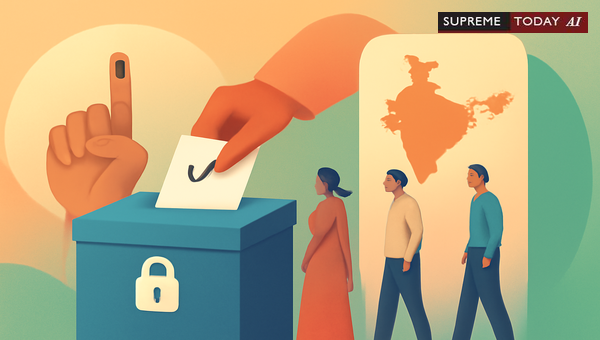
Why Free and Fair Elections Are Crucial for Democracy
In the heart of every thriving democracy lies the principle of free and fair elections. These elections serve as the cornerstone for expressing the people's will, ensuring government legitimacy, and fostering stability. But what makes them so vital, and how does Indian law safeguard this process? This blog delves into the importance of free and fair elections, drawing from key judicial pronouncements and constitutional frameworks to provide a comprehensive overview.
Whether you're a voter, a civic enthusiast, or someone curious about democratic processes, understanding this topic highlights why matters. Note that this is general information based on legal precedents and not specific legal advice—consult a qualified lawyer for personalized guidance.
The Fundamental Role in Democratic Governance
Free and fair elections are not just procedural formalities; they are the main spring of a healthy democratic life and the life-blood of constitutional democracy2018 0 Supreme(Chh) 220. Courts have consistently emphasized that they confer legitimacy on governments by allowing the genuine expression of public will 2024 2 Supreme 342.
The Importance of Free and Fair Elections becomes evident when we consider their role as the primary mechanism for . Without them, democracy risks foundering, as noted in observations about untruths plaguing electoral processes: Untruths before elections, during elections and after elections seem to be too prevalent for a healthy political society. It is of the first importance that elections must be free and fair if the democratic system is not to founder2021 0 Supreme(Guj) 160.
Key elements include:- Independence of electoral authorities: Essential to prevent executive or legislative interference 2018 0 Supreme(Raj) 593.- Transparency and protection from malpractices: Ensuring no , bribery, or coercion 2024 2 Supreme 342 2018 0 Supreme(Raj) 593.- Equal opportunity and voter secrecy: Guaranteeing free exercise of electoral rights 2014 8 Supreme 400.
Constitutional and Judicial Foundations
The Constitution of India, through Articles like 324 (vesting powers in the ), alongside judicial interpretations, mandates free and fair polls. The has termed elections the 2018 0 Supreme(Chh) 220. In S. Raghbir Singh Gill, it was stressed that electoral administration must remain free from pressure, ensuring fairness for all 2018 0 Supreme(Raj) 593.
Further, democracy is government by the people and the right of election is the very essence of the constitution
. This underscores the judiciary's role in safeguarding integrity when deviations threaten fairness 2017 0 Supreme(SC) 946.
From additional precedents, democracy thrives on honest, brave and risk-taking officials who conduct polls, as they are as crucial as the election itself 2017 0 Supreme(All) 2103. Courts have also linked this to voter rights: the right to vote is indispensable, involving opinion formation and free choice at the polling booth 2012 0 Supreme(Ori) 303.
The 's Pivotal Responsibilities
The (ECI) bears a constitutional duty to conduct impartial elections 2024 2 Supreme 342. Its independence is paramount, with powers to issue directions for transparency and fill procedural gaps 1980 0 Supreme(SC) 281. The process spans delimitation, registration, voting, and counting—all must be impartial 1971 0 Supreme(SC) 78.
In one case, the ECI's commitment to regular free and fair elections was highlighted as stemming from , serving both instrumental (selecting governors) and intrinsic (expressing popular will) roles 2018 0 Supreme(SC) 916. Courts reinforce that the ECI cannot transgress parliamentary laws but holds plenary powers under to supervise fair conduct 2018 0 Supreme(SC) 916.
Safeguarding Voter Participation and Preventing Malpractices
Voters must exercise rights freely, with ballot secrecy as a core feature. Violations impair democracy, as and free exercise of electoral rights are essential features of free and fair elections2014 8 Supreme 400. Transparency in candidate disclosures ensures informed choices 1980 0 Supreme(SC) 281.
Malpractices like bribery or undermine legitimacy 1971 0 Supreme(SC) 78. Judicial interventions quash tainted elections or order re-polls 2017 0 Supreme(SC) 946. For instance, in cooperative society elections, governments may cancel polls in public interest under statutes like , if irregularities persist 2008 0 Supreme(Mad) 1543.
High constitutional functionaries must avoid actions that invite allegations, as they impact free and fair polls—even good faith acts can be misunderstood during high-tempo elections 2021 0 Supreme(Guj) 160.
Judicial Oversight and Limitations
Courts act as guardians, intervening via writs under and when principles are violated 2021 0 Supreme(Guj) 160. They can fill legal vacuums 2015 8 Supreme 641 but generally refrain from interfering unless clear malpractices exist 2017 0 Supreme(SC) 946.
Notably, courts cannot add new disqualifications beyond statutory grounds (e.g., , ; ) or direct parties not to field candidates with charges—that's for Parliament 2018 0 Supreme(SC) 916. Recommendations include laws mandating parties to revoke membership of those charged in heinous offenses.
In bar association elections, infirmities led to supervisory actions to ensure fairness 2012 0 Supreme(Ori) 303. Similarly, nomination rejections for substantial defects (e.g., invalid Form-K) are upheld to maintain integrity 2021 0 Supreme(Guj) 160.
Challenges and Recommendations for Stronger Elections
While frameworks exist, challenges like criminalization persist. The has urged disqualifications on charge-framing in serious cases, yet legislative action lags 2018 0 Supreme(SC) 916.
To bolster free and fair elections:- Strengthen ECI independence.- Enhance transparency in disclosures and procedures.- Combat malpractices with robust safeguards.- Promote voter education for active participation.- Ensure judicial vigilance against violations 2017 0 Supreme(SC) 946.
Even personnel risks, like deaths on duty, highlight the human element—extraordinary pensions recognize their sacrifice 2017 0 Supreme(All) 2103.
Key Takeaways
Free and fair elections are the foundation of democratic institutions—they must not only be done but seem to be done2021 0 Supreme(Guj) 160. Indian jurisprudence, from constitutional mandates to court rulings, reinforces this through independent authorities, voter protections, and targeted interventions. As democracy evolves, ongoing reforms are essential to sustain public trust.
Stay informed, participate actively, and support . For specific concerns, seek professional legal counsel.
This post draws from established precedents for educational purposes.
#FreeAndFairElections #IndianDemocracy #ElectoralIntegrity












