Searching Case Laws & Precedent on Legal Query.....!
Analysing the retrieved Case Laws
Scanned Judgements…!



Searching Case Laws & Precedent on Legal Query.....!
Analysing the retrieved Case Laws
Scanned Judgements…!
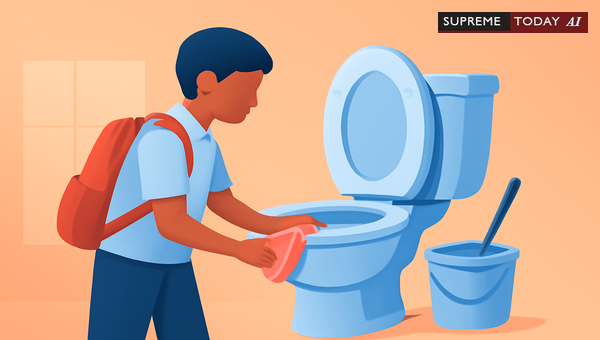
In schools and educational institutions, maintaining hygiene is crucial, but questions often arise about assigning cleaning tasks like toilet maintenance to students. A common query is: Training the student to clean toilet is an offence? This issue touches on , , sanitation guidelines, and potential misconduct. While sanitation training is emphasized in various legal documents, it raises concerns about exploitation or abuse.
This blog post examines whether such training constitutes a legal offence, drawing from official guidelines and court cases. Note: This is general information based on available legal documents and is not specific legal advice. Consult a qualified lawyer for your situation.
Training students to clean toilets is not classified as an offence under relevant legal provisions, provided it is part of a legitimate training or employment process and not linked to illegal activity or misconduct2025 0 Supreme(SC) 114. Legal texts prioritize , encouraging proper training for attendants without criminalizing the activity itself 2024 0 Supreme(Raj) 1399.
Key points include:- Emphasis on toilet maintenance through training and outsourcing, not prohibition 2025 0 Supreme(SC) 114.- Offences like ragging or target abuse, not routine cleaning training 2020 0 Supreme(SC) 579
.- Guidelines promote training lady attendants and others for hygiene, viewing it as standard practice 2024 0 Supreme(Raj) 1399.
Legal documents consistently highlight the need for clean toilets in public and school settings. For instance, they stress sanitation, hygiene, and proper maintenance of toilets and recommend outsourcing cleaning services and training attendants, especially women and differently-abled persons2025 0 Supreme(SC) 114. Training is portrayed as essential for hygiene standards.
Specific guidelines state: the guidelines for public toilets include training lady attendants and providing them with proper responsibilities and certifications2024 0 Supreme(Raj) 1399. This implies training—even for students in educational contexts—is a recognized operational activity, not an offence.
No provision explicitly criminalizes training students or personnel for cleaning. Instead, documents encourage outsourcing maintenance to professional agencies and attendant training as part of procedures 2024 0 Supreme(Raj) 1399. Routine sanitation tasks fall outside offence categories unless tainted by misconduct.
Offences in reviewed documents focus on specific harms:- Ragging and abuse: Penalties apply to physical or mental harassment, not cleaning training 2020 0 Supreme(SC) 579.- : Cases involve assault during school activities, unrelated to hygiene training
.- Waste dumping: Prohibited in certain areas, but irrelevant to training 2017 0 Supreme(Del) 501.
The act of training a student in cleaning toilets does not fall under these offences unless it involves abuse, coercion, or illegal activities—none indicated in core texts.
Related judgments provide context, showing how toilet-related incidents can lead to scrutiny but rarely deem cleaning itself criminal. In one case, a teacher discovered students in a toilet to clean the soiled cloth of one of the student, yet faced abetment of suicide allegations lacking evidence. The court emphasized no prior complaints and protection of children's rights against , dismissing weak claims 2024 0 Supreme(Chh) 668 2025 Supreme(Online)(Chh) 10640 2024 Supreme(Online)(Chh) 16541.
Another involved a teacher taking a student to a toilet, but acquittal followed due to discrepancies in the prosecution's case, including delay in registering the case, lack of medical examination, affirming the lies with the prosecution2006 0 Supreme(Mad) 1632.
Sexual offence cases highlight risks: A headmaster directing a student to clean the toilet escalated to rape allegations under , but courts stressed evidence needs 2021 0 Supreme(Mad) 2798. In disciplinary matters, a headmistress punished a student for urinating outside a dirty toilet, but proceedings were vitiated for procedural flaws 2017 0 Supreme(Cal) 565.
Teacher misconduct cases, like sexual misbehaviour with a female student, led to penalties, but again, not for cleaning assignments 2014 0 Supreme(Tri) 164. Pollution cases touched toilet hygiene without criminalizing training 2024 Supreme(Online)(Ker) 81491. These illustrate: Mere training isn't the issue; abuse or coercion is.
Sanitation rights under underscore the nature of obligation imposed upon the state to provide sanitation, including facilities at petrol pumps with trained staff 2022 0 Supreme(Pat) 269.
While legitimate training is fine, exceptions apply:- Coercion or abuse: Invokes ragging 2020 0 Supreme(SC) 579 or
.- or unsafe conditions: Could violate or labor laws, though not detailed here.- Minors/vulnerable groups: Extra caution needed; in schools violates child's dignity and right to life2024 0 Supreme(Chh) 668.
If training humiliates or exploits, it risks legal action, as seen in cases where toilet incidents fueled misconduct probes.
To stay compliant:- Conduct training ethically with consent and documentation.- Prioritize transparency; frame as hygiene education.- Adhere to for minors.- Outsource to professionals where possible 2024 0 Supreme(Raj) 1399.- Train staff properly, including certifications for attendants 2024 0 Supreme(Raj) 1399.
Institutions should document activities to preempt misinterpretation, ensuring alignment with proper sanitation, training, and outsourcing to professional agencies2025 0 Supreme(SC) 114.
Training students to clean toilets, when lawful and ethical, is not an offence. Legal frameworks support sanitation training as vital for hygiene, distinguishing it from abuse 2024 0 Supreme(Raj) 1399 2025 0 Supreme(SC) 114. Court cases reinforce that allegations require solid evidence, protecting routine activities while penalizing misconduct.
Key takeaways:- Focus on legitimate, consensual training.- Avoid coercion to steer clear of ragging or abuse laws.- Document everything for protection.
Prioritize hygiene without compromising rights. For tailored advice, seek professional legal counsel.
References:1. 2025 0 Supreme(SC) 1142. 2024 0 Supreme(Raj) 13993. 2020 0 Supreme(SC) 5794.
5. 2017 0 Supreme(Del) 5016. Other cases: 2024 0 Supreme(Chh) 668, 2006 0 Supreme(Mad) 1632, 2021 0 Supreme(Mad) 2798, etc. #SchoolLaw, #SanitationTraining, #ChildRightsIndia


There appears to be no reasonable ground for a teacher to call a girl student to the staff room and asked her to go inside the attached to the toilet, on hearing the footsteps of someone coming to the staff room had no wrong had been done. ... She also stated that the teachers have the liberty to ask any question to the students regarding their family background and if the student is from poor family background teacher can help the said student. 8. ... Manikho, the appellant asked the victim to come out of the ....

The sum and substance of the complaint is that the son of the complainant gone to the toilet, had not cleaned it properly. Therefore, he was asked to clean it. Being aggrieved, the petitioner has called the defacto complainant and advised her to teach clean bowel habits to her son. ... Therefore, this Court is of the view that the teacher in a School cannot be prosecuted for teaching the student to have clean habits. Hence, Spl.SC.No.143 of 2023 stands quashed. ... On a complaint given by the mother of ....

The petitioner went to the toilet and knocked at the door of the toilet and when the door was opened, she found three students therein. One of the student replied that they had gone inside to clean the soiled cloth of one of the student. ... She has a good reputation in the school and in the society and by no stretch of imagination can she be accused of an offence like abetment of suicide of a student. ... While she was on her way to staff rooms, she saw some students....
The petitioner went to the toilet and knocked at the door of the toilet and when the door was opened, she found three students therein. One of the student replied that they had gone inside to clean the soiled cloth of one of the student. ... She has a good reputation in the school and in the society and by no stretch of imagination can she be accused of an offence like abetment of suicide of a student. ... While she was on her way to staff rooms, she saw some students....

The petitioner went to the toilet and knocked at the door of the toilet and when the door was opened, she found three students therein. One of the student replied that they had gone inside to clean the soiled cloth of one of the student. ... She has a good reputation in the school and in the society and by no stretch of imagination can she be accused of an offence like abetment of suicide of a student. ... While she was on her way to staff rooms, she saw some students....

On 29.3.2001 at about 2.20 p.m., P.W.2 informed P.W.1 that a 9th Standard student by name Allaudin Basha is taken by the accused to the Toilet and on receiving such information, P.W.1 directed P.Ws 2, 4 and 6 to go and find out as to what is happening and they brought P.W.3, the student who made a written ... Therefore there is nothing wrong in a student and a teacher going to the toilet meant for students as well as the teachers. Neither P.W.2, nor P.Ws 4 and 6 have seen the occurrence. ... On seeing t....

KERALA STATE POLLUTION CONTROL BORD, DISTRICT OFFICE, USHUS BUILDING, BIG BAZAR, KOLLAM, PIN - 691001 3 KOTTARAKARA MUNICIPALITY, KOTTARAKARA P.O., KOLLAM DISTRICT, REPRESENTED BY ITS SECRETARY, PIN - 691506 4 CLEAN ... Whether the toilet situated near the house of the 5th respondent is causing air/water pollution and nuisance to the party respondent; ii. Whether the toilet unit is kept in a hygienic condition; 2. ... However, there was a direction to the petitioner to take appropriate steps to see that the toilet block ....
The petitioner is the Convener of the District Association of the Revolutionary Student Youth Front, he was charged with the offence. The Observation Mahazar and Rough Sketch prepared in the presence of witnesses, and the posters seized. ... 2020, the respondent Police found a large wall painting in the public toilet at Karur Bus Stand, measuring 3 feet by 2 feet. ... None of these witnesses directly connected the petitioner to the alleged offence. Hence, the petitioner seeks the quashing of the proceedings. 4. ... The ....

Learned counsel for the petitioner submits that petitioner is a person with clean antecedent and allegation is of recovery of 439.92 litres of liquor from an auto, carrier of cycles, bamboo orchard and from the toilet of Vikash Kumar and petitioner as detailed in the FIR. ... The petitioner apprehends his arrest in a case registered for the offence punishable under Section 30(a) of the Bihar Prohibition and Excise Act . 3. ... It is further submitted that the house in question is a joint family property, as such, it cannot be alleged wit....

Mr An is aged 18 (16 at the time of the offence), receiving secondary education in Hong Kong, was a F3 student when he was arrested. Mr An is single and lives with his parents and younger sister in the Mainland. ... At about 4 pm, Mr An took X to a disabled toilet on 1/F, Departure Hall, Lok Ma Chau Control Point. X sat on the toilet bowl at the request of Mr An. Mr An took from X’s schoolbag the said condom and put it on. ... At the material time, Mr An was aged 16, a Secondary 3 studen....

At the same time, sanitation has an essential public health dimension. Therefore, contamination negatively impacts public health and the life and well-being of everyone in the community, affecting their human rights to health, life, food, and a healthy environment.[Inga. In this regard, sanitation is not only about an individual's right to access a toilet or latrine. Inadequate sanitation leads to contamination of the environment, public spaces, and water bodies through faeces and wastewater.

If OMC officials observe during the inspection that (a) Toilet is found to be not clean or (b) Water is not available or (c) Latch on the toilet door is not available/not working or (d) Toilet door found to be locked at any outlet, a photograph of the toilet shall be taken and letter shall be issued instantly listing the penalty as per MDG. Third instance (a) Rs. 35,000/- or 45% of the monthly dealer commission (based on average of last 6 months), whichever is higher and b) suspension of Sales and supplies for 7 days or rectification of the defect in toilet, whichever is later. Pe....
Their paternal grandmother put both "X" and "Y" in the home as their mother left the matrimonial home. When "X" went inside the toilet, the accused followed her and allegedly committed rape on her. On 06.04.2015, at about 03.00 pm, the victim "X" was directed by the accused (Head Master of the school) to clean the toilet. Similarly he directed one "A" studying IVth standard to clean the garden area.

Allegedly, the writ petitioner had also instructed an assistant teacher of the school to make an announcement by mike in the classrooms to be audible to all the students, thereby asking them to move out of the school through the main gate only so that they could see the erring student holding the writing while standing thereat. On that day, a student of class XII of the school did not use the urinal in the toilet on the alleged ground that it was dirty and urinated outside the toilet. The notice referred to an incident that took place in the school premises on July 28, 2011....

Involvement of a teacher in sexual misbehaviour with a student is beyond the professional ethics of a teacher. Sexual misbehaviour with a female student by a teacher is a very heinous offence. In a Departmental Proceedings, circumstantial evidences are considered vital evidences for arriving at the material decision.


An indispensable Tool for Legal Professionals, Endorsed by Various High Court and Judicial Officers
Please visit our Training & Support
Center or Contact Us for assistance

Scan Me!
India’s Legal research and Law Firm App, Download now!


For Daily Legal Updates, Join us on :



 Back to top


