


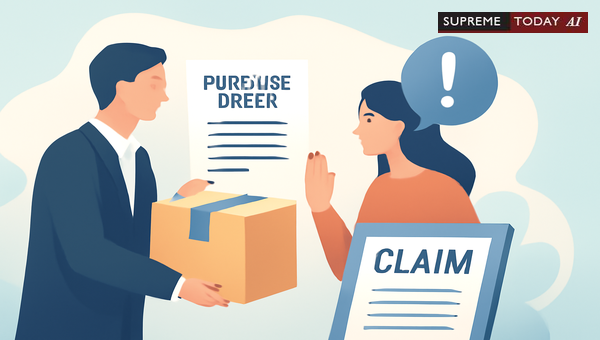
Can Plaintiff Claim Display Goods Without a Purchase Order?
In the world of business transactions, disputes over goods—especially display goods used for promotional purposes—can arise unexpectedly. Imagine supplying display items to a retailer or partner, only to face resistance when seeking their return or compensation without a formal purchase order in place. A common question businesses ask is: Can a plaintiff claim display goods from a defendant without a purchase order?
This article dives into the legal nuances, drawing from key case analyses and principles. While often serve as the backbone of such claims, alternatives like may come into play. Note: This is general information based on reviewed cases and should not replace professional legal advice. Always consult a qualified attorney for your specific situation.
The Critical Role of in Goods Claims
(POs) are more than paperwork—they form binding agreements that outline terms, quantities, and obligations. Without one, a plaintiff's claim for display goods typically faces an uphill battle.
Binding Nature of
The documents reviewed show that plaintiffs and defendants frequently rely on POs to govern transactions. For instance, bills were raised against accepted POs, establishing clear terms. As noted, the plaintiff and defendant had a series of that governed their transactions. The plaintiff raised bills against each accepted purchase order, which were binding and established the terms of their agreement 2015 0 Supreme(Del) 4424.
In claims for display goods, the absence of a PO specifying these items weakens the position significantly. Courts emphasize that goods must be ordered, delivered, and accepted to support recovery 2007 0 Supreme(Del) 1167.
Evidence of Delivery and Acceptance
Acknowledgment of receipt is pivotal. If the defendant hasn't confirmed receiving display goods via a PO, the claim may falter. The acknowledgment of receipt of goods is critical. If the defendant has not acknowledged receipt of display goods as per a purchase order, the plaintiff may not have a valid claim .
Supporting this, other cases highlight that POs issued and accepted trigger obligations. For example, Defendant Company made no payments and the goods had been shipped on four consignments subsequent to the said which were accepted
. Here, the treated PO admissions as evidence of transactions, underscoring their weight.
Insights from Relevant Case Law
Courts consistently rule that claims without proper POs require robust proof of delivery and acceptance, especially for defective or unordered goods.
Defective Goods and Unordered Supplies
In one ruling, a plaintiff couldn't claim payment for unaccepted goods: in cases where goods were supplied without a proper purchase order, courts have ruled that the plaintiff must demonstrate that the goods were delivered and accepted. For instance, in one case, the court found that the plaintiff could not claim payment for goods that were not ordered or accepted 2007 0 Supreme(Del) 1167.
Similarly, under the (Sections 15, 16(1)(a), etc.), delivery imposes implied conditions, but plaintiffs must prove non-acceptance of 'as is' terms. Oral and documented evidence of complaints pre-delivery supported a refund claim, rejecting 'as is' defenses due to lack of acceptance proof
.
in Recovery Suits
The onus lies on the claimant. In a commercial dispute, The learned evaluated the evidence on record and found that the plaintiff had established his claim for outstanding goods, as the defendant failed to substantiate defects or returns 2025 0 Supreme(Del) 206. Conversely, without evidence, claims fail: The lies on the party asserting a claim, and failure to provide credible evidence results in upholding the original judgment 2025 0 Supreme(Del) 206.
Jurisdictional aspects also tie back to POs. The defendant placed upon the plaintiff under which the plaintiff supplied the goods—courts uphold agreed jurisdictions in POs, avoiding disputes over venue 2014 0 Supreme(Bom) 2219.
Counterarguments: Claiming Without a Purchase Order
While POs are ideal, plaintiffs aren't entirely without options. Courts may consider:
- : If the defendant benefited from display goods (e.g., used for promotion), recovery might be possible via equity principles. Substantial evidence of intent and benefit is required.
- : Ongoing dealings or acknowledgments can imply agreements. For instance, the plaintiff company is engaged in the business of manufacturing and sale... defendant placed purchase order on the plaintiff led to upheld recovery for breaches like unmet exemptions 2014 0 Supreme(Del) 1513.
However, unilateral actions by defendants, like deductions without adjudication, violate : unilateral deductions by the defendant without proper adjudication violated principles of , leading to the plaintiff's recovery claim being upheld 2024 0 Supreme(Mad) 1922.
In contexts, clear invoices and lack of protest bind parties: submitted to it by the plaintiff and there was no protest of this claim at all when the invoices were presented to the defendant
. Defendants must prove , or plaintiffs prevail.
Practical Recommendations for Businesses
To strengthen claims for display goods:
- Always Secure POs: Document specifics for display items explicitly. Secure Documentation: The plaintiff should ensure that all future transactions are accompanied by formal .
- Track Acknowledgments: Obtain signed receipts or emails confirming delivery.
- Prepare Alternatives: Gather evidence for or implied terms if no PO exists. Consider Alternative Claims: If pursuing a claim without a purchase order, the plaintiff should prepare to present evidence supporting alternative legal theories, such as .
- Jurisdiction Clauses: Include clear venue terms in agreements to avoid delays 2013 0 Supreme(Del) 1873.
Cases like furniture seizures remind us that property claims need possession proof or bills of sale if not delivered
DAVID v. MENDIS et al
.Conclusion: Prioritize Documentation for Strong Claims
Generally, a plaintiff cannot reliably claim display goods without a purchase order, as courts prioritize binding POs for proof of agreement, delivery, and acceptance 2015 0 Supreme(Del) 4424 2007 0 Supreme(Del) 1167. While counterarguments exist, they demand compelling evidence.
Key Takeaways:- POs are essential for enforceable claims.- favors documented transactions.- Explore equity only with strong supporting facts.
Businesses should formalize all dealings to mitigate risks. For tailored advice, reach out to a legal expert familiar with commercial law in your jurisdiction.
References: 2015 0 Supreme(Del) 4424 2007 0 Supreme(Del) 1167 2025 0 Supreme(Del) 206 2024 0 Supreme(Mad) 1922 2014 0 Supreme(Bom) 2219 2014 0 Supreme(Del) 1513















