
SupremeToday Landscape Ad
AI Thinking

AI Thinking...

Searching Case Laws & Precedent on Legal Query.....!

Scanned Judgements…!

Checking relevance for Property Owners Association VS State of Maharashtra...

2024 8 Supreme 387 : In Minerva Mills the Supreme Court struck down Section 4 of the Forty‑Second Amendment, holding that the amendment’s attempt to give absolute primacy to Directive Principles (including Article 31‑C) over Fundamental Rights (Article 14) was unconstitutional; thus it limited the scope of Article 31‑C and reaffirmed the balance between fundamental rights and directive principles. By contrast, in Sanjeev Coke the Court, while noting concerns about the reasoning in Minerva Mills, proceeded on the basis that Article 31‑C (as it stood before the Forty‑Second Amendment) remained operative and held that once a law is protected by Article 31‑C, Article 14 cannot be invoked against it. Hence, Sanjeev Coke treats Article 31‑C as a shield against Article 14 challenges, whereas Minerva Mills curtails that shield by restoring the supremacy of fundamental rights.Checking relevance for Property Owners Association VS State Of Maharashtra...

1996 4 Supreme 223 : Minerva Mills upheld the revival of Article 31C (as it stood after the Kesavananda Bharati decision) and struck down Section 4 of the 42nd Amendment, thereby confirming that Article 31C remained valid. Sanjeev Coke, while also proceeding on the premise that Article 31C was revived, criticised the majority opinion in Minerva Mills and expressed agreement with Justice Bhagwati’s dissenting view, yet it did not overturn the Minerva Mills holding and continued to apply the revived Article 31C.Checking relevance for Union of India VS Tarsem Singh...

2019 0 Supreme(SC) 1041 : In Minerva Mills v. Union of India (1981) the Supreme Court declared the amended Article 31‑C unconstitutional, effectively rendering Article 31‑C a dead letter. By contrast, in Sanjeev Coke Manufacturing Co. v. Bharat Coking Coal Ltd. (1983) the Court interpreted the phrase material resources of the community in Article 39(b) to include all resources – natural and man‑made, public and privately owned – thereby giving a broad, inclusive meaning to the term. Thus, Minerva Mills dealt with the validity of the constitutional amendment (Article 31‑C), while Sanjeev Coke dealt with the substantive scope of material resources of the community under Article 39(b).Checking relevance for Excel Glasses Ltd. and Others VS State of Kerala...

Checking relevance for Kanaka Durga Wines, Visakhapatnam VS Government Of A. P. ...

1995 0 Supreme(AP) 229 : In Minerva Mills Ltd. v. Union of India the Supreme Court held that Section 4 of the Constitution (Forty‑Second Amendment) Act, 1976 – which amended Article 31‑C – was unconstitutional, striking down the amendment that expanded the protective scope of Article 31‑C. In contrast, Sanjeev Coke Mfg. Co. v. Bharat Coking Coal Ltd. dealt with the Constitution (Twenty‑Fifth Amendment) Act, 1971, which protected laws enacted to give effect to clauses (b) and (c) of Article 39. The Court upheld the validity of that amendment and held the Coking Coal Mines (Nationalisation) Act, 1972 to be protected under Article 31‑C. The Sanjeev Coke judgment expressly noted it did not overrule Minerva Mills and was concerned only with the 25th amendment, not the 42nd amendment addressed in Minerva Mills.Checking relevance for BAPUJI EDUCATIONAL ASSOCN. VS STATE...

1984 0 Supreme(Kar) 202 : In Minerva Mills Ltd. v. Union of India (AIR 1980 SC 1789) the Supreme Court struck down the 42nd Constitution Amendment’s insertion in Art. 31‑C, holding that the amendment violated the basic structure of the Constitution. In Sanjeev Coke Mfg. Co. v. Bharat Coking Coal Ltd. (AIR 1983 SC 239) a Constitution Bench expressed doubt about the correctness of the Minerva Mills decision but expressly held that the Court remains bound by the Minerva Mills judgment, which continues to be good law. Thus, the jurisprudential difference is that Minerva Mills invalidated the amendment, whereas Sanjeev Coke did not overturn that ruling but merely questioned it, reaffirming the continued authority of Minerva Mills.


AI Overview

AI Overview...

  • Main points and insights:

  • Decisions in Minerva Mills and Sanjeev Coke are by Co-equal Benches: Both cases were decided by five-judge Supreme Court benches. Despite some criticisms, Sanjeev Coke did not overrule Minerva Mills, as decisions of co-equal strength cannot simply overturn each other ["1996 4 Supreme 223"], ["1982 0 Supreme(SC) 236"], ["1989 0 Supreme(Ker) 115"].

  • Sanjeev Coke expressed 'misgivings' about Minerva Mills but did not overrule it: The majority in Sanjeev Coke acknowledged doubts regarding Minerva Mills' reasoning but explicitly stated that it was not the appropriate case to revisit or overrule that decision, especially since a review petition was pending ["2024 8 Supreme 387"], ["1989 0 Supreme(Ker) 115"].

  • Legal relationship and constitutional principles: Both cases upheld the validity of the respective nationalization laws and the constitutional amendments involved. However, Sanjeev Coke raised concerns about the reasoning in Minerva Mills, but these were not sufficient to overturn it ["1986 0 Supreme(Bom) 321"], ["1983 0 Supreme(SC) 383"].

  • Criticism and subsequent judicial stance: Some judgments expressed misgivings about Minerva Mills' reasoning, but the Supreme Court clarified that doubts expressed in Sanjeev Coke did not amount to overruling or invalidating Minerva Mills. The latter remains a key precedent, with subsequent judgments following its principles ["1982 0 Supreme(SC) 236"], ["1989 0 Supreme(Ker) 115"], ["1983 0 Supreme(Bom) 311"].

  • Analysis and Conclusion:

  • The jurisprudential difference between Minerva Mills and Sanjeev Coke lies primarily in their relationship rather than in a substantive overturning. Sanjeev Coke voiced doubts about Minerva Mills' reasoning but explicitly did not overrule it, respecting the doctrine of precedent and the authority of co-equal benches ["1996 4 Supreme 223"], ["1982 0 Supreme(SC) 236"].

  • Minerva Mills is considered a cornerstone decision affirming the basic structure doctrine and the limitations on amending the Constitution to preserve its core features, including judicial review and the supremacy of the Constitution ["1996 4 Supreme 223"].

  • Sanjeev Coke reflects a more cautious approach, expressing skepticism about certain reasoning in Minerva Mills but maintaining its validity until a higher bench explicitly overrules it ["1989 0 Supreme(Ker) 115"].

  • In summary, the key jurisprudential difference is that Sanjeev Cokequestioned but did not overrule Minerva Mills, leaving its principles intact but indicating possible doubts about its reasoning, whereas Minerva Mills remains a foundational case for the basic structure doctrine ["1996 4 Supreme 223"], ["1982 0 Supreme(SC) 236"].


References:

Judicial Scrutiny and Article 31C: Comparing Minerva Mills and Sanjeev Coke Holdings

Minerva Mills vs Sanjeev Coke: Unpacking Article 31C Differences

In the evolving landscape of Indian constitutional law, few debates have shaped the balance between fundamental rights and Directive Principles as profoundly as the judgments in Minerva Mills Ltd. v. Union of India (1980) and Sanjeev Coke Mfg. Co. v. Bharat Coking Coal Ltd. (1983). What is the jurisprudential difference between Minerva Mills and Sanjeev Coke judgments? This question lies at the heart of Article 31C's contentious history, particularly its role in shielding laws implementing socio-economic policies from judicial scrutiny under Articles 14 and 19.

These landmark cases arose amid amendments to the Constitution aimed at advancing socialist goals, but they tested the limits of Parliament's amending power under the basic structure doctrine established in Kesavananda Bharati (1973). This post delves into their holdings, distinctions, and lasting implications, drawing on key judicial documents for clarity. Note: This is general information and not specific legal advice; consult a qualified lawyer for your situation.

The Evolution of Article 31C

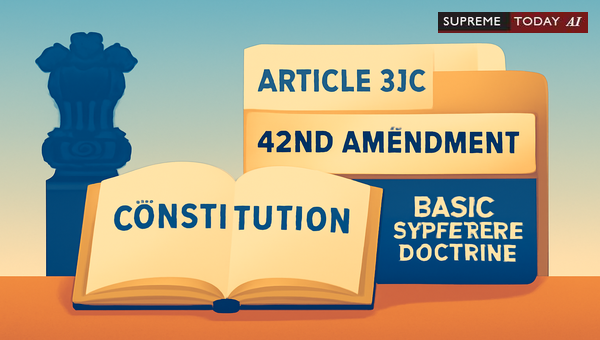
Article 31C, introduced by the 25th Amendment (1971), originally protected laws giving effect to Article 39(b) and (c)—principles directing the State to ensure equitable distribution of material resources and prevention of wealth concentration—from challenges under Articles 14 (equality) and 19 (freedoms). The 42nd Amendment (1976) expanded this shield to all Directive Principles in Part IV, sparking constitutional crises.

Kesavananda Bharati upheld the original Article 31C as compliant with the basic structure, setting the stage for future scrutiny. [

#Article31C, #MinervaMills, #SupremeCourtIndia
Chat Download
Chat Print
Chat R ALL
Landmark
Strategy
Argument
Risk
Chat Voice Bottom Icon
Chat Sent Bottom Icon
SupremeToday Portrait Ad
logo-black

An indispensable Tool for Legal Professionals, Endorsed by Various High Court and Judicial Officers

Please visit our Training & Support
Center or Contact Us for assistance

qr

Scan Me!

India’s Legal research and Law Firm App, Download now!

For Daily Legal Updates, Join us on :

whatsapp-icon Back to top







