


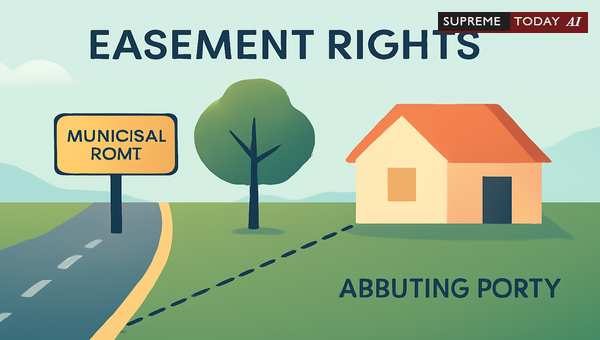
Over Municipal Road: What Property Owners Need to Know
Owning property that abuts a public or municipal road comes with certain privileges—and potential disputes. Imagine discovering a neighbor or third party attempting to build on or claim usage rights over the road frontage right in front of your home. A common question arises: Whether a Person will Get Easement Right over Municipal Road in Front of him? This issue pits property owners' absolute access rights against potential third-party . In this post, we'll break down the legal principles, drawing from established case law, to clarify who holds the upper hand.
While this guide provides general insights based on judicial precedents, it's not a substitute for professional legal advice. Consult a qualified attorney for your specific situation.
The Core Legal Principles: Right of Access for Abutting Properties
Property owners with land immediately abutting a public road enjoy a fundamental right to access and use the frontage facing that road. This is not merely convenient—it's legally protected. Courts have consistently ruled that structures or obstructing this access are liable for removal, as they deprive the owner of free . For instance, when structures encroach over roadside areas or frontage, they impede access rights, making them removable to preserve the owner's entitlements 1989 0 Supreme(All) 236.
This principle underscores that your property's road-facing boundary isn't just a line on a map—it's a corridor essential for enjoyment of your land.
Public Road Status: No Automatic Rights from Historical Use
Not every well-trodden path qualifies as a public road granting rights to all. The mere fact that a passage was historically used by the public does not establish it as a public road or confer to third parties. If the land remains private or lacks official designation as a municipal road, unauthorized users cannot claim based solely on past usage 2017 0 Supreme(Pat) 57.
Proper legal recognition—such as government notification or municipal designation—is required. Without it, third-party or claims fail. As one judgment notes, land forming part of a cannot be assigned to any third party, regardless of adjacent private boundaries or government ownership
.
Easementary Rights: Access at Every Point
Owners of properties adjoining a highway or are entitled to access from every point of their property to the road. This right is considered absolute unless restricted by law or regulation 1997 0 Supreme(Mad) 1573. Third parties cannot interfere with this without authorization.
In a related context, courts affirm that even over panchayat or municipal roads, have unobstructed access. For example, no person can occupy a public road, and obstructions like stored materials must be removed to ensure free access from all points 2010 0 Supreme(Mad) 3929. This extends to scenarios where hayricks or manure block pathways—such interferences justify legal action for removal.
Third-Party Use of Abutting Areas: Generally Not Permissible
Can a neighbor park vehicles, build structures, or run a business on the municipal road frontage in front of your property? Typically, no. Use by third persons for commercial or residential purposes is impermissible unless the area is legally designated as a public road or common area with granted public rights 2019 0 Supreme(Raj) 2922 1983 0 Supreme(Ori) 36.
on roadside or abutting areas invite removal to protect both the property owner and public interest 1989 0 Supreme(All) 236 2005 0 Supreme(AP) 557. A key precedent highlights that even temporary parking, like auto rickshaws on a highway frontage, requires regulatory approval. In one case, courts limited parking to five vehicles at a time as a temporary measure, explicitly stating it conferred no permanent right, while directing police protection for abutting shop owners' access 2019 0 Supreme(Ker) 201.
Moreover, whether a house directly abuts the public road or the roadside verge (patri), permanent structures deprive the owner of access and must be addressed 2015 0 Supreme(Ori) 558.
Key Restrictions in Practice
- Commercial : Converting roadside space for shops or parking without permission violates access rights.
- Obstructions: Any barrier affecting free passage from property to road is actionable.
- No Prescriptive Rights: Long-term use doesn't ripen into easement without formal dedication.
Exceptions and Limitations: When Third Parties Might Have Claims
There are narrow exceptions. If the abutting area is officially notified as a public road or common passage, limited public use may be allowed, subject to regulations 2000 0 Supreme(Mad) 555. For non-residential uses, prior approvals for land use changes are mandatory, especially in regulated zones 2018 0 Supreme(Del) 3255 2019 0 Supreme(Del) 1766.
However, even public roads demand full width usage for traffic, and retain paramount access claims. In eviction disputes, portions of residential buildings used commercially are treated separately, but this doesn't extend to road 2011 0 Supreme(P&H) 600. Courts have clarified that on government land lack standing to claim protections 2019 0 Supreme(Ker) 201.
In improvement trust cases, plaintiffs must prove legal rights to resist removal; mere adjacency doesn't suffice without evidence 2008 0 Supreme(Bom) 480.
Insights from Landmark Judgments
Judicial trends reinforce owner protections:- Access Over Panchayat Roads: can sue for against obstructions; absence of notifications strengthens claims 2010 0 Supreme(Mad) 3929.- Highway Frontage: Shop owners successfully sought police aid against illegal parking, with courts mandating traffic committees for resolutions 2019 0 Supreme(Ker) 201.- Roadside Structures: Permanent builds on land abutting homes are removable to restore access 2015 0 Supreme(Ori) 558.- No Third-Party Assignment: Public streets remain for public use, not private gain
.
These cases illustrate courts' reluctance to allow , prioritizing ' rights.
Conclusion and Key Takeaways
Generally, third parties cannot claim over a municipal road in front of your property unless backed by official designation or permission. hold strong, absolute rights to unobstructed access, with typically removable via legal action.
Essential Takeaways:
- Protect Your Frontage: Monitor and challenge unauthorized uses promptly.
- Seek Designation Proof: Demand evidence of public road status for any claims.
- Legal Recourse: File for or removal if access is blocked 1989 0 Supreme(All) 236 1997 0 Supreme(Mad) 1573.
- Regulatory Compliance: Commercial uses need approvals; historical use alone fails 2017 0 Supreme(Pat) 57.
Legal Citation Highlights:- Access rights: 1989 0 Supreme(All) 236 1997 0 Supreme(Mad) 1573 2005 0 Supreme(AP) 557- No rights from past use: 2017 0 Supreme(Pat) 57 2019 0 Supreme(Raj) 2922- Encroachment removal: 1983 0 Supreme(Ori) 36 2018 0 Supreme(Del) 3255
Stay vigilant about your property rights. For personalized guidance, reach out to a local property law expert.
(Word count: approximately 1050)
#EasementRights #PropertyLaw #PublicRoadAccess












