




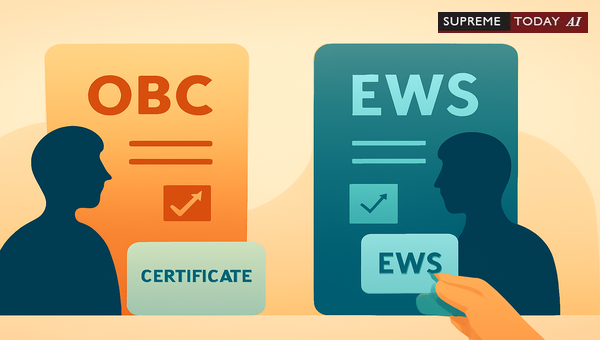
Is OBC Eligible for EWS Reservation in India?
In the competitive landscape of government jobs, education admissions, and public sector opportunities in India, reservation policies play a pivotal role. A common question arises: whether OBC is eligible for EWS reservation or not? This query often stems from confusion over overlapping criteria like economic disadvantage and social backwardness. This blog post delves into the legal framework, court rulings, and guidelines to clarify this issue. Note: This is general information based on available legal documents and is not specific legal advice. Consult a qualified lawyer for personalized guidance.
Understanding OBC and EWS Reservations
OBC () reservation addresses social and educational backwardness, typically requiring a (NCL) certificate to exclude economically advanced members. It aims to uplift historically disadvantaged groups under and 16(4) of the Constitution.
EWS () reservation, introduced via the in ( and 16(6)), provides a 10% quota for economically disadvantaged individuals from the General category. It focuses purely on economic criteria: family income below ₹8 lakh annually, limited land/assets, and exclusion from other reserved categories like SC, ST, or OBC.
The key distinction? Reservations are . Claiming benefits from multiple categories undermines the .
Main Legal Finding: OBC Candidates Are Not Eligible for EWS
Based on judicial pronouncements and government guidelines, candidates belonging to the OBC category are not eligible for the EWS reservation. EWS applies exclusively to the General category and explicitly excludes OBC, SC, or ST candidates. 2022 0 Supreme(SC) 1135
Key Points from Court Rulings
- EWS limited to General category: EWS reservation is exclusively for the General category and does not extend to SC, ST, or OBC (Paras 4-8). 2022 0 Supreme(SC) 1135
- Economic criteria only: Eligibility hinges on family income, assets, and valid certificates issued per government norms. OBC status disqualifies applicants. 2020 0 Supreme(Del) 1117
- Mutual exclusivity: Reservations for backward classes (OBC) are separate from economic-based EWS quotas. Overlap would violate equality principles. 2022 1 Supreme 720 2022 0 Supreme(SC) 1135
Detailed Legal Analysis
EWS Restricted to General Category
Courts have consistently upheld that EWS is for General category candidates facing economic hardship but not social backwardness. In a pivotal ruling, the court stated: EWS reservation applies only to the General category and not to SC, ST, or OBC, aligning with the constitutional design separating caste-based and economic reservations. 2022 0 Supreme(SC) 1135
This prevents double-dipping, where OBC candidates (already benefiting from 27% quota) claim an additional 10% EWS slice, diluting opportunities for true General-EWS applicants.
Certificate Requirements and Verification
EWS demands a valid certificate confirming economic status and General category belonging. Failure to produce it results in consideration under . Similarly, OBC claims require timely NCL certificates; late submissions often lead to rejection. 2026 0 Supreme(Gau) 3
For instance, in a recruitment case, candidates without OBC certificates at verification were rightly rejected, as ads mandate documentation for reservation claims. Courts won't intervene in clear eligibility lapses. 2026 0 Supreme(Gau) 3
OBC status is by birth and not by acquisition, with certificates merely affirming it. Late submissions don't retroactively qualify candidates. 2022 0 Supreme(Del) 2079
Constitutional Principles Reinforcing Exclusivity
The framework emphasizes: Caste only cannot be the basis for reservation, and must be excluded from backward class benefits. EWS, being economic-only, can't extend to OBC. 1999 10 Supreme 270 2007 3 Supreme 598
In university recruitments, EWS application requires specific guidelines; absent them, it's invalid, underscoring category distinctions. 2024 0 Supreme(J&K) 210
Post-graduate medical admissions further mandate seat increases (e.g., 25%) for EWS without affecting existing quotas, ensuring no cross-category bleed. 2025 0 Supreme(Gau) 197
Exceptions? None Found
No provisions allow OBC candidates to avail EWS. Even if economically weak, OBC must use their dedicated quota. Authorities must enforce this to avoid constitutional violations. 2022 1 Supreme 720
In NEET-related cases, misclassified OBC candidates couldn't demand OBC seats post-cutoff if documentation failed, reinforcing strict rules. 2021 0 Supreme(Raj) 1027
Practical Implications and Recommendations
- For OBC candidates: Apply under OBC with valid NCL certificates. Don't pursue EWS—it's ineligible.
- For General candidates: Check economic criteria and obtain EWS certificates timely.
- Institutions/Employers: Verify categories rigorously; reject invalid dual claims. Non-compliance risks legal challenges.
- General advice: Monitor notifications for cutoffs, percentiles, and document deadlines. Late certificates rarely help. 2022 0 Supreme(Del) 2079
In patent examiner recruitments, even technical qualifications demand category proof; reservations follow strict -like norms. 2021 0 Supreme(Del) 298
Conclusion and Key Takeaways
In summary, OBC candidates are not eligible for EWS reservation, as affirmed by courts and policy. 2022 0 Supreme(SC) 1135 EWS is General-only, economically driven, and with OBC. This upholds fairness in India's reservation ecosystem.
Key Takeaways:- EWS: General category, income < ₹8L, no other reservations.- OBC: Social backwardness, NCL certificate required.- Always submit docs on time; categories don't overlap.- Stay updated via official gazettes and memos.
For deeper insights, review references like 2020 0 Supreme(Del) 1117 for certificate guidelines. This evolving area may see updates—bookmark for more!
References:1. 2022 0 Supreme(SC) 1135: Core ruling on EWS exclusivity.2. 2020 0 Supreme(Del) 1117: EWS criteria details.3. 2022 1 Supreme 720: OBC-EWS distinction.4. Others integrated as noted.
#EWSReservation, #OBCEligibility, #ReservationIndia












