Searching Case Laws & Precedent on Legal Query!
Scanned Judgements…!



Searching Case Laws & Precedent on Legal Query!
Scanned Judgements…!
Prevailing Documents vs. Pleadings
Documents as Evidence and Their Relation to Pleadings The courts emphasize that documents must be properly incorporated into pleadings to be admissible. Merely filing documents without referencing or including them in pleadings generally leads to their rejection, as evidenced by multiple cases where documents not mentioned in pleadings were excluded (e.g., 2024 6 Supreme(Telangana) 723, 2022 0 Supreme(Del) 1994). Courts have consistently held that evidence beyond pleadings is inadmissible unless properly introduced through amendments or proper referencing. Sources: 2022 0 Supreme(Gau) 939, 2024 6 Supreme(Telangana) 723, 2022 0 Supreme(Del) 1994
Amendments and Filing of Documents Amendments to pleadings are governed by specific rules, notably Order VI Rule 17 CPC, and are generally permitted if there is a reasonable cause and the amendments relate to the existing pleadings. Under the Commercial Courts Act, amendments to include documents or pleadings are often given precedence over general rules, especially when issues are yet to be framed (2023 0 Supreme(Bom) 542, 2023 0 Supreme(Chh) 41). However, courts scrutinize whether the amendments are made timely and whether the documents were previously available or should have been disclosed earlier. Sources: 2023 0 Supreme(Bom) 542, 2023 0 Supreme(Chh) 41, 2023 0 Supreme(Bom) 1252
Timing and Proper Procedure for Filing Documents The timing of filing documents is crucial. Documents filed late or without proper reference in pleadings are typically rejected. For example, documents found during house shifting or discovered after filing are generally not admitted unless they are explicitly referenced in pleadings or allowed through formal amendments (2024 6 Supreme(Telangana) 723, 2022 0 Supreme(Del) 1994). The courts also reject attempts to introduce documents at late stages without proper foundation, emphasizing the importance of pleadings as the basis for evidence. Sources: 2024 6 Supreme(Telangana) 723, 2022 0 Supreme(Del) 1994
Legal Principles on Evidence Beyond Pleadings Evidence outside the pleadings, without proper foundation or reference, is generally inadmissible and can cause prejudice to the opposing party. Courts have held that documents not supported by pleadings or proper amendments are to be eschewed (2023 0 Supreme(Del) 2786). Conversely, if documents are referenced in pleadings or filed with valid amendments, they are likely to be admitted, especially if issues are yet to be framed (2022 0 Supreme(Del) 1994, 2022 0 Supreme(MP) 364). Sources: 2023 0 Supreme(Del) 2786, 2022 0 Supreme(Del) 1994, 2022 0 Supreme(MP) 364
Special Statutes and Prevailing Law The Commercial Courts Act and amendments to CPC give precedence to procedural provisions specific to commercial disputes, including rules for disclosure and filing of documents. These laws aim to streamline procedures and reduce delays, often allowing documents to be filed if they pertain to the suit and are properly referenced (2023 0 Supreme(Chh) 41).
Analysis and ConclusionIn summary, courts generally prioritize pleadings as the foundation of a case. Documents not incorporated into pleadings or filed without proper reference or amendments are typically not admitted as evidence. However, if amendments are permitted timely and documents are properly referenced, they can significantly influence the outcome. The prevailing principle is that evidence must be anchored in pleadings—either by proper incorporation or through valid amendments—to be considered in the adjudication process. Special statutes like the Commercial Courts Act reinforce these principles, emphasizing procedural correctness and timely disclosure.
References:- 2022 0 Supreme(Gau) 939- 2023 0 Supreme(Bom) 542- 2024 6 Supreme(Telangana) 723- 2023 0 Supreme(Del) 2786- 2023 0 Supreme(Chh) 41- 2023 0 Supreme(Bom) 1252- 2022 0 Supreme(MP) 364- 2022 0 Supreme(Del) 1994
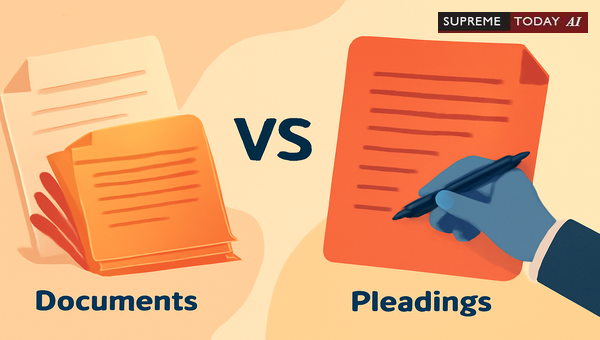
In the intricate world of litigation, parties often grapple with a fundamental question: What will prevail—documents or pleadings? This dilemma arises frequently in Indian courts, where pleadings form the bedrock of a case, yet documents provide the evidentiary muscle. Understanding this dynamic is essential for litigants, lawyers, and anyone navigating the judicial system. This post delves into the prevailing authority between documents and pleadings, drawing from established legal principles under the (CPC) and key case laws.
While pleadings outline the claims and defenses, documents substantiate them. However, courts typically emphasize that evidence must align with pleadings to be admissible. This article explores the nuances, supported by judicial precedents, to help you appreciate how courts balance these elements. Note: This is general information and not specific legal advice. Consult a qualified lawyer for your case.
Pleadings are the formal written statements— by the plaintiff and by the defendant—that disclose the real matter in dispute. They serve as the foundation of litigation, guiding the court's focus on relevant issues. Courts must critically examine both pleadings and accompanying documents to ascertain the merits of the case 2015 0 Supreme(MP) 734 2012 2 Supreme 602.
As held in various rulings, pleadings must be clear and precise: Pleadings are considered the foundation of litigation, serving as formal allegations by the parties regarding their claims and defenses. They must disclose the real matter in dispute between the parties 2001 0 Supreme(Mad) 670 1981 0 Supreme(Gau) 59. Without robust pleadings, even strong documents may falter.
Documents filed alongside pleadings are crucial for proving allegations. Courts insist on documentary proof: Documents filed in support of pleadings are essential for substantiating claims. The court insists on documentary proof to support the allegations made in pleadings 2012 2 Supreme 602 2012 0 Supreme(Raj) 361.
However, merely filing documents isn't enough—they must be referenced in pleadings. In the absence of denial by the opponent, pleadings and documents may be deemed 2020 0 Supreme(MP) 292. Yet, courts reject documents not incorporated into pleadings. For instance, Even if the documents are produced, the same will be without any foundation in the pleadings 2023 0 Supreme(SC) 563.
From additional case insights: A perusal of the documents filed also show the pleadings to be in consonance with the documents filed 2017 0 Supreme(Del) 3296. This underscores that harmony between the two is key.
Amendments under allow updating pleadings to include new documents or clarify issues, provided there's reasonable cause and no prejudice to the other side. The latest amendment may prevail if it resolves ambiguities 2015 0 Supreme(P&H) 1185.
In commercial suits, amendments aren't casually granted: The application is devoid of any pleadings showing reasonable cause for non-disclosure of the said documents with the as is mandatorily required under 2023 0 Supreme(Bom) 542. Courts prioritize timely disclosure.
Further, mere filing of documents without amendment of the ... would in any case lead to as they are beyond the pleadings 2023 0 Supreme(Del) 2786. Amendments must be sought before issues are framed for better chances of acceptance 2023 0 Supreme(Del) 450.
Context matters. In bidding processes, original physical documents may trump electronic ones if discrepancies arise 2024 0 Supreme(Gau) 23. In property disputes, boundaries prevail over extents only if correctly referenced and agreed upon; otherwise, linear measurements take precedence 2019 0 Supreme(Mad) 2112.
Under special statutes like the , procedural rules for document disclosure streamline processes, often allowing referenced documents even post-filing if issues aren't framed yet 2023 0 Supreme(Chh) 41.
Courts consistently hold: Documents must be properly incorporated into pleadings to be admissible. Merely filing documents without referencing or including them in pleadings generally leads to their rejection (drawing from cases like 2022 0 Supreme(Gau) 939, 2024 6 Supreme(Telangana) 723, 2022 0 Supreme(Del) 1994). Late introductions without foundation prejudice opponents 2023 0 Supreme(Del) 2786.
All the documents are to be produced along with the pleadings or at least before framing of issues 2010 0 Supreme(Del) 1011.
To maximize success:- Align Documents with Pleadings: Reference all key documents explicitly to avoid rejection.- File Timely: Produce documents with initial pleadings; seek amendments promptly if needed 2023 0 Supreme(Mad) 995.- Anticipate Objections: Inadvertent omissions can be rectified, but deliberate delays harm credibility 2023 0 Supreme(Del) 2786.- Commercial Disputes: Leverage specific CPC provisions for faster disclosure 2023 0 Supreme(Bom) 542.
Pay heed to contexts like property or tenders, where specific rules apply.
In Indian courts, pleadings generally prevail as the foundational framework, with documents gaining weight only when properly supporting or referenced within them. Courts eschew evidence untethered to pleadings, emphasizing procedural rigor to ensure fair trials. While amendments offer flexibility, they demand justification and timeliness.
Key Takeaways:- Pleadings define the dispute; documents prove it—ensure synergy.- Seek amendments early to incorporate vital evidence.- Context (e.g., commercial suits, property) can shift priorities.- Always prioritize clarity to avoid admissions by default.
By anchoring your case in precise pleadings backed by admissible documents, you strengthen your position. For tailored guidance, consult a legal expert. Stay informed on CPC amendments to navigate these complexities effectively.
References (select case IDs): 2001 0 Supreme(Mad) 670, 1981 0 Supreme(Gau) 59, 2015 0 Supreme(MP) 734, 2012 2 Supreme 602, 2012 0 Supreme(Raj) 361, 2020 0 Supreme(MP) 292, 2015 0 Supreme(P&H) 1185, 2024 0 Supreme(Gau) 23, 2019 0 Supreme(Mad) 2112, 2022 0 Supreme(Gau) 939, 2023 0 Supreme(Bom) 542, 2023 0 Supreme(Del) 2786, 2023 0 Supreme(SC) 563, 2017 0 Supreme(Del) 3296, 2010 0 Supreme(Del) 1011, 2023 0 Supreme(Del) 450, 2021 0 Supreme(Kar) 75, 2017 0 Supreme(Del) 3072
#DocumentsVsPleadings, #IndianLaw, #CourtEvidence


on those documents. ... Mazumdar further argues that the plaintiff had not raised any objection in the written statement rather they had filed the written statement refuting those pleadings made in the plaint based on those documents which are exhibited along with the affidavit. ... Mazumdar that the averments made in the plaint are based only on those exhibits and it will be discernible from the evidence on affidavit that the those #HL_STA....

with a commercial suit, the settled principles of law governing amendment of pleadings would have to be given a go bye. ... The application is devoid of any pleadings showing reasonable cause for non-disclosure of the said documents with the plaint as is mandatorily required under Order XI Rule 1(1) of the CPC, as applicable to commercial suits. Such casual reasons cannot be accepted. ... It was further submitted that Commercial Courts Act,....

Learned counsel for the petitioner would submit the documents which are intended to bring on record are found while shifting the house. Further as he was unaware of these documents by the date of filing of the suit, reference of these documents were not made in the pleadings. ... Further pleaded that as per the contemplation under Order VII Rule 14 of CPC the plaintiff shall place the documents relied upo....

Agarwala regarding mere filing of documents without amendment of the written statement at the first blush would seem attractive, however, at a closer scrutiny of law inasmuch as the absence of pleadings, would in any case lead to eschewing of the evidence as they are beyond the pleadings. ... This argument would not withstand the scrutiny of law since it is the basic substratum of the issue that prejudice would be caused to the respondent/p....

jurisdictional High Court or any amendment to the Code of Civil Procedure, 1908 (5 of 1908), by the State Government is in conflict with the provisions of the Code of Civil Procedure, 1908 (5 of 1908), as amended by this Act, the provisions of the Code of Civil Procedure as amended by this Act shall prevail ... From the preamble and statement of objects and reasons, it is quite vivid that Commercial Courts Act being a special Act shall prevail over the exist....

Therefore, the portion of the amendment seeking to introduce the aforementioned documents, as also the pleadings relatable to such documents and the pleadings pertaining to the other suit, cannot be permitted and the application deserves to be only partly allowed. ... During the pendency of the suit, the plaintiffs have moved the instant application under Order VI Rule 17 of the CPC, seeking amendment of the plea....

It was hence submitted that due to absence of necessary pleadings and the documents the suit is bound to fail hence plaintiff be permitted to withdraw the suit with liberty to institute a fresh suit on the same cause of action upon making the relevant pleadings and filing necessary documents. ... The question for consideration is as to whether the grounds taken by the plaintiff in his application i.e. failure to make neces....

(b) at the time of framing of issues; (c) at the time of cross examination of plaintiffs' side witnesses by the applicants, based on this pleadings, is not entitled to turnaround and object at a belated stage that the pleadings of the applicants shall be struck off by invoking ... The learned counsel submitted that inadvertently the documents were not included in the list of documents filed along with written statement and....
documents on record. ... Counsel for plaintiff that vide order dated 08.11.2016, parties were directed to file only those original documents, of which copies are already on record. However, from the perusal of order it appears that liberty was granted to "file documents" and not only "original documents". ... Both the parties requests for adjournment on the ground that they have to place on record some original ....

It is an admitted position that the additional documents were filed on behalf of the plaintiff on the same date as the replication. A perusal of the pleadings in the suit would also show that the aforesaid documents sought to be filed are not contrary to the pleadings of the plaintiff in the suit. ... Ltd., 2019 SCC OnLine Del 9813 on the ground that the issues in the said suit had already been framed and the doc....

Therefore, it is very difficult to sustain the said direction as well. Even if the documents are produced, the same will be without any foundation in the pleadings.

(b) Right to amend the pleadings even after the limitation period has expired avails in the realm of election law although it’s exercise is conditioned by the factors such as nature & substance of amendment, delay & latches, the stage of proceedings & the like, is not much in dispute since the provisions of CPC are made mutatis mutadis applicable to the trial of election petitions vide Sec.24 of the Karnataka Municipalities Act, 1964; where challenge is laid on the ground of corrupt practice, ....
Documents which come into existence after the pleadings are filed. If documents falling under category I(a) and II(a) are not produced along with the plaint or written statement as the case may be, the party has no right as such to produce those documents in evidence at the time of hearing, but in view of Sub-rule (3) of Rule 14 of Order VII and Sub-rule (3) of Rule 1A of Order VIII, the court has the power to receive such documents in evidence even at the time of hearing. Do....
A perusal of the documents filed also show the pleadings to be in consonance with the documents filed. The plaintiff, on the basis of the pleadings, has made out a case for the suit being maintainable under Order 37 of the CPC.

All the documents are to be produced along with the pleadings or at least before framing of issues. Where a party deliberately does not produce the documents despite repeated opportunities and specific notice to produce documents and takes the stand that documents were irrelevant, such a party cannot be allowed later on to produce the same documents on the plea that they were relevant and needed for adjudication of the matter. Despite the fact that CPC was amended and Parliam....


An indispensable Tool for Legal Professionals, Endorsed by Various High Court and Judicial Officers
Please visit our Training & Support
Center or Contact Us for assistance

Scan Me!
India’s Legal research and Law Firm App, Download now!


For Daily Legal Updates, Join us on :



 Back to top


