


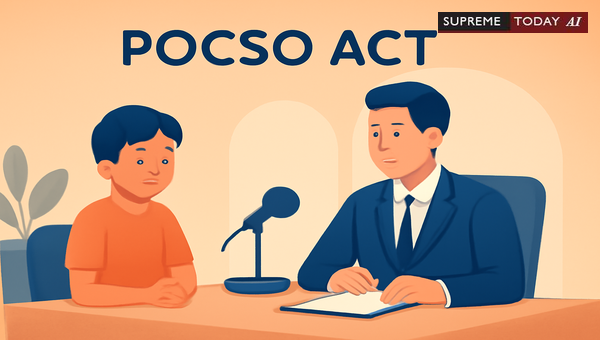
Questioning Child Victims in POCSO Cases: The Legal Framework
In cases involving the , safeguarding the well-being of child victims is paramount. A common query arises: What type of questions can be taken to a police officer in POCSO cases? While police play a crucial role in initial investigations, the courtroom procedure for examining child witnesses is strictly regulated to prevent . This blog explores the nuanced process under , emphasizing the court's intermediary role and judicial safeguards.
Understanding this framework is essential for legal professionals, investigators, and advocates seeking to ensure justice without compromising the child's dignity. Let's delve into the details.
The Core Procedure Under
mandates a protective mechanism during the recording of a child victim's . The or the counsel for the accused cannot directly examine or the child. Instead, they must communicate their questions to the , which then puts those questions to the child. This is explicitly stated: during the recording of of a child victim, the or the counsel for the accused shall communicate the questions to be asked to the child to the , which shall then put those questions to the child 2019 0 Supreme(Kar) 829 2020 0 Supreme(Mad) 2360.
This procedure ensures a child-friendly atmosphere, shielding the minor from aggressive or suggestive questioning that could cause emotional distress. Questions posed to police officers during investigation differ, as they occur pre-trial and focus on fact-gathering under controlled conditions, but trial-stage interrogation follows this court-mediated model.
Key Principles for Framing Questions
- Appropriateness: Questions must be non-aggressive, suitable for the child's age, and aligned with their mental capacity 2019 0 Supreme(Kar) 829.
- Non-Leading Nature: The court ensures queries are not suggestive or leading, preventing undue influence 2019 0 Supreme(Kar) 829
.
- Minimizing Trauma: Framing avoids unnecessary recalls, respecting the child's emotional well-being 2019 0 Supreme(Kar) 829
.
- Communication Only: Prosecution or defense relays questions via the court; direct interaction is prohibited 2019 0 Supreme(Kar) 829 2020 0 Supreme(Mad) 2360.
These guidelines stem from the Act's intent to prioritize the child's dignity over .
The Pivotal Role of the Court
The presiding judge or magistrate acts as a neutral intermediary, assessing and relaying questions. This role is reinforced in judicial pronouncements like , which highlights maintaining a child-friendly environment 2019 0 Supreme(Kar) 829. The court may pose preliminary questions to gauge the child's understanding and rational response capacity, particularly for very young victims
.
In , the stressed: the court must ensure questions are not suggestive or leading and are appropriate for the child's mental capacity 2019 0 Supreme(Kar) 829. This judicial oversight prevents hostile cross-examination and upholds .
Limitations on Direct Examination and Police Involvement
Direct questioning by parties is barred to avoid trauma. While police officers handle initial statements under POCSO protocols—such as mandatory reporting under Section 19—they cannot bypass court procedures at trial. For instance, investigative irregularities, like those noted in some cases, do not invalidate credible child testimony if corroborated, as victim's accounts carry significant weight 2024 0 Supreme(Cal) 1418. Courts have upheld convictions relying on consistent victim and family testimonies despite lapses, emphasizing: Victim's testimony in sexual assault cases is given significant weight, and investigative irregularities do not automatically invalidate credible 2024 0 Supreme(Cal) 1418.
Police roles are preliminary; trial questioning remains court-exclusive. Relatedly, obligations like prompt reporting apply universally, even to professionals like doctors, without needing sanctions if acts stray from duties 2025 Supreme(KER) 357 2025 0 Supreme(Ker) 309. The in noted: Prompt and proper reporting of the commission of offence under the is of utmost importance 2025 0 Supreme(Ker) 309.
Judicial Safeguards and Exceptions
Courts conduct in exceptional cases but adhere to limits; no broad preliminary powers exist without state consent 2018 0 Supreme(Ker) 493. Exceptions for recalling a are rare, permitted only if essential for justice and not to plug evidentiary gaps 2024 0 Supreme(Ker) 438.
Statements under POCSO are confined to police or magistrates, with counseling notes remaining confidential and excluded from charge-sheets
. This reinforces: A statement under the can be made only to a police officer or a magistrate
.
Abuse of police powers, such as improper arrests, falls outside official duties and invites scrutiny under 2013 0 Supreme(Gau) 824. Allegations of harassment must be viewed at face value, without probing truth at preliminary stages 2013 0 Supreme(Gau) 824.
Practical Recommendations for Stakeholders
To comply effectively:- Prosecutors and Defense: Prepare questions in advance, submit to court, avoiding direct child contact.- Judicial Officers: Assess child's capacity via preliminaries; tailor questions sensitively
.- Investigators: Focus on ethical pre-trial probes, ensuring reporting compliance 2025 Supreme(KER) 357.- All Parties: Promote child-centric processes per guidelines 2019 0 Supreme(Kar) 829.
Conclusion and Key Takeaways
In POCSO cases, questions for child victims—whether from prosecution, defense, or indirectly linked to police investigations—must route through the court under Section 33. This protects dignity, fosters child-friendly proceedings, and aligns with precedents like NIPUN SAXENA and GOUTAM. Direct approaches risk and harm.
Key Takeaways:- Court intermediates all trial questions 2019 0 Supreme(Kar) 829 2020 0 Supreme(Mad) 2360.- Prioritize non-leading, age-appropriate queries
.- Exceptions are narrowly applied 2024 0 Supreme(Ker) 438.- Victim testimony remains robust despite investigative flaws 2024 0 Supreme(Cal) 1418.
This post provides general insights based on legal provisions and cases; it is not specific legal advice. Consult a qualified lawyer for case-specific guidance.
References:1. 2019 0 Supreme(Kar) 829: Procedure and court's role.2. 2020 0 Supreme(Mad) 2360: Child-friendly questioning.3.
: Preliminary assessments.4. 2024 0 Supreme(Ker) 438: Recall exceptions.5. 2024 0 Supreme(Cal) 1418: Victim testimony weight.6. 2025 Supreme(KER) 357, 2025 0 Supreme(Ker) 309: Reporting duties.7.
: Statement confidentiality.8. 2013 0 Supreme(Gau) 824: Police powers limits. #POCSOAct #ChildProtection #LegalGuide















