


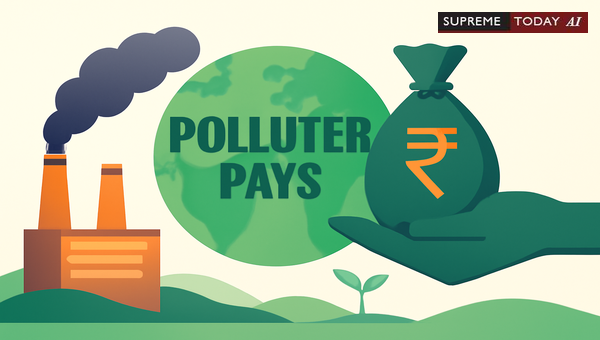
Polluter Pays Principle in Indian Environmental Law
In an era where industrial growth often clashes with environmental preservation, the Polluter Pays Principle (PPP) stands as a beacon of accountability. This core tenet of environmental law ensures that those responsible for pollution bear the financial burden of remedying the harm they cause. But what exactly does this mean in the context of Indian law? How has it been enshrined through judiciary and legislation? This blog delves into the Polluter Pays Principle in Indian environmental law, drawing from landmark cases, statutes, and recent developments to provide a comprehensive overview.
Whether you're a business owner navigating compliance, an environmental advocate, or simply concerned about pollution's impact, understanding PPP is crucial. Note that this article offers general information and is not a substitute for professional legal advice.
What is the Polluter Pays Principle?
The Polluter Pays Principle mandates that the costs associated with preventing and remedying pollution should be borne by those who cause it. This includes not only compensation for victims but also the costs of restoring the environment 1998 8 Supreme 504 1996 0 Supreme(SC) 2164. It is rooted in the idea that industries engaged in hazardous activities are absolutely liable for any harm caused, regardless of the precautions they may have taken 2006 3 Supreme 49 2010 0 Supreme(Mad) 269.
In essence, PPP internalizes environmental costs, preventing the public from subsidizing polluters' actions. It aligns with broader goals of sustainable development, emphasizing that economic progress must not come at the expense of ecological health.
Judicial Endorsement: Supreme Court Milestones
India's judiciary has been pivotal in embedding PPP into national law. The Supreme Court first robustly affirmed the principle in the landmark case of Vellore Citizens’ Welfare Forum v. Union of India () 5 SCC 647. Here, the Court ruled that polluting industries must compensate for harm to individuals and the environment, with liability extending to restoring ecological balance 2010 0 Supreme(Mad) 3211 2006 3 Supreme 49. The judgment explicitly linked PPP to the Precautionary Principle, stating it forms part of sustainable development 1996 0 Supreme(SC) 2164 1998 8 Supreme 504.
Further reinforcing this, in Indian Council for Enviro-Legal Action, the Court held: once the activity carried on is hazardous or inherently dangerous, the person carrying on such activity is liable to make good the loss caused... irrespective of the fact whether he took reasonable care 2020 0 Supreme(Mad) 730. This underscores absolute liability under PPP.
The National Green Tribunal (NGT) has also invoked PPP extensively. For instance, it has directed that wherever necessary, the Polluter Pays principle has to be the initiates to check the violations by providing requisite funds, to be recovered from the polluters
MUKESH KUMAR AGGARWAL VS CPCB & ORS. - National Green Tribunal
. In another ruling, the NGT emphasized: The members of the appellant association being responsible for the pollution, cannot escape the responsibility of not meeting the expenses of removing the sludge from the river... The 'precautionary principle' and principle of 'polluter-pays' are the integral part and parcel of national environmental law 2009 6 Supreme 774.Legislative Framework Supporting PPP
Statutorily, the Environment (Protection) Act, provides the backbone for PPP implementation. It empowers authorities to assess damages and enforce compensation from polluters 2010 0 Supreme(Mad) 3211 1996 7 Supreme 307. Pollution Control Boards are duty-bound to impose environmental compensation, as noted: the above orders cast a duty upon the Pollution Control Board to take appropriate steps for imposing environmental compensation and to realise the same from the polluters 2020 0 Supreme(Ker) 1036.
Internationally, the Rio Declaration () bolsters this by obligating states to develop national laws on liability and compensation for environmental damage 2016 0 Supreme(HP) 1579 2016 0 Supreme(HP) 1341. In India, PPP is further supported by constitutional provisions, with courts holding: In view of the above-mentioned constitutional and statutory provisions we have no hesitation in holding that the Precautionary Principle and the Polluter Pays Principle are part of the environmental law of the country 2017 0 Supreme(Ker) 962.
Real-World Applications and Case Studies
PPP's practical application shines in cases like the Tamil Nadu tanneries pollution saga. The Supreme Court upheld compensation imposition on polluters, stressing that liability persists until full remediation 2010 0 Supreme(Mad) 3211. Notably, it applies to historical pollution too—industries remain liable for past damages despite later controls 2010 0 Supreme(Mad) 3211 2006 3 Supreme 49.
NGT cases illustrate ongoing enforcement. Polluters have been directed to fund remediation, with principles like: Polluter Pays Principle (PPP) - The principle mandates that the costs of environmental damage caused by polluters should be recovered from the polluters themselves 2024 Supreme(Online)(NGT) 767 2025 Supreme(Online)(NGT) 98. Courts have established funds for restoration, recoverable from violators, addressing issues like air quality crises where AQI in Mathura District crosses 400, adversely affecting the health of citizens
MUKESH KUMAR AGGARWAL VS CPCB & ORS. - National Green Tribunal
.However, challenges persist. Notifications exempting polluters or allowing retroactive regularization contradict PPP, as they undermine accountability 2025 Supreme(Online)(NGT) 98 2024 Supreme(Online)(NGT) 4995. Enforcement gaps, such as delayed recoveries, highlight the need for vigilant monitoring.
Broader Implications and Challenges
PPP promotes sustainable development by integrating environmental costs into business decisions. It aligns with the public trust doctrine, obligating the state to protect resources. Yet, success hinges on political will and robust mechanisms. As one source notes, Its success depends on vigilant enforcement and the political will to hold polluters accountable 2025 0 Supreme(SC) 253.
In NGT proceedings, PPP supports fines, damage recovery, and remediation directives 2024 Supreme(Online)(NGT) 3942 2025 Supreme(Online)(NGT) 421 2025 Supreme(Online)(NGT) 859 2023 Supreme(Online)(NGT) 5033. Businesses must proactively comply to avoid liabilities that encompass not just immediate damages but full ecological restoration.
Key Takeaways and Recommendations
- PPP is firmly established in Indian law via judiciary (e.g., Vellore case) and statutes like the Act.
- Absolute liability applies to hazardous activities, covering past and present pollution.
- Enforcement tools include compensation, remediation funds, and NGT directives.
- Challenges: Exemptions and weak implementation; solutions lie in stricter oversight.
For stakeholders:- Advocate PPP in harm cases, claiming individual and restoration costs.- Monitor evolving case law and comply with Pollution Control Board orders.- Embrace sustainable practices to preempt liabilities.
In conclusion, the Polluter Pays Principle is a vital tool for environmental justice in India, ensuring polluters internalize costs and fostering sustainability. While enforcement varies, its judicial and legal foundations remain strong. Stay informed, as interpretations evolve with new rulings.
This post is for informational purposes only and does not constitute legal advice. Consult a qualified attorney for specific matters.
References
- 1998 8 Supreme 504 1996 0 Supreme(SC) 2164 2006 3 Supreme 49 2010 0 Supreme(Mad) 269 2010 0 Supreme(Mad) 3211 1996 7 Supreme 307 2016 0 Supreme(HP) 1579 2016 0 Supreme(HP) 1341
MUKESH KUMAR AGGARWAL VS CPCB & ORS. - National Green Tribunal
2020 0 Supreme(Mad) 730 2020 0 Supreme(Ker) 1036 2017 0 Supreme(Ker) 962 2009 6 Supreme 774 2024 Supreme(Online)(NGT) 767 2025 Supreme(Online)(NGT) 98












