


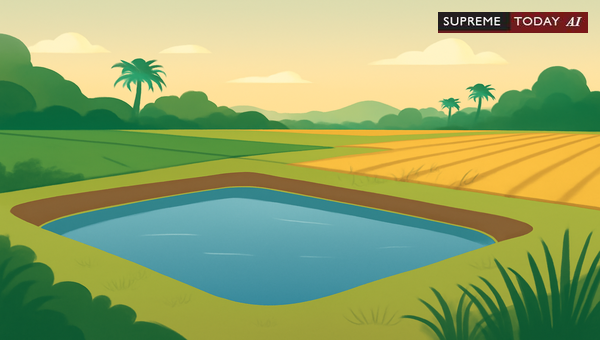
Pond in Agricultural Land: Treated as Under Kerala Law?
In Kerala, where agriculture and water bodies intertwine, landowners often face confusion over land classifications. Imagine owning a plot of agricultural land with a pond dug for irrigation or fish farming. A critical question arises: Whether a pond in agricultural land will be treated as ? This uncertainty can impact development plans, conversions, and legal compliance under the (the Act).
This blog post breaks down the legal framework, key judicial interpretations, and practical considerations. While this provides general insights based on statutes and precedents, it is not legal advice. Consult a qualified lawyer for your specific situation.
Understanding the Legal Framework
The Act aims to conserve paddy lands and wetlands, imposing restrictions on their conversion. To determine if a pond qualifies as a , we must examine the definitions.
Definition of
Under the Act, a is defined as land lying between terrestrial and aquatic systems, where the water table is usually at or near the surface or covered by shallow water. It encompasses backwaters, estuaries, fens, lagoons, mangroves, marshes, salt marshes, and swamp forests. Crucially, it does not include paddy lands and rivers2019 0 Supreme(Ker) 601 2017 0 Supreme(Ker) 1281.
This exclusion highlights a clear distinction: wetlands are separate from paddy lands, preventing dual classification 2017 0 Supreme(Ker) 1281.
Definition of
includes all types of land where paddy is cultivated at least once a year or is suitable for paddy cultivation but left uncultivated. It also covers such as bunds, drainage channels, ponds, and canals 2014 0 Supreme(Ker) 743 2020 0 Supreme(Ker) 393.
Ponds can thus be part of as allied features, but only if linked to paddy cultivation.
Key Findings: When Is a Pond NOT a ?
Courts have clarified that not every pond automatically becomes a . Here are the pivotal factors:
- Manmade vs. Natural Ponds:
- The Act differentiates between natural wetlands and manmade ponds. Ponds created for specific purposes like aquaculture in dry land do not qualify as wetlands2014 0 Supreme(Ker) 743 2015 0 Supreme(Ker) 1528.
Explicitly, a pond dug in dry land for aquaculture is ... not to be considered 2015 0 Supreme(Ker) 1528.
Association with Paddy Cultivation:
Ponds as retain status only if tied to paddy cultivation. If repurposed (e.g., for aquaculture), they lose this character and are neither nor 2014 0 Supreme(Ker) 743 2015 0 Supreme(Ker) 1528.
Low-Lying Land or Waterlogging Insufficient:
- Merely being low-lying or waterlogged during monsoons does not classify land as . Statutory characteristics must be met 2017 0 Supreme(Ker) 1281 2020 0 Supreme(Ker) 165.
- In one case, property treated as solely due to being low lying land with water logging was challenged, referencing precedents like 2025 Supreme(Online)(Ker) 38288 2025 0 Supreme(Ker) 2439.
These rulings emphasize purpose, history, and compliance over mere presence of water.
Insights from Additional Judicial Precedents
Further cases reinforce that ponds in agricultural land are typically not wetlands:
Pond in Dry Land: The existence of a pond by itself in a dry land cannot be treated as a since by the definition of the word '', the pond must be an allied construction of the . If the surrounding properties are not then the existence of a pond cannot make the area where the pond is situated... 2025 Supreme(Online)(Ker) 32391.
Revenue Records and : Even if shown as a pond in revenue records, it does not automatically become unless it fits the Act's criteria. Applications to remove land from the succeed if it's not truly 2021 Supreme(Online)(KER) 2372 2025 Supreme(Online)(Ker) 38288.
Waterlogging Alone Fails: Merely because a property is lying fallow and gets waterlogged during the rainy season or otherwise, due to the low-lying nature of the property, the property cannot be treated as 2025 Supreme(Online)(Ker) 50512.
However, natural or notified waterbodies may qualify. For instance, under broader , wetlands include und... (undefined excerpts suggest inclusion of certain ponds) 2024 Supreme(Online)(NGT) 4003 2024 Supreme(Online)(NGT) 1489. Yet, for agricultural contexts in Kerala, manmade ponds dominate non- classifications.
Historical conversion matters: Land converted to dry land before the Act (effective ) or not in the is less likely to be reclassified, even with ponds 2025 Supreme(Online)(Ker) 38288 2024 0 Supreme(SC) 1320.
Practical Implications for Landowners
If Your Pond Is Manmade: For irrigation or aquaculture in non-paddy agricultural land, it generally will not be treated as . Gather evidence of its creation and use.
Converted Uses: If once part of but now repurposed, it may lose protections 2014 0 Supreme(Ker) 743.
Legal Strategy:
- Emphasize the pond's purpose and history.
- Use site inspections or agricultural expert reports.
File under for removal if applicable 2025 Supreme(Online)(Ker) 48714.
Exceptions: Natural ponds or those in notified wetlands/paddy lands may still qualify. Check revenue records and status.
Conclusion and Key Takeaways
Ponds in agricultural land will not typically be treated as wetlands if manmade, unassociated with paddy cultivation, and not meeting the Act's specific criteria. Judicial precedents consistently prioritize statutory definitions over superficial features like waterlogging or pond presence 2017 0 Supreme(Ker) 1281 2025 Supreme(Online)(Ker) 32391.
Key Takeaways:- Manmade ponds for aquaculture in dry/agricultural land are excluded 2015 0 Supreme(Ker) 1528.- Allied ponds require paddy linkage 2014 0 Supreme(Ker) 743.- Low-lying or seasonal waterlogging insufficient 2025 Supreme(Online)(Ker) 38288.- Historical use and records decisive 2024 0 Supreme(SC) 1320.
Landowners should document everything and seek professional advice. This analysis draws from the , and cases like those cited 2019 0 Supreme(Ker) 601 2017 0 Supreme(Ker) 1281 2014 0 Supreme(Ker) 743 2015 0 Supreme(Ker) 1528
Word count: 1028. For personalized guidance, contact a Kerala land law expert.
#KeralaWetlandAct, #PondClassification, #AgriculturalLaw












