


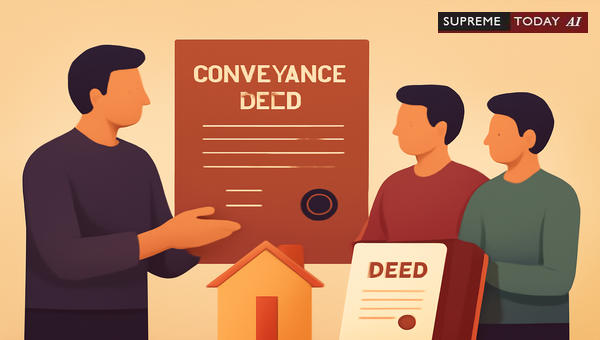
Father's Oral Property Division Invalid After Sons' : Case Law Insights
In family property disputes, tensions often arise when parents attempt to redistribute assets after formal transfers. A common scenario involves a executed in favor of sons, followed by the father's oral attempt to divide the property. Is such an oral division legally effective? Typically, no—once a vests title in the sons, subsequent oral arrangements lack legal force without proper formalities. This post examines the issue: in the Name of the Sons the Father s Attempt to Orally Divide the Property now is Not Legally Effective the Property Belongs to the Sons Case Laws Supporting this, drawing on key judgments and principles under Indian law.
We'll explore deed validity, the pitfalls of oral partitions, claims, and practical recommendations. Note: This is general information, not legal advice. Consult a qualified lawyer for your specific situation.
Understanding Conveyance and Settlement Deeds in Family Contexts
A or transfers property ownership, often used by parents to gift assets to children during their lifetime. Once registered, it generally confers to the grantees (e.g., sons), making revocation difficult without strong grounds like or coercion. 2022 0 Supreme(Ker) 1054
In contrast, an —a verbal agreement to divide property—may suffice for joint family holdings under Hindu law but fails against registered deeds. Courts prioritize written, registered instruments for immovable property under the , and . An oral attempt post-deed is typically ineffective, as title has already passed. 2024 0 Supreme(Mad) 2074
Key Principle: of Registered Deeds
Registered unconditional gift or settlement deeds cannot be unilaterally revoked. As held: A cannot be unilaterally revoked, and can be granted if the plaintiff proves to perform the contract.2024 0 Supreme(Mad) 2074
Validity of Deeds Executed in Favor of Sons
When a parent executes a deed favoring sons, courts scrutinize for vitiating factors. However, absent proof of , , or , the deed stands, and the property belongs to the sons.
Evidence of Required
Trial courts often invalidate deeds based on unreliable witnesses or suspicious execution: The trial court found that the was vitiated due to unreliable witness testimony and circumstances surrounding its execution.2022 0 Supreme(Ker) 1054 If no such proof exists, the deed holds, blocking oral reallocations.
and Claims
Challenges alleging the parent was misled (e.g., believing the deed benefited all children) can void it: In a related case, it was argued that the mother executed the under , believing it was in favor of all her children.1996 0 Supreme(Mad) 1238 Yet, plaintiffs bear the burden, and mere family ties don't presume .
Oral Partitions: Why They Fail Post-Deed
Post-conveyance, a father's oral division lacks efficacy because:- Title Vesting: Property devolves to sons via deed; father retains no undivided interest. 2024 Supreme(SRI)(SC) 12731- Statutory Requirements: Oral partitions bind only if no prior registered title exists. Subsequent oral claims are unenforceable. 2017 0 Supreme(Mad) 425- Rights: Sons as co-owners or absolute owners prevail; one can't settle entire shares orally. The first defendant in fact had no right whatsoever to execute the in respect of the entire property in favour of his son fourth defendant. That being the case, the plaintiffs being the co-owners certainly entitled to the share.2017 0 Supreme(Mad) 425
In partition suits, courts confirm: The plaintiff is entitled to the partition as prayed for. But only if deed invalidity is proven first. 2023 0 Supreme(Mad) 2956
Case Laws Supporting Property Belonging to Sons
Several precedents affirm that registered deeds to sons prevail over later oral attempts:
Unchallenged Deeds Hold Firm: No means the deed stands. The first defendant’s mother or the defendants 2 to 4 have not taken any steps to file a suit for .2024 0 Supreme(Mad) 2074
No : Under , deeds without express maintenance clauses can't be cancelled for neglect. For cancellation of a under the Act, must be stated within the document; implied obligations are insufficient.2025 Supreme(Online)(Ker) 57487
Burden on Challengers: In cases, defendants prove good faith if relationship raises suspicion, but family ties alone insufficient. Merely because the parties to the deed of settlement were related to each other or merely because the donor was old or of weak character, no presumption of would arise.
Invalid Subsequent Settlements: A father's post-deed oral or further deed attempts fail if he lacks full title. In view of my above findings... the executed by the first defendant in favour of his son, the third defendant is invalid.2022 0 Supreme(Mad) 3345
Cancellation Deeds Illegal: Unregistered or unilateral cancellations post-settlement are void. 2017 0 Supreme(Mad) 2497
Challenges and Equity Considerations
Courts balance equity but uphold deeds unless vitiated:- Intent Crucial: Mother's (or father's) purpose, like maintenance security, supports validity. Social pressures may influence but don't automatically invalidate. 2015 0 Supreme(Mad) 3467 1997 0 Supreme(Mad) 401- Revocation Rare: Only via suit proving coercion; unilateral acts fail. 1996 4 Supreme 722
In partial partition cases, prior deeds limit scope: The partition deed dated 12.11.1967 is not a result of , and coercion.2023 0 Supreme(Mad) 2956
Recommendations for Family Property Disputes
- Gather Evidence: Collect deed documents, witnesses, and intent proofs before challenging.
- File Suit if Grounds Exist: For /duress, seek .
- Opt for Mediation: Amicable resolution preserves family ties.
- Register Properly: Future transfers must include express conditions if maintenance expected. 2025 Supreme(Online)(Ker) 57487
Conclusion: Property Rights Vest with Sons Post-Deed
A registered conveyance or in sons' names generally makes subsequent oral divisions by the father legally ineffective. The property belongs to the sons unless challengers prove through , , or —burdens rarely met without compelling evidence. Key cases like 2022 0 Supreme(Ker) 1054, 1996 0 Supreme(Mad) 1238, and 2024 0 Supreme(Mad) 2074 underscore deed .
Key Takeaways:- Prioritize registered deeds over oral claims.- Family relationships don't auto-invalidate transfers.- Seek professional advice to navigate disputes.
For tailored guidance, contact a property law expert. Stay informed on evolving precedents to protect your rights.
#PropertyLaw #FamilyDisputes #SettlementDeed















