Searching Case Laws & Precedent on Legal Query.....!
Analysing the retrieved Case Laws
Scanned Judgements…!



Searching Case Laws & Precedent on Legal Query.....!
Analysing the retrieved Case Laws
Scanned Judgements…!
Section 138 of the Negotiable Instruments Act, 1881 (NI Act) is a key provision concerning the dishonour of cheques due to insufficient funds, and it is classified as a compoundable offence ["2026 Supreme(Online)(Del) 1458"], ["2026 Supreme(Online)(P&H) 1445"], ["2026 Supreme(Online)(P&H) 1517"].
Several judgments indicate that offences under Section 138 are compoundable, and parties often settle disputes by paying the cheque amount in full or in part, leading to acquittals or quashing of proceedings ["2026 Supreme(Online)(Del) 1458"], ["2026 Supreme(Online)(P&H) 1445"], ["2026 Supreme(Online)(P&H) 1517"]. For example, in one case, the respondent confirmed receipt of Rs. 4 lakh in full settlement and consented to quashing the proceedings ["2026 Supreme(Online)(Del) 1458"].
Courts have emphasized the importance of the presumption under Sections 139 and 118 of the NI Act, which presume that the cheque was issued for consideration and in discharge of a liability, unless the accused proves otherwise ["2026 Supreme(Online)(Del) 1458"], ["2026 Supreme(Online)(P&H) 1517"], ["2025 Supreme(Online)(Ker) 56168"].
The judgments reflect that procedural aspects, such as issuance of statutory notices and compliance with legal requirements, are crucial in proceedings under Section 138 ["2026 Supreme(Online)(Del) 1458"], ["2026 Supreme(Online)(P&H) 1445"], ["2026 Supreme(Online)(P&H) 1517"].
Courts have also considered defences related to limitations, absence of liability, or the cheque being issued for a time-barred debt, which can lead to dismissal or acquittal if proven ["2025 Supreme(Online)(Ker) 56168"], ["2026 Supreme(Online)(P&H) 1517"].
Notably, the courts have set aside convictions and judgments where parties have settled the dispute, and the offence has been compounded, reinforcing that Section 138 offences are primarily intended for settlement rather than punishment ["2026 Supreme(Online)(Del) 1458"], ["2026 Supreme(Online)(P&H) 1445"].
Analysis and Conclusion:The legal landscape up to 2026 consolidates the view that offences under Section 138 of the NI Act are predominantly compoundable, with courts often quashing proceedings upon settlement. The presumption of liability in favour of the complainant is rebuttable, and procedural compliance is vital. Recent judgments underscore the importance of settlement, consent, and proper legal procedure, with courts willing to set aside convictions where these conditions are met, highlighting the offence's nature as amenable to compromise ["2026 Supreme(Online)(Del) 1458"], ["2026 Supreme(Online)(P&H) 1445"], ["2026 Supreme(Online)(P&H) 1517"].
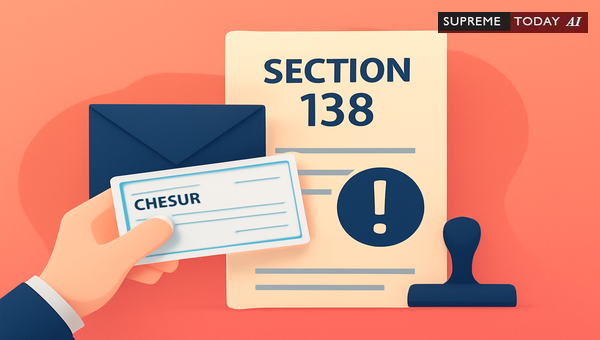
cases are commonplace in India, often arising from business transactions gone sour or personal loans unpaid. A frequent query from users is about specific judgments, such as 138 negotiabli instrument act judgnment 2026 – likely referring to () judgments from 2026. While no exact 2026 judgment matching this description appears in available legal records, numerous precedents outline critical principles under Section 138. This post breaks down the legal framework, procedural musts, and judicial insights to help you navigate these cases.
Note: This is general information based on established case laws and not specific legal advice. Consult a qualified lawyer for your situation.
Section 138 criminalizes the dishonour of a cheque due to insufficient funds or exceeding arrangement, deeming it an offence if procedural steps are followed. It's primarily a civil wrong with criminal implications, making it compoundable under . Courts emphasize strict compliance with prerequisites like . 2022 0 Supreme(Raj) 1512
Key ingredients for a valid Section 138 complaint include:- Cheque issued for discharge of a .- Dishonour due to insufficient funds or similar reasons.- Demand notice within of dishonour information.- Failure to pay within of notice receipt. 2022 0 Supreme(Raj) 2933 2022 0 Supreme(Raj) 739
Procedural lapses can doom a case. The mandatory 15-day notice under gives the drawer a chance to settle, and non-compliance often leads to dismissal. 2022 0 Supreme(Raj) 2933
Courts dismiss complaints in default only after fair discretion, ensuring no undue prejudice. 2005 0 Supreme(Raj) 49
Section 138 offences are viewed as civil disputes with criminal teeth, favoring settlements. Compromises often result in quashing under . 2013 0 Supreme(Raj) 2304 2022 0 Supreme(Raj) 1512
From analyzed cases:- under : Once a cheque is issued towards a debt, the burden shifts to the accused to rebut. Failure to do so upholds conviction, as seen where loan evidence was unchallenged. 2024 0 Supreme(Chh) 665- Sentence Leniency: Courts may alter imprisonment to fines, especially post-payment. One revision saw a sentence reduced to Rs. 5,000 fine, quashing jail time due to 2014 payments. 2024 0 Supreme(Guj) 1066- : For companies, complaints must specify directors' roles in day-to-day affairs; absent notice to them quashes proceedings against individuals. 2021 0 Supreme(Mad) 2147
In another instance, different ink on a cheque probablized a defense of prior transactions, rebutting and leading to acquittal. 2015 0 Supreme(Mad) 1214
Defendants often succeed on:- Invalid Notice: Insufficient content or untimely service. A potato merchant's case failed due to defective notice under . 2022 0 Supreme(Cal) 401- Non-Prosecution: Acquittals for complainant absence set aside if merits undecided; opportunity for arguments mandated. 2020 0 Supreme(Cal) 177- : Summoning irrelevant accounts books impermissible; complainant bears initial proof. 2005 0 Supreme(Raj) 284
countermanded don't escape Section 138 if towards liability. 2024 0 Supreme(Chh) 665
Additional precedents reinforce these principles:- Multiple complaints for same dishonour may be barred. 2024 0 Supreme(Guj) 1066- Opportunity on merits before acquittal essential. 2020 0 Supreme(Cal) 177
Though no 2026-specific judgment is pinpointed, evolving interpretations stress fairness, like condoning justified delays given compoundability. 1954 0 Supreme(Raj) 266
For Complainants (Payee): - Verify cheque details pre-filing.- Issue precise, timely notice.- Maintain transaction records to uphold .
For Drawers (Accused):- Respond promptly to notice.- Gather rebuttal evidence (e.g., prior dealings).- Seek settlement to leverage compoundability.
For Courts: Exercise discretion judiciously, prioritizing substance over minor procedural hitches where justice demands. 2005 0 Supreme(Raj) 49
Stay compliant to avoid pitfalls in cheque transactions. For tailored advice, reach out to a legal expert.


section 138 of the Negotiable Instruments Act, 1881 („NI Act‟). ... Accordingly, judgment dated 07.11.2023 passed by the learned Magistrate and judgment dated 20.01.2026 passed by the learned Sessions Court are set-aside. 14. Petitioners Nos. 1 and 2 are acquitted of the offence under section 138 NI Act. ... He also confirms that respondent No.3 has received the sum of Rs.04 lacs in full-and-final settlement of the amount comprised in the subject cheque and consents to the compounding ....

They prayed for compounding of offence under Section 138 of N.I. Act and acceptance of the revision petition. 5. ... Offence punishable under Section 138 of the Act is a compoundable offence. As in the present case, parties have settled their dispute with regard to dishonour of cheque in question. ... In the given circumstances, the petitioner deserves to be acquitted of the offence punishable under Section 138 of the Act, by compounding the same. 11. ... Judgment Judgment Operative P....

NIA-116 of 2017 under Section 138 of the Negotiable Complaint Instruments Act read with Section 420 IPC. Date of decision: 24.01.2024. ... Offence punishable under Section 138 of the Act is a compoundable offence. As in the present case, parties have settled their dispute with regard to dishonour of cheque in question. ... S. 138 of the Negotiable Simple imprisonment for one year and to pay Manjeet Instruments Act, 1881 compensation of Rs.40,00,000/- to the complainant. 1. ... In the g....

of the Negotiable Instrument Act, of the Negotiable Instrument Act, 1881, theof 2015 under section 138 of the Negotiable Instrument Act, 1881. ... Act, 1881.

Case No. 1683 of 2009 while acquitting the applicant for the offence u/s. 138 of Negotiable Instrument Act by setting aside order date 18.10.2010 in Cr. Case No. 2030 of 2009, passed by the learned Metropolitan Magistrate, (Negotiable Instrument Act) Court No. 6, Ahmedabad. 3. ... Two complaints for dishonor of cheque had been file by the complainant in light of the provisions u/s. 138 of Negotiable Instrument Act and hence the complaints came to be ....

The learned district Judge, in the course of his judgnment, raised the following point as arising for his consideration:"whether Savitramma alias Shanthamma inherited the suit schedule properties and that they are her "stridhana" under S. 10 (2) (g) of the Mysore Hindu Law Women's rights Act, 1933?" ... ... ( 12 ) UNDER S. 10 of ihe Act however, 'stridhana' means property of every discrition belonging to a Hindu female, other than property in which he has, by law or under the terms of an instrument, only a limited estat....

of the Negotiable Instrument Act. ... First, the merits of the case under Section 138 of the Negotiable Instrument Act need not be delved into in great details. It also appears that the petitioners’ contention as regards a prayer under Section 91 of the Code of 1973 was rejected by the learned Trial Court. ... The respondent no. 2 filed a complaint case vide C Case No. 74083 of 2016 under Section 138 of the Negotiable Instrument Act against the peti....

(1) of the Act.” ... of the Negotiable Instruments Act is not maintainable. ... In course of time charge was framed under section 138 of the Negotiable Instruments Act by the Joint Sessions Judge, 1 of the Negotiable Instruments Act. ... Act a negotiable instrument span
The respondent No.2, as complainant filed a petition of complaint under section 138 of the Negotiable Instrument Act, 1881 before the ... Afterwards, the complainant filed a petition of complaint against the instant appellant under section 138 of the Negotiable Instrument the Negotiable Instrument Act, suffer imprisonment 2015 convicting the appellant under section 138 of the Negotiable Instruments Act, 1881 and sentencing him

under Section 138 of the Act of 1881. ... However, this presumption coupled with the object of Chapter XVII of the Act leads to the conclusion that by countermanding payment of post-dated cheque, a party should not be allowed to get away from the penal provision of Section 138 of the Act. ... Learned counsel for the applicant would submit that the learned courts below erred in convicting the applicant for commission of offence under Section 138 of the Act of 1881. .......

Dishonour of cheque for insufficiency, etc., of funds in the account. 11. Analysis of evidence Section 138 of the Negotiable Instrument Act:-

Dishonour of cheque for insufficiency, etc., of funds in the account. 13. Section 138 of the Negotiable Instrument Act is as follows:-

9. Section 138 of the Negotiable Instrument Act is as follows:- —Where any cheque drawn by a person on an account maintained by him with a banker for payment of any amount of money to another person from out of that account for the discharge, in whole or in part, of any debt or other liability, is returned by the bank unpaid, either because of the amount of money standing to the credit of that account is insufficient to honour the cheque or that it exceeds the amount arranged to be paid from that account by an agreement made with that bank, such person shall be deemed to ha....

C-37773 of 2009 under Section 138 of the Negotiable Instrument Act.
8(c) Section 138 of the Negotiable instrument Act runs as follows:- "Where any cheque drawn by a person on an account maintained by him with a banker for payment of any amount of money to another person from out of that account for the discharge, in whole or in part, of any debt or other liability, is returned by the bank unpaid, either because of the amount of money standing to the credit of that account is insufficient to honour the cheque or that it exceeds the amount arranged to be paid from that account by an agreement made with that bank, such person shall be deemed t....


An indispensable Tool for Legal Professionals, Endorsed by Various High Court and Judicial Officers
Please visit our Training & Support
Center or Contact Us for assistance

Scan Me!
India’s Legal research and Law Firm App, Download now!


For Daily Legal Updates, Join us on :



 Back to top


