


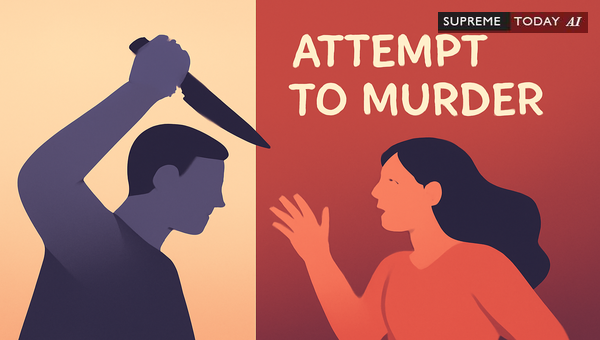
to Murder Under IPC: Key Elements Explained
In the realm of criminal law, few charges carry the gravity of to murder. Under Indian law, particularly of the (IPC), this offense hinges on a delicate balance between intent, action, and potential outcome. But what exactly qualifies as an to murder? Is a mere threat enough, or must there be a clear step towards causing death?
This blog post delves into the legal nuances of to murder, drawing from established judicial principles and case law. We'll break down the essential ingredients, distinguish it from or mere threats, and highlight key factors courts consider. Whether you're seeking clarity for educational purposes or navigating a legal scenario, this guide provides a comprehensive overview. Note: This is general information and not specific legal advice. Consult a qualified lawyer for personalized guidance.
Understanding to Murder: The Core Legal Framework
to murder under IPC is defined as whoever does any act with such intention or knowledge, and under such circumstances that, if he by that act caused death, he would be guilty of murder 2024 0 Supreme(Raj) 83. The offense does not require actual death or even bodily injury; the focus is on the accused's (guilty mind) coupled with an (guilty act) 2021 0 Supreme(MP) 733.
The main legal finding is clear: an requires an done with the specific intention or knowledge that, if successful, it would amount to murder, irrespective of immediate bodily injury or death. The act must be such that, if not intercepted, it would be sufficient to cause death or bodily injury likely to cause death. Mere threats or attempts without an in execution do not suffice 2021 0 Supreme(MP) 733 2000 3 Supreme 437.
Essential Ingredients of the Offense
To convict under IPC, prosecutors must prove:- Intention or Knowledge: The accused must have the necessary to constitute murder. The intention or knowledge of the accused must be such as is necessary to constitute murder. In the absence of intention or knowledge which is the necessary ingredient of , there can be no offence of to murder 2024 0 Supreme(Raj) 83 2022 0 Supreme(Chh) 425.- : This must go beyond and be in execution of the intent. The act must be an in execution of the intent or purpose 2021 0 Supreme(MP) 733.- Circumstances: If the act caused death, it would amount to murder
.
Courts infer intent from factors like the weapon used, manner of attack, targeted body part, motive, and opportunity 2021 0 Supreme(MP) 733.
Key Distinctions: vs.
A thin but crucial line separates from . involves preliminary steps, while requires the 1961 0 Supreme(SC) 205. For example:- Threats Alone: Threats alone without do not constitute to murder 2000 3 Supreme 437. Simply saying I will kill you isn't enough without action.- Overt Acts: Throwing a deadly weapon or firing a gun, even if missing, can qualify if intent is proven 2021 0 Supreme(MP) 733.
In , even an incomplete act like poisoning, part of a series leading to death but interrupted, constitutes 1961 0 Supreme(SC) 205. Similarly, even incomplete acts that are part of a series of acts leading to death, if interrupted, can still be 1961 0 Supreme(SC) 205.
Role of Injuries and Punishment
Bodily injury is not essential to establish 2021 0 Supreme(MP) 733. However, if injury occurs:- First Part of : Up to 10 years imprisonment and fine.- Second Part: If hurt is caused, punishment may extend to life imprisonment
2025 0 Supreme(Raj) 2134.
Thus, it can be seen that the to murder the complainant caused the injury and resultantly he became paralysed. When that be the consequence of the to murder, the case would definitely be fallen under the second part of , IPC
.
Injuries are a factor but not decisive; though the injuries sustained by the victim are also one of the factor in considering the intention of the accused persons... yet there are other circumstantial evidence 2023 0 Supreme(Jhk) 1057.
Inferring Intent: Circumstantial Evidence Matters
Intent is rarely confessed; it's gathered from conduct. Key indicators include:- Nature of Weapon and Manner: Use of firearms or knives targeting vital areas signals murder intent 2021 0 Supreme(MP) 733.- Accused's Conduct: Fleeing the scene or repeated attacks 2023 0 Supreme(Jhk) 1057.- Motive: Past enmity often plays a role 2025 0 Supreme(Raj) 2059.
The act and conduct herein of the accused persons becomes material to gather the intention of the accused persons in committing to murder 2023 0 Supreme(Jhk) 1057. Without this, even serious injuries might be deemed accidental: it was a case of accident and not an to murder 2025 0 Supreme(Raj) 2059.
Case Law Insights and Examples
Judicial precedents reinforce these principles:- Poisoning or Shooting Cases: Interrupted acts with lethal potential qualify 1961 0 Supreme(SC) 205 2016 0 Supreme(Chh) 454.- No Injury Needed: Presence of bodily injury capable of causing death is not essential to establish 2021 0 Supreme(MP) 733.- Acquittals for Lack of Intent: Trauma-induced statements without initial mention of murder led to scrutiny 2025 0 Supreme(Ker) 2460 2025 Supreme(Online)(Ker) 26446.
Observing that if the charge is one of at murder, the intention to kill is the principal ingredient of the crime 2025 0 Supreme(SC) 1677. In vehicular pursuits with intent to kill, it falls under 2017 0 Supreme(Del) 464.
Exceptions and Common Defenses
Not every violent act is to murder:- Purely Preparatory Acts: Buying poison without administering it 1961 0 Supreme(SC) 205.- Mere Threats: No overt execution 2000 3 Supreme 437.- Accidental Acts: Having said so, learned counsel argued that it was a case of accident and not an to murder 2025 0 Supreme(Raj) 2059.- Lack of Specific Intent: Impulsive acts without murder knowledge 2021 0 Supreme(MP) 733.
Substance of offence is intention or knowledge that acts done as such, death would be caused and offender will be guilty of murder and actually death is not caused. This would amount to an offence of to murder 2017 0 Supreme(J&K) 442 2017 0 Supreme(J&K) 378.
Prosecution and Defense Strategies
For Prosecution:- Prove in execution of murder intent.- Examine weapon, manner, and circumstances meticulously 2021 0 Supreme(MP) 733.
For Defense:- Argue absence of or specific intent.- Highlight preparatory nature or accident 1961 0 Supreme(SC) 205.
To establish to murder, prosecution must prove in execution of the that the act would result in murder 2021 0 Supreme(MP) 733.
Conclusion: Key Takeaways
to murder under IPC typically revolves around preceding an that could cause death if unchecked. Courts emphasize that the intention precedes the act attributed to accused 2025 0 Supreme(Raj) 2134, distinguishing it from lesser offenses.
Key Takeaways:- Intent inferred from circumstances, not just injuries.- essential; threats insufficient.- Punishment up to life if hurt caused.- Focus on conduct and motive for proof.
Understanding these elements can clarify complex cases. Always seek professional legal counsel for advice tailored to your situation.
References
- 2021 0 Supreme(MP) 733: Core principles on overt acts and intent.
- 2000 3 Supreme 437: Threats without acts.
- 1961 0 Supreme(SC) 205: vs. .
, 2024 0 Supreme(Raj) 83, 2023 0 Supreme(Jhk) 1057, etc.: Additional case insights on .
Word count: 1028. This post is for informational purposes only.
#AttemptToMurder, #Section307IPC, #IndianPenalCode












