


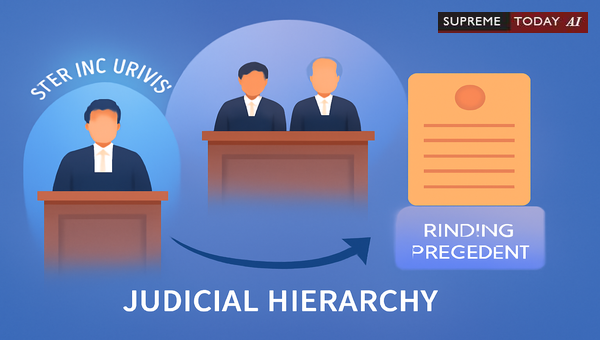
Can Single Judge Declare Division Bench ?
In the intricate world of Indian jurisprudence, the doctrine of plays a pivotal role in maintaining judicial consistency. But what happens when a single judge seeks to hold a division bench judgment as ? This question— by Single Judge Holding Division Bench Judgement—often arises in proceedings, raising concerns about and the principle of .
This blog post delves into the legal principles governing such scenarios, drawing from established precedents. While this provides general insights, it is not legal advice—consult a qualified lawyer for specific cases.
Understanding the Doctrine
What Does '' Mean?
A decision is deemed when rendered in ignorance or forgetfulness of a binding authority, statutory provision, or relevant precedent, leading to demonstrably wrong reasoning 2014 0 Supreme(AP) 1319 2019 0 Supreme(Raj) 1768 2010 0 Supreme(UK) 84. It typically involves oversight or carelessness, where the court fails to consider relevant statutory law or binding higher court decisions 2014 0 Supreme(AP) 1319 2019 0 Supreme(Raj) 1768 2010 0 Supreme(UK) 84.
The doctrine serves as a narrow exception to , ensuring flawed decisions do not bind future cases. However, it is not a tool for mere disagreement; there must be clear evidence of ignorance of binding material 2002 0 Supreme(Kar) 528 2019 0 Supreme(Raj) 1768.
Binding Nature of Larger Bench Decisions
Decisions from larger benches, such as or , bind single judges and unless proven 1995 0 Supreme(All) 165 2010 0 Supreme(All) 2179 1986 0 Supreme(Pat) 288. A single judge must adhere to the of a larger bench unless it is:
- Impliedly overruled or whittled down by subsequent judgments.
- Clearly contradicted by a co-equal or smaller bench (rarely applicable).
- Rendered , i.e., ignorant of binding authority or statute 1995 0 Supreme(All) 165 2010 0 Supreme(All) 2179 1986 0 Supreme(Pat) 288.
Simply disagreeing with a larger bench does not suffice. If a single judge believes the decision is , it should refer the matter to a larger bench rather than ignore it outright 2002 0 Supreme(Kar) 528 2019 0 Supreme(Raj) 1768.
Limits on Single Judges Questioning Larger Benches
A single judge cannot lightly declare a division bench judgment . Courts emphasize judicial discipline:
- Exceptional Circumstances Only: Questioning requires proof of oversight, such as ignoring a ruling or statute 1995 0 Supreme(All) 165 2010 0 Supreme(All) 2179 1986 0 Supreme(Pat) 288.
- Referral is Preferred: The proper course is reference to a larger bench for authoritative resolution 2014 0 Supreme(AP) 1319 1995 0 Supreme(All) 165.
Labeling decisions casually undermines consistency. and higher bench rulings remain binding unless explicitly overruled or clearly 2014 0 Supreme(AP) 1319 1995 0 Supreme(All) 165.
Insights from Key Cases
judgments illustrate these principles. For instance, in one case, a division bench addressed a single bench's reliance on a decision, holding it for not accounting for an earlier larger bench ruling, invoking
. The division bench noted: The Division Bench answered the above reference by holding that a Challan presented without Chemical Examiner's taken into account an earlier decision of the in larger Bench to be in view of the doctrine of
.
Similarly, another ruling critiqued single benches for declaring larger bench judgments : However, I express my respectful disagreement with the aforementioned Single Bench judgements on the ground that a smaller Bench could not have declared the judgement of a larger Bench to be
. This aligns with the view that smaller benches lack authority to override larger ones without reference
.
In cases like those involving Ajit Singh alias Jeeta, single bench decisions were scrutinized for erroneously applying against binding division bench rulings, especially when ignoring precedents like State of Haryana
.
Other precedents reinforce this:
- A division bench judgment was called by another for overlooking prior rulings, but only after careful analysis 2020 0 Supreme(Jhk) 879: The judgment relied by the petitioners of the Division Bench of this Court is as held by the Division Bench in W.P.(S) No.6302 of .
- Single judges holding prior single or division bench decisions led to full bench references due to conflicting views 2013 0 Supreme(All) 141 2012 0 Supreme(All) 3362.
These examples highlight procedural lapses, like failing to consider cases (Narendra Kumar Amin, Tulsiram), rendering decisions vulnerable 2023 0 Supreme(Bom) 2240.
Hierarchical Doctrine and
is sacrosanct. Smaller benches cannot declare larger ones without authority; such actions demand reference to superior benches 2022 0 Supreme(P&H) 262. The in State of Bihar v. Kalika Kuer () warned: The earlier judgement may seem to be not correct yet it will have the binding effect on the later Bench of coordinate jurisdiction... It creates confusion... and ultimately maligns the image of the 2011 0 Supreme(All) 3168.
Practical Implications and Recommendations
- For Litigants: When challenging precedents, prove with evidence of ignored binding material.
- For Courts: Refer doubtful cases to larger benches to uphold discipline 2014 0 Supreme(AP) 1319 1995 0 Supreme(All) 165.
- Caution: Avoid loose application of to prevent precedent erosion 2002 0 Supreme(Kar) 528 2019 0 Supreme(Raj) 1768.
Conclusion and Key Takeaways
A single judge may hold a division bench judgment only with clear evidence of oversight of binding authority, but typically, referral to a larger bench is the prudent path. This preserves and judicial harmony.
Key Takeaways:- requires demonstrable ignorance, not mere disagreement 2014 0 Supreme(AP) 1319 2019 0 Supreme(Raj) 1768.- Larger bench decisions bind single judges unless exceptionally flawed 1995 0 Supreme(All) 165.- Refer conflicts upward for resolution.- Uphold hierarchy to ensure legal certainty.
This analysis draws from authoritative sources, underscoring the doctrine's limited scope. For tailored advice, seek professional legal counsel.
#PerIncuriam, #JudicialPrecedent, #IndianLaw












