Searching Case Laws & Precedent on Legal Query..!
Scanned Judgements…!



Searching Case Laws & Precedent on Legal Query..!
Scanned Judgements…!
The application to the Labour Court or Tribunal can be made after the expiry of 45 days from the date of the application to the Conciliation Officer, as clarified by multiple judgments 2024 0 Supreme(Jhk) 279, 2025 0 Supreme(Mad) 2618, 2023 0 Supreme(Del) 6056, 2024 0 Supreme(Ker) 1626.
Time Limit for Filing Applications
Section 2A(3) prescribes that the application must be filed within three years from the date of dismissal, retrenchment, or termination, after the 45-day conciliation period has expired 2025 Supreme(Online)(Mad) 66553.
Legal Principles and Judicial Interpretations
In some cases, the courts have emphasized that Section 2A proceedings are independent of other sections like Section 33 or 10, and the dispute can be filed directly after the prescribed period 2025 0 Supreme(Mad) 2618, 2024 0 Supreme(Ker) 1626.
Exceptions and Specific Cases
Some judgments also clarify that there is no time limit under Section 10 for approaching the Labour Court, but Section 2A imposes a specific limitation of 45 days for initiating proceedings post-conciliation 2023 0 Supreme(Del) 6056.
Notable Judgments and Principles
References:- 2024 0 Supreme(Jhk) 279, 2025 0 Supreme(Mad) 2618, 2023 0 Supreme(Del) 6056, 2024 0 Supreme(Ker) 1626, 2025 Supreme(Online)(Mad) 66553, 2021 Supreme(Online)(MAD) 20919, 2022 Supreme(Online)(DEL) 2997, 2025 Supreme(Online)(Mad) 74317,
SC Bars Fresh Section 11 Petitions After Arbitral Termination - Supreme Court
,Delhi HC Sets Aside Award Over Arbitrator's Failure to Assess No Dues Certificate Voluntariness - High Court of Delhi
,Supreme Court Bars High Court Review of Arbitrator Appointments - Supreme Court
,Bombay HC Rejects UP Assembly's 'Frustration' Claim, Upholds TCS Award - High Court of Bombay
, 1981 0 Supreme(SC) 511, 1979 0 Supreme(SC) 496, 1995 0 Supreme(SC) 640, 1980 0 Supreme(SC) 473, 1981 0 Supreme(SC) 403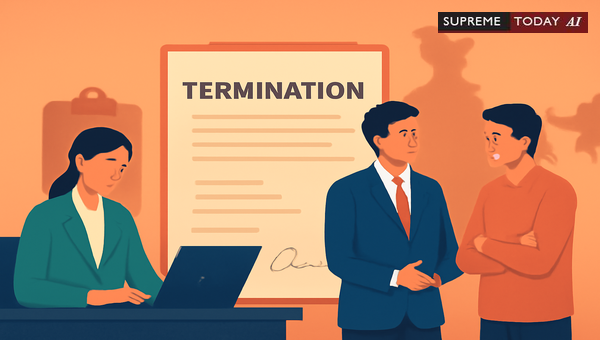
In the dynamic world of employment relations in India, employers often face tough decisions, especially when disputes are brewing. Imagine this: an employee raises a grievance, are underway, and the matter is —under judicial consideration. Can you terminate their employment without legal repercussions? The Legal Implications of Terminating an Employee during Proceedings hinge on procedural safeguards under the (IDA), particularly .
This blog post breaks down the key legal framework, procedural requirements, limitation periods, and judicial insights. While this provides general guidance, it is not legal advice—consult a qualified lawyer for your specific situation.
refers to a matter pending before a court or . In labour law, this often involves conciliation or of disputes like , , or . Terminating an employee during such proceedings can invite challenges under the IDA, exposing employers to claims of .
Under , individual workmen aggrieved by discharge, , , or termination can seek redressal. However, this right is not absolute and comes with strict procedural steps. Courts have emphasized compliance to prevent abuse of process. 2024 0 Supreme(Jhk) 279
The law, as clarified by case law, mandates that employees cannot directly rush to the or . Here's the step-by-step process:
This is reinforced in , a : irrespective of anything contained in of the said Act, any individual workman who has been discharged, dismissed, retrenched or terminated from service, may make an application directly to the or for of the industrial dispute after expiry of 45 days from the date he has made the application to the . 2025 0 Supreme(Jhk) 8
Key Point: Bypassing the renders the application invalid. The 45-day period is mandatory. 2024 0 Supreme(Jhk) 279 2023 0 Supreme(Del) 6056
Even if procedural steps are followed, timing is critical. Applications must be filed within three years from the date of discharge, , , or termination. 2009 5 Supreme 485 2025 Supreme(Online)(Mad) 66553
This limitation is independent of the 45-day conciliation window—the former is a prerequisite, the latter a statutory bar. Delays beyond three years are generally not condonable without exceptional circumstances. 2009 5 Supreme 485
Post-2010 amendments to the IDA clarified: The effect of amendment is that any workman who has been discharged, dismissed, retrenched or terminated... may make an application directly to the or ... after the expiry of 45 days from the date he has made an application to the . 2019 0 Supreme(Mad) 1825
Indian courts, including the and , have consistently upheld these requirements:
In one ruling, courts noted (3) prescribes the three-year limit from the date of termination, after the 45-day conciliation period. 2025 Supreme(Online)(Mad) 66553
Exceptions:- beyond three years may be possible in rare cases with sufficient cause. 2009 5 Supreme 485- proceedings are independent of Sections 10 or 33, but conciliation remains mandatory. 2025 0 Supreme(Mad) 2618 2024 0 Supreme(Ker) 1626
Terminating during pending conciliation () risks the employee validly approaching the post-45 days, potentially leading to , , or compensation. Employers should:
Failure to heed these can result in tribunals holding terminations unlawful. 2022 0 Supreme(Del) 1936
Legal practitioners should scrutinize procedural history to challenge non-compliant applications. 2024 0 Supreme(Jhk) 279
Navigating employee termination during proceedings demands strict adherence to of the Industrial Disputes Act. Employees can approach Labour Courts only after 45 days of unsuccessful conciliation and within 3 years of termination. Deviations risk , protecting employers from frivolous claims while ensuring fair process.
Key Takeaways:- First: (mandatory). 2024 0 Supreme(Jhk) 279- Then: 45-day wait. 2025 0 Supreme(Jhk) 8- Limit: 3 years from termination. 2009 5 Supreme 485- Amendments (2010) streamline but don't eliminate steps. 2016 0 Supreme(Kar) 38
Stay compliant to mitigate risks. For tailored advice, reach out to a labour law specialist.
Word count: 1028. References are indicative of case laws; full texts available via legal databases.
#LabourLawIndia, #EmployeeTermination, #IndustrialDisputesAct


the learned Labour Court or Tribunal for adjudication of the dispute after expiry of 45 days from the date he has made an application to the conciliation officer of the appropriate government for conciliation of the dispute and upon receipt of such application, the learned labour court or ....

In the second decision (Codimen case), this Court held that in the case of an individual dispute falling under Section 2A of the Industrial Disputes Act, the provisions of Section 33 would not be attracted. ... under section 17, as the case may be; or (c)when a reference is made to a Court, [#HL_STA....

The petitioner, a workman, filed a claim petition before the Labour Court under Section 2A of the Industrial ... Issues: The main issue was the maintainability of the petitioner's claim under Section 2A of the Industrial ... The Court also found that it could not extend the limitation period as prescribed under Section 2A of the Industrial Disputes Act ... l0, any such workman as is spe....

(A) Industrial Disputes Act, 1947 - Section 2A(2) - Kerala Co-operative Societies Act, 1969 - Section 69 ... Since the Conciliation Officer failed to settle the dispute within 45 days, she filed an application before the Labour Court, Kollam under Section 2A(2) of the Industrial Disputes#H....
Section 2A (3) of the Industrial Disputes Act .

However, the conciliation could not be completed and the period of 45 days as contemplated under Section 2-A of the Industrial Disputes Act, expired on 24.03.2017. ... application direct to the Labour Court or Tribunal for adjudication of the dispute referred to therein after the expiry of forty-five days#H....

Industrial Disputes (Amendment) Act, 2010 - Section 2-A - Central Act XIV of 1947 - Section 2A - Industrial ... 2A after the period of limitation, whether it can be given a different entry by means of invoking Section 2(k) of Act, needs to ... isolation or harmoniously, needs to be decided in an appropriate case - Legislative wants to close the door in categories falling under Section ... However, the conciliatio....

and Sections: Industrial Disputes Act, 1947, Section 2A - The court discussed the provisions of Section 2A of the Industrial Disputes ... Industrial Disputes - Order dated 18.11.2020 under Section 2A of the Industrial Disputes (Amendment) Act 2010 - Summary of Acts ... The court emphasized that the Labour Court has the jurisdiction to adjudicate the dispute under Section#HL_END....
Officer, CGIT-Cum Labour Court- II (‘Labour Court’, for short) in pursuance to reference being made to the Labour Court for adjudication of the dispute under Section 2A of the Industrial Disputes Act, 1947 (‘ID Act’, for short). ... No doubt, the case of terminati....
Section 2A (3) of the Act stipulates that the application referred to in sub-section (2) shall be made to the Labour Court or Tribunal before the expiry of three years from the date of discharge, dismissal, retrenchment, or otherwise termination of service. ... Upon receipt of such application, the Labour C....
Sub-Section (2) of Section 2A of the Act, 1947, which is a non-obstante provision, provides that irrespective of anything contained in Section 10 of the said Act, any individual workman who has been discharged, dismissed, retrenched or terminated from service, may make an application directly to the Labour Court or Tribunal for adjudication of the industrial dispute after expiry of 45 days from the date he has made the application to the Conciliation Officer of the appropriate Govern....
12. Section 2A(2) of the Industrial Disputes Act, 1947, allows a workman to directly approach the Labour Court or Industrial Tribunal for adjudication of disputes arising from discharge, dismissal, retrenchment, or termination, provided an application has been made to the Conciliation Officer and the dispute remains unresolved for 45 days. The Labour Court or Tribunal then adjudicates the dispute as if it were referred by the Government. However, the application under Section 2A(2) i....

In order to maintain an application under section 2-A of Industrial Disputes Act, it has been clearly provided under subsection (2) that notwithstanding anything contained in section 10, any such workman who has been discharged, dismissed, retrenched or terminated may make an application directly to the learned Labour Court or Tribunal for adjudication of the dispute after expiry of 45 days from the date he has made an application to the conciliation officer of the appropriate govern....
The effect of amendment is that any workman who has been discharged, dismissed, retrenched or terminated as specified in sub-Section (1) of Section 2A may make an application directly to the Labour Court or Tribunal for adjudication of his individual dispute after the expiry of 45 days from the date he has made an application to the conciliation officer of the appropriate Government for conciliation of the dispute. It provides that such application to the Labour Court or Trib....

Sub-Section (3) of Section 2A lays down the time limit for making such application to Labour Court or Tribunal. The effect of amendment is that any workman who has been discharged, dismissed, retrenched or terminated as specified in sub-section (1) of Section 2A may make an application directly to the Labour Court or Tribunal for adjudication of his individual dispute after the expiry of 45 days from the date he has made an application to the conciliation officer of the appropriate G....


An indispensable Tool for Legal Professionals, Endorsed by Various High Court and Judicial Officers
Please visit our Training & Support
Center or Contact Us for assistance

Scan Me!
India’s Legal research and Law Firm App, Download now!


For Daily Legal Updates, Join us on :



 Back to top


