Searching Case Laws & Precedent on Legal Query..!
Scanned Judgements…!



Searching Case Laws & Precedent on Legal Query..!
Scanned Judgements…!
Memory Loss and Its Impact on Will Execution - The Supreme Court emphasizes that genuine memory loss, such as amnesia, affects a person's rational understanding, which is crucial for valid execution of a will. When a testator suffers from memory loss, it can be considered a suspicious circumstance that requires careful scrutiny. The Court has held that the testator who has already departed cannot confirm whether a document is their will, adding solemnity to the proof process ["2025 0 Supreme(Bom) 1188"], ["2006 0 Supreme(Mad) 1133"], ["
T. Mahalakshmi Ammal VS Krishnan Venkateswari - Current Civil Cases
"].Deliberate Concealment or Lying to Avoid Will Signing - If a person deliberately withholds memory or falsely claims not to have seen the will being signed, it can be interpreted as a suspicious circumstance or even fraudulent conduct. The Court considers such behavior as indicative of possible undue influence or fraud, especially when the circumstances suggest that the person was aware of the signing but chose not to see it, potentially to avoid confirming the will's authenticity ["2023 0 Supreme(Del) 3356"], ["2025 0 Supreme(Bom) 1188"], ["2006 0 Supreme(Mad) 1133"].
Stand of the Supreme Court on Suspicious Circumstances - The Supreme Court has clarified that the presence of suspicious circumstances alone does not automatically invalidate a will. However, such circumstances warrant thorough investigation. The Court states that the existence of suspicious circumstances alone may not be sufficient and emphasizes that the court may not start with a suspicion and it should not close its mind to find the truth ["
T. Mahalakshmi Ammal VS Krishnan Venkateswari - Current Civil Cases
"], ["2025 0 Supreme(Bom) 1188"].Legal Principles Regarding Will Proof - The Court mandates proof of due execution, including signatures in the testator's handwriting or in their presence and by their direction. If memory loss or suspicious behavior is present, expert opinions and evidence of the circumstances are crucial to establish authenticity ["2025 0 Supreme(Bom) 1188"], ["2017 0 Supreme(Del) 4229"].
Analysis and Conclusion:Loss of memory, whether due to genuine medical conditions or deliberate concealment, falls under circumstances that can raise suspicion regarding the validity of a will. The Supreme Court's stance is that such circumstances require rigorous proof and careful evaluation. Deliberate lying or withholding memory to avoid witnessing the signing can be viewed as suspicious and potentially fraudulent, impacting the validity of the will. Ultimately, the Court stresses that suspicious circumstances must be examined thoroughly, but they do not automatically invalidate a will unless proven to be fraudulent or undue influence.
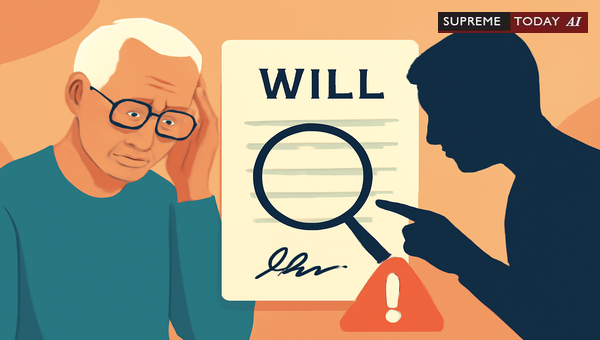
In estate planning and inheritance disputes, questions often arise about the validity of a will when the testator or witnesses claim memory loss about the signing process—or worse, deliberately lie about not seeing it. A common query is: whether loss of memory to say the other person signed or deliberately lying to not see the will being signed comes under what? In these circumstances, what is the stand of the ?
This blog post delves into the legal principles governing such scenarios under Indian law, primarily the . We'll examine , the impact of memory issues, deliberate deception, and key precedents. While memory loss alone doesn't automatically void a will, or can tip the scales. Note: This is general information, not specific legal advice—consult a lawyer for your case.
The validity of a will hinges on the testator's at the time of execution. This means the testator must understand the nature of the act, the extent of their property, and the natural objects of their bounty (family members or heirs). Courts assess the mental state precisely at signing, not before or after. 1999 0 Supreme(Gau) 21
Key principle: is primarily judged by the mental state of the testator at the time of signing, focusing on their ability to understand the nature and effect of the act. 1999 0 Supreme(Gau) 21
Memory loss, such as from age or illness, does not automatically invalidate a will if the testator was otherwise lucid. For instance, courts have upheld wills from elderly testators (even 80-year-olds who died soon after) where evidence showed they comprehended the dispositions. 2005 1 Supreme 684
From other rulings, mere mental disorders or memory issues don't negate capacity if the testator was aware and signed voluntarily. 2001 5 Supreme 520
The (person presenting the will) bears the burden of proof. They must show:- The testator signed voluntarily.- .- No or .
Witness testimonies, medical evidence, and execution circumstances are crucial. In one case, the emphasized: The of the Will has to show that the Will was signed by the testator; that he was at the relevant time in a . 2017 0 Supreme(Del) 1580
If memory loss is alleged, expert opinions and ' accounts can affirm capacity. Registration alone doesn't prove validity—full compliance with is required, including attestation by two witnesses. 2013 Supreme(Online)(KER) 35834 2025 0 Supreme(All) 2171
Deliberate lying about witnessing the signing—claiming I don't remember seeing it signed when they did—raises red flags of , , or fabrication. This isn't mere forgetfulness; it's potential deceit to challenge the will.
Legal classification: Such conduct (invalidates) the will if it affects . includes misrepresentation, suppression of facts, or coercion. 2004 8 Supreme 304
amplify scrutiny, like:- Beneficiary's active role in execution.- Unusual dispositions (e.g., disinheriting natural heirs without reason).- Witness inconsistencies or memory claims that seem fabricated.
The holds: Cases in which the execution of the will is surrounded by stand on a different footing. 2025 0 Supreme(All) 2171
In , the Court noted: As to whether any particular feature or a set of features qualify as 'suspicious' would depend on the facts and circumstances of each case. 2025 0 Supreme(Del) 586
If proven, the onus shifts heavily to the to dispel doubts. For example, failure to prove attestation under can doom the will. 2025 0 Supreme(All) 2171
Attestation requires witnesses to see the signing or acknowledge it. What is required is that even if the testator has not signed in their presence, he must acknowledge to each of them that he has signed the will. 2017 0 Supreme(P&H) 453
Lying about this could indicate forgery or , invalidating the will regardless of the testator's capacity. 2005 1 Supreme 684
The consistently prioritizes evidence over speculation. In cases like those cited:- Upholding wills: If capacity is proven via witnesses and no coercion exists, memory lapses are overlooked. 1999 0 Supreme(Gau) 21 2005 1 Supreme 684- Invalidating wills: (e.g., no explanation for disinheriting heirs) or proof leads to rejection. 2017 0 Supreme(P&H) 453
A pivotal ruling: The must address trial court findings on attestation lapses in appeals. Burden remains on them to prove . 2025 0 Supreme(All) 2171
Another: The execution of a Will must be proved in accordance with and . heighten this burden. 2025 0 Supreme(All) 2171
In challenges, courts reaffirm: Onus on to show sound mind and freedom from influence. 2017 0 Supreme(Del) 1580
For families facing will disputes:- Document thoroughly: Video record execution if possible, get medical certificates on mental state.- Choose independent witnesses: Avoid beneficiaries as scribes or sole witnesses.- Challenge strategically: Mere memory claims won't suffice—gather medical or contradictory evidence.
Exceptions:- Memory loss without incapacity or influence: Will valid.- Proven /coercion: Will void. 2005 1 Supreme 684
Disclaimer: This article summarizes general legal principles from judgments like 2005 1 Supreme 684, 1999 0 Supreme(Gau) 21, and others. Laws evolve, and outcomes depend on facts. Seek professional legal counsel for advice tailored to your situation.
References:1. 2005 1 Supreme 684: and .2. 1999 0 Supreme(Gau) 21: Memory loss and capacity.3. 2004 8 Supreme 304: in legal acts.4. 2025 0 Supreme(All) 2171: Section 63 Succession Act, suspicious cases.5. 2025 0 Supreme(Del) 586: Defining suspicious features.6. 2017 0 Supreme(P&H) 453: Attestation rules.
#WillValidity #TestamentaryCapacity #SupremeCourt


Unlike other documents the will speaks from the death of the testator, and so, when it is propounded or produced before a court, the testator who has already departed the world cannot say whether it is his will or not; and this aspect naturally introduces an element of solemnity in the decision of the ... He submitted that in the facts of the present case, the Plaintiffs have therefore duly proved due execution of the said Will by satisfying the criteria laid down by the Hon'ble Supreme Court#....

The statement that he was associated with the person who drafted the Will of the Testator and the former had asked him to sign the same, did not entitle him to say that he did not see the Testator signing the document, nor as testified by PW1. ... What are these circumstances are not spelt-out substantially. In Murthy vs. C. Saradambal (2022) 3 SCC 209, the Supreme Court has held some illustrations of suspicious circumsta....

(iii) The question of loss of self-control comes up indirectly in deciding whether a particular provocation was grave or not. ... Here again, the court would have to apply the test of a reasonable person in the circumstances. 15. ... The issue of loss of self-control on receipt of sudden provocation was also discussed by the Supreme Court in the case of Dauvaram Nirmalkar v. ... The Supreme #HL_S....

ALABAMA Opinion of the Court full cognitive function. The memory loss is genuine: Let us say the person has some kind of amnesia, which has produced a black hole where that recollection should be. ... What matters is whether a person has the “rational un- derstanding” Panetti requires—not whether he has any particular memory or any particular mental illness. ... With the exception of the fina....

it shall be signed by some other person in his presence and by his direction. ... Cases in which the execution of the will is surround- ed by suspicious circumstances stand on a different footing. ... The Hon'ble Supreme Court, in the case of K. ... The Hon'ble Supreme Court, in the case of Guro (Smt.) vs. ... A will is required to fulfil all the formalities required under Section 63 of the Succession Act, that is to say: (a) The t....

I need not go into the question as to whether judgment and decree of the lower appellate court or this Court would be binding on the defendants 6 to 14 who are not impleaded in the lower appellate court or in this appeal. ... Narayani Pillai had the inability to execute a document voluntarily due to loss of memory. Some part of her brain was damaged. Capacity or ability of a person depends on the region (of brain) affected. 18. ... ....
shall be signed by some other person in his presence and by his direction. ... Proof of signature and handwriting of person alleged to have signed or written document produced. ... Following the above rulings, the Supreme Court in Mahesh Kumar (dead) by LRs. Vs. ... Unlike other documents the will speaks from the death of the testator, and so, when it is propounded or produced before a court, the testator who has already departed the world cannot say....

Then coming to the specialty of the Will, the Supreme Court has observed since the Will speaks from the death of the testator, when it is propounded or produced before a Court, the testator who has already departed the world cannot say, whether it is his Will or not; and this aspect naturally introduces ... As ruled by the Hon'ble Supreme Court in Sridevi & others v. ... In similar circumstances of a case of this nature, this #HL_ST....
Registration Act, 1908 (16 of 1908), unless its execution by the person by whom it purports to have been executed is specifically denied.” 48. The Supreme Court in H. Venkatachala Iyengar v. B.N. Thimmajamma & Ors. ... As to whether any particular feature or a set of features qualify as “suspicious” would depend on the facts and circumstances of each case.

the loss of dependency/loss of contribution is arrived at loss of consortium, funeral expenses and loss to the loss of estate, loss of consortium and funeral expenses Pending interlocutory applications, if any, stand disposed of.
D2 and D7, the defendant has stated that the plaintiff had obtained several signatures in blank papers and stamp papers during the financial transactions. So, it is clear that the defendant has not taken a definite stand under what circumstances he has signed in the stamp papers.
Once, therefore, Aidasani himself suggested that Tinani had indeed witnessed the Will, he can hardly be heard to deny the due execution and attestation of it. What matters, and what matters only, is whether the attesting witness duly witnessed the execution of the Will as required by Section 63 of the Succession Act (by seeing it being signed or receiving an indication of it having been signed, etc).
The manner in which the Will was required to be valid and its was required to be established was considered in para 14 of the judgment, which reads as follows: “14. In this regard, we may usefully refer the pronouncement of the Supreme Court reported at (2005) 2 SCC 784 Sridevi & Ors. v. Jayaraja Shetty & Ors. The propounder of the Will has to show that the Will was signed by the testator; that he was at the relevant time in sound disposing state of mind; that he understood the nature and effect of dispositions and had put his signatures to the testament of his own free will and that he had ....

What is required is that even if the testator has not signed in their presence, he must acknowledge to each of them that he has signed the will, or has authorised some other person to sign it on his behalf and that such person has signed it (or has affixed his mark thereto). Thus, a will is compulsorily required to be attested by at least two witnesses, each of whom has seen the testator sign or affix his mark on it, or to whom the testator acknowledged having signed it/affixed his mark on it, or that under his direction, somebody else had affixed his signatures/mark. It ma....

I am not aware of any proper format for making such statements nor are statements necessarily to be addressed to any one in particular. The I.O. observes that no entries were found in the RD Passbooks, BORD journal or the BO accounts book. What is important is whether the person making the statement has signed it in the presence of witnesses or not. On these accounts the statements holds goods and should be treated as such.


An indispensable Tool for Legal Professionals, Endorsed by Various High Court and Judicial Officers
Please visit our Training & Support
Center or Contact Us for assistance

Scan Me!
India’s Legal research and Law Firm App, Download now!


For Daily Legal Updates, Join us on :



 Back to top


