Searching Case Laws & Precedent on Legal Query.....!
Analysing the retrieved Case Laws
Scanned Judgements…!



Searching Case Laws & Precedent on Legal Query.....!
Analysing the retrieved Case Laws
Scanned Judgements…!
Depositing a cheque into a brother’s account without the owner’s knowledge, especially if the cheque is forged or filled in fraudulently, can be prosecuted as cheating or forgery, and the person responsible may be liable for criminal proceedings ["2026 Supreme(Online)(Del) 80"].
Analysis and Conclusion:
References:- ["2025 Supreme(Online)(Tel) 55247"]- ["1995 Supreme(Online)(Ker) 994"]- ["2026 Supreme(Online)(Del) 80"]- ["2023 0 Supreme(Del) 1528"]- ["2023 Supreme(Online)(Gau) 7474"]
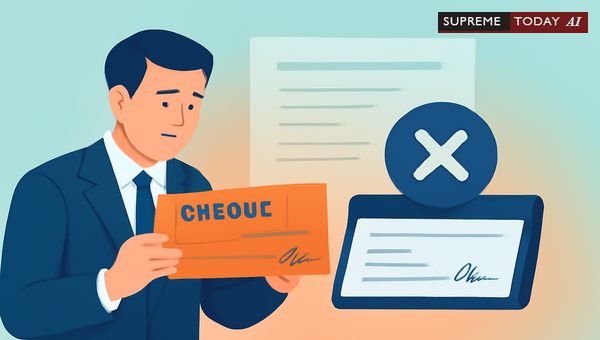
Imagine discovering a cheque issued from your bank account—without your knowledge or permission—by a family member or employee, only for it to bounce due to insufficient funds. This scenario raises a critical question: a cheque credit by employee in his brother account without consent of owner—does this constitute an offence under ()?
In today's digital and business-driven world, cheque-related disputes are common, especially in cases involving unauthorized use. This blog post breaks down the legal implications, drawing from key judicial precedents and statutory provisions. Note that this is general information and not specific legal advice; consult a qualified lawyer for your situation.
The question revolves around an employee (or someone) issuing a cheque from his brother's (the account owner's) account without the owner's consent. If the cheque is dishonoured, can the account holder or issuer face under ? Typically, Section 138 punishes due to insufficient funds or exceeding arranged limits, but only if issued for a 2023 4 Supreme 711 2009 0 Supreme(SC) 722 2016 6 Supreme 733.
Key conditions include:- The cheque must be presented within its validity period (usually six months).- A demand notice must be sent, and payment not made within 15 days.
However, absence of owner's consent introduces complexities like , , or , potentially affecting Section 138 applicability.
Section 138 states: Where any cheque drawn by a person on an account maintained by him with a banker for payment of any amount of money to another person from out of that account for the discharge, in whole or in part, of any debt or other liability, is returned by the bank unpaid, either because of the amount of money standing to the credit of that account is insufficient to honour the cheque or that it exceeds the amount arranged to be paid from that account by an agreement made with that bank, such person shall be deemed to have committed an offence... 2023 0 Supreme(Guj) 778 2021 0 Supreme(UK) 150
Ramesh Nagarkoti VS Kedar Datt Purohit
.Under , there's a presumption that the cheque was issued for a debt or liability unless proved otherwise 2025 2 Supreme 109 2001 2 Supreme 61 2018 0 Supreme(HP) 1284. But this presumption doesn't override issues of authority or consent.
Issuing a cheque without the owner's consent may not automatically trigger Section 138 unless linked to a valid debt. Courts emphasize: the cheque must be for a 2009 0 Supreme(SC) 722. Fraudulent or unauthorized cheques might fall outside this, leading to defenses like under other laws (e.g., , 420).
The law does not explicitly require explicit consent for Section 138, focusing instead on debt/liability and procedures 2025 2 Supreme 109. However, on another's account (e.g., brother's) raises questions of validity. If proven fraudulent, it may invalidate Section 138 proceedings, as the cheque isn't a 'valid' instrument for debt discharge 1984 0 Supreme(SC) 279.
In one case, courts noted that disputed facts like financial or authenticity require full trial, not quashing at initial stages 2023 0 Supreme(Guj) 778. Similarly, for (e.g., company officers), complaints must aver consent, connivance, or negligence2023 0 Supreme(P&H) 315. Without such, liability doesn't attach.
and 139 create of . As held: In a trial under Section 138... a presumption will have to be made that every negotiable instrument was made or drawn for ... once execution... is either proved or admitted
Ramesh Nagarkoti VS Kedar Datt Purohit
. But the accused can rebut by showing no debt existed or issuance was unauthorized—e.g., probable defense creating doubt 2021 0 Supreme(UK) 150.Bare denial isn't enough; evidence of non-existence of debt or lack of authority shifts the burden back
Ramesh Nagarkoti VS Kedar Datt Purohit
.Employee/Brother Context: If an employee issues from brother's account without consent, it's akin to misuse. Courts have quashed complaints lacking proof of role or authority 2023 0 Supreme(P&H) 315. In partnership cases, firms must be arraigned if cheques are from firm accounts; partners aren't liable otherwise 2021 0 Supreme(UK) 150
Ramesh Nagarkoti VS Kedar Datt Purohit
2016 0 Supreme(Ker) 441.Fraudulent Transactions: Cases of unauthorized debits (e.g., during demonetization without consent) highlight that complaints must disclose clearly, or risk quashing 2022 0 Supreme(Mad) 3040. on superiors fails without evidence 2022 0 Supreme(Mad) 3040.
One judgment clarifies: cheques from personal accounts aren't attributable to firms, limiting liability 2016 0 Supreme(Ker) 441
Ramanee Narayanan VS C. K. Mukundan
.In extortion-like scenarios (forced issuance), intent matters—no wrongful gain/loss means no offence 2010 0 Supreme(Mad) 1400.
If facing such a situation:- Verify Debt: Confirm if cheque links to enforceable liability 2023 4 Supreme 711.- Prove Lack of Consent: Gather evidence (e.g., bank statements, affidavits).- Follow Procedures: Send demand notice if complaining; respond promptly if accused.- Explore Alternatives: File for () or civil recovery if unauthorized.- For Businesses/Employees: Secure accounts, authorize signatories clearly to avoid vicarious claims 2023 0 Supreme(P&H) 315.
Courts direct trials for complex issues, often within timelines (e.g., 8 months) 2023 0 Supreme(Guj) 778.
Issuing a cheque on a brother's account without owner's consent generally does not automatically constitute a Section 138 offence unless tied to a legally enforceable debt and procedures are met. Lack of consent serves as a potent defense, potentially shifting to charges. Presumptions favor holders, but rebuttals via evidence of unauthorized acts prevail.
Key Takeaways:- Focus on debt/liability and authority2009 0 Supreme(SC) 722.- Unauthorized cheques may escape Section 138 but attract other liabilities.- Always document transactions to rebut presumptions.
Stay vigilant with financial instruments. For personalized guidance, seek professional legal counsel.
References (select cases):- 1984 0 Supreme(SC) 279, 2025 2 Supreme 109, 2023 4 Supreme 711, 2009 0 Supreme(SC) 722, 2016 6 Supreme 733, 2001 2 Supreme 61, 2018 0 Supreme(HP) 1284, 2023 0 Supreme(Guj) 778, 2023 0 Supreme(P&H) 315, 2021 0 Supreme(UK) 150,
Ramesh Nagarkoti VS Kedar Datt Purohit
, 2016 0 Supreme(Ker) 441. #Section138, #ChequeBounce, #NIACT


money standing to the credit of that account is insufficient to honour the cheque or that it exceeds the amount arranged to be paid from that account by an agreement made with that bank, such person shall be deemed to have committed an offence and shall, without prejudice to any other provisions of this ... Dishonour of cheque for insufficiency, etc., of funds in the account. ... Even if in the complaint it is stated that the petitioner, who is the brother#H....

... 3In the written statement filed by the first defendant, it is admitted that a cheque for a sum of rupees one lakh was presented by a customer named Sri. K. Narayanan, for collection and credit to his account on 29-12-1982. ... A banker who has in good faith and without negligence received payment for a customer of a cheque crossed generally or specially to himself shall not, in case the title to the cheque proves defective, incur any liability to the true owner ....

of the amount of money standing to the credit of that account is insufficient to honour the cheque or that it exceeds the amount arranged to be paid from that account by an agreement made with that bank, such person shall be deemed to have committed an offence and shall without prejudice to any other ... Dishonour of cheque for insufficiency, etc., of funds in the account. ... Where any cheque drawn by a person on an account mainta....

P.4(d) and on 9.12.1943 himself drew a cheque for Rs.2,800/- Ext. P.4(c), and thereafter disappeared. The balance remaining to the credit of his account at that time was Rs.124-90/-. ... 14. ... The Court of Appeal held that the strict liability of the Bank to the real owner of the cheque, at common law, was to some extent modified by the statute and if the Bank was not negligent in opening the account and collecting the cheque, Bank cannot be made liable to the tr....

In the written complaint the complainant demanded credit of the cheque amount to S/B Account No. 13741. On the same day, an FIR was lodged whereafter Golaghat P.S. ... The Exhibit 1 was deposited to the S/B Account of the respondent No. 1 bearing No. 13741. As the said Exhibit 1 cheque was crossed cheque it indicated that the said amount is to be deposited in the Account of the respondent No. 1. ... After proper enquiry in the Branch, as pleaded, the relevant #HL_STAR....

Submission regarding respondent being a money lender without registration, in view of allegations and denial thereof, the same becomes a disputed question of fact and requires to be proved at the stage of trial and on this account alone FIR cannot be quashed. ... allegation about consent, connivance or negligence. ... , it is necessary to aver in the complaint, their position and duties, and also their role with regard to the issue and dishonour of the cheque, disclosing consent, connivance or negligenc....

Furthermore, by filling the date in the cheque before presenting it to their bankers, without the knowledge, consent, or authorization of the Petitioner Company, a false document was created, thereby committing the offence of forgery for the purpose of cheating p class="para" data-page ... Despite being aware that the Account was inoperative, the cheque was nevertheless presented for encashment. 45. It is further alleged that the date on the cheque was subsequently filled in by hand a....

of that account is insufficient to honour the cheque or that it cheque drawn by a person on an account the cheque or that it exceeds the amount etc., of funds in the account. ... His liability was unlimited and there was no legal distinction between the owner and the business.

is returned by the bank unpaid, either because of the amount of money standing to the credit of that account is insufficient to honour the cheque or that it exceeds the amount arranged to be paid from that account by an agreement made with that bank, such person shall be deemed to have committed an ... , whichever is earlier; (iii) that cheque is returned by the bank unpaid, either because the amount of money standing to the credit of the account is insufficient to ....

standing to the credit of that account is insufficient to honour the cheque or that it exceeds the amount arranged to be paid from that account by an agreement made with that bank, such person shall be deemed to have committed an offence and shall, without prejudice to any other provisions of this Act ... cheque is returned by the bank unpaid, either because the amount of money standing to the credit of the account is insufficient to honour the #HL_S....

However, the first accused has falsely transacted to a tune of Rs.1,65,00,000/- into the complainants account without his knowledge and consent. During demonetization, he and his family members deposited demonetised money Rs.58,25,000/- in their accounts maintain at Tiruppur Branch. The first accused, without any cheque signed by the complainant or his family members, had debited from his account and his family members account.
The Partnership Firm was not in any way associated with Exhibit-P1. It is a cheque individually issued by the accused from his own account maintained with his Bankers.
The Partnership Firm was not in any way associated with Exhibit-P1. It is a cheque individually issued by the accused from his own account maintained with his Bankers.

Whether any offence appears to have been committed and if so by whom? On 5th July one cheque for Rupees one crore has been wrongly encashed by the said Hero Exports, since SI Tr.Arulraj threatened to take criminal action against him of the cheques were not honoured by his company in this very complaint which according to him could land him and other Directors in Jail. By then it was becoming late and it was about five pm. He gave the cheque details and asked his company officials to get the cheques and without his consent he was forced to sign the said MOU.

Having confirmed the verdict of guilty and conviction, I am satisfied that there is absolutely no merit in the challenge against the direction regarding disposal of the property that is the proceeds of Ext. P11 cheque standing to his credit in the petitioners account. The said direction does not also, in these circumstances, warrant interference.


An indispensable Tool for Legal Professionals, Endorsed by Various High Court and Judicial Officers
Please visit our Training & Support
Center or Contact Us for assistance

Scan Me!
India’s Legal research and Law Firm App, Download now!


For Daily Legal Updates, Join us on :



 Back to top


