


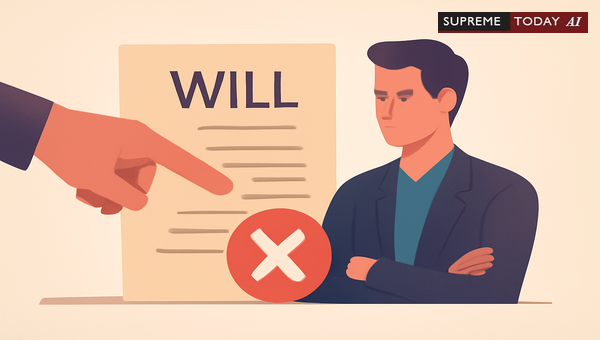
Is a Will Favoring a Brother While Excluding Wife and Daughter Valid in India?
Imagine a scenario where a loved one passes away, leaving their entire estate to a brother, completely cutting out their wife and daughter. Shocking? Perhaps. But is it legally possible? The question Will in Favor of Brother Excluding Daughter and Wife Valid arises frequently in estate disputes, especially under Indian law. While it may seem unfair, the law generally upholds a 's freedom to dispose of their property as they wish—provided certain conditions are met.
This blog post dives deep into the legal principles governing will validity, drawing from established precedents and statutory provisions. We'll explore when such a will stands firm and when it might crumble under scrutiny. Note: This is general information based on legal principles and is not specific legal advice. Consult a qualified lawyer for your situation.
The 's Right to Exclude Heirs
Under Indian law, particularly the (applicable to certain communities), a has significant . Courts consistently recognize that a can exclude even close heirs like a wife or daughter, as long as the will is properly executed and free from . 2017 0 Supreme(P&H) 453 2022 0 Supreme(P&H) 2106
The exclusion alone does not invalidate the will. As emphasized in key judgments, the court emphasizes the importance of proving the Will's genuineness and the absence of surrounding its . 2022 0 Supreme(P&H) 2106
This principle stems from the idea that property owners should decide their legacy, not courts or heirs. However, this freedom isn't absolute—strict formalities must be followed.
Essential Conditions for a Valid Will
For a will favoring a brother while sidelining a spouse and child to hold up, it must meet the rigors of :
- Proper and : The will must be in writing, signed by the , and attested by at least two witnesses. 2017 0 Supreme(Cal) 56
- Clear Intention: The 's intent must be unambiguous. Courts typically don't probe subjective reasons for exclusion unless red flags appear. 2022 0 Supreme(P&H) 2106
Failure here can doom the document. In one case, a settlement deed (analogous to will challenges) was invalidated because defendants couldn't prove voluntary amid . 2025 0 Supreme(Mad) 3677 The court noted, The lies on the party claiming a settlement deed's validity to demonstrate it was executed voluntarily and without .
Navigating
What turns a bold exclusion into a battleground? . Mere exclusion of natural heirs like a wife or daughter isn't enough to strike it down, especially if the lived with the brother long-term and evidence supports it.
Examples of red flags include:- Unnatural dispositions without explanation.- 's illiteracy or dependency.- Witnesses benefiting indirectly.- Sudden changes near death.
In a dispute, the court rejected a will completely cutting off wife and children, stating, Will is unnatural as it completely cuts off wife and children – Exclusion is shrouded with grave suspicion.
Usha Jain VS Snehalata Kumudini Barnabas
Conversely, if reasons are specified—like my divorced wife and my daughter—and formalities are met, courts may uphold it. 2019 0 Supreme(Del) 545Another precedent involved a gift to a granddaughter from a half-share, upheld despite other heirs, showing exclusions aren't fatal if proven genuine. 2023 Supreme(Online)(KAR) 3410
The : A Heavy Lift
The proponent (often the brother here) carries the heavy burden to prove genuineness, especially with exclusions. 2001 0 Supreme(P&H) 574 Strengthening factors include:- Registration of the will.- Credible attesting witnesses.- Absence of .
Evidence like consistent and no coercion tips the scales. In property disputes mistaken for , courts dismissed partition claims for lack of proof, affirming dispositions. 2025 Supreme(Online)(Mad) 49969 The court affirmed that properties were and not , dismissing claims for partition based on lack of evidence for joint family status.
Lessons from Precedents
Indian courts have tackled similar scenarios:
- Upholding Exclusions: Wills disfavoring heirs were validated when was flawless and no suspicion lurked. 2017 0 Supreme(P&H) 453 2022 0 Supreme(P&H) 2106
- Invalidations: A will voided because the brother's wife attested it, violating the witness/beneficiary rule under relevant laws. 2024 Supreme(HK)(HKCFI) 109 To sum up, the disposition made to the brother of the Deceased by the Will is void because the wife of the brother acted as an attesting witness thereof.
- Claims: Heirs succeeded where deeds lacked voluntary proof, mirroring will challenges. 2025 0 Supreme(Mad) 3677
These cases underscore: context matters. A will excluding a daughter for specific reasons, like in family partitions, often survives if documented.
Usha Jain VS Snehalata Kumudini Barnabas
Practical Recommendations
To safeguard such a will:1. Follow Formalities Religiously: Use lawyers for drafting, ensure two disinterested witnesses.2. Document Intent: Include reasons for exclusions to preempt suspicion.3. Register It: Boosts evidentiary value.4. Gather Evidence: Affidavits from witnesses, medical records showing sound mind.
Proponents must be trial-ready, as challengers (wife/daughter) will probe for weaknesses.
Key Takeaways
- Yes, Potentially Valid: A will favoring a brother over wife and daughter can be enforceable if properly executed under the Indian Succession Act and lacking . 2022 0 Supreme(P&H) 2106
- Burden on Proponent: Prove genuineness rigorously. 2001 0 Supreme(P&H) 574
- Context is King: Exclusion isn't suspicious per se; evidence decides.
Estate planning is personal yet perilous. While testators enjoy freedom, heirs' challenges are common. For tailored guidance, seek professional advice.
#WillValidity #InheritanceLaw #IndianEstateLaw















